
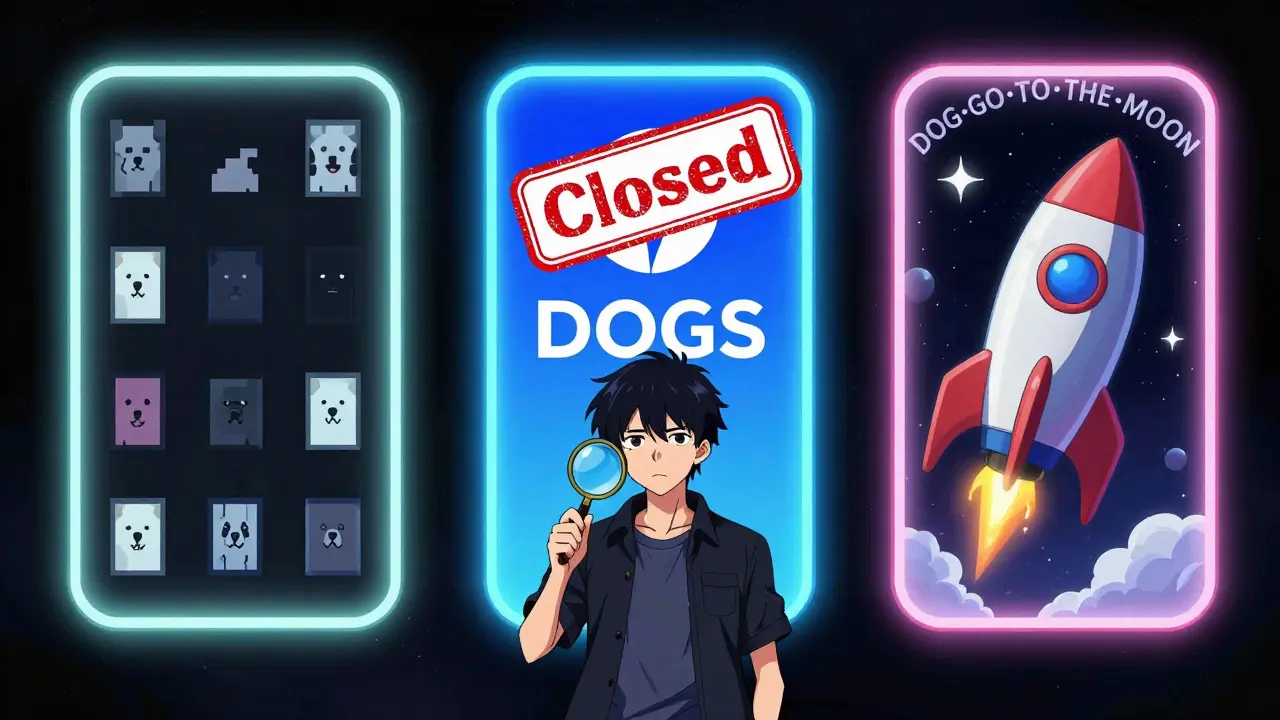
Have you seen the buzz about a DOGGY airdrop? If you are looking for free tokens from a project called "DOGGY," stop right there. There is no verified, active airdrop for a project specifically named "DOGGY" that matches the massive community distributions seen in other dog-themed cryptocurrencies. In fact, searching for this term often leads to confusion between three entirely different projects: the dormant Crypto Doggy NFT collection of 10,000 pixelated dogs, the massive DOGS token Telegram-native cryptocurrency on the TON blockchain airdrop that concluded in late 2024, and the Bitcoin-based DOG•GO•TO•THE•MOON Runestone Ordinals project.
Mixing these up can cost you money or worse, lead you into a scam. The crypto space is flooded with lookalike names designed to catch your attention when you misspell a popular token. This guide breaks down exactly what is real, what ended, and how to spot the fakes so you don't lose your funds chasing a ghost.
The Truth About the "DOGGY" Project
Let's clear the air immediately. The entity known as "DOGGY" in current market data refers to Crypto Doggy a collection of 10,000 unique, generative pixelated NFTs. This is not a fungible token like Bitcoin or Ethereum; it is a non-fungible token (NFT) collection. As of mid-2026, this project shows almost zero trading activity, with a price hovering around $0.0002177 USD and a 24-hour volume of $0.
Why does this matter? NFT collections do not typically use "airdrops" in the way meme coins do. Airdrops usually involve sending thousands of identical tokens to many wallets to build a community. NFTs are unique digital assets. While some NFT projects give away early access or whitelist spots, a traditional "claim your free DOGGY tokens" campaign does not exist for this specific brand. If you see a website claiming to distribute free DOGGY tokens, it is likely a phishing site trying to steal your private keys or drain your wallet.
The lack of liquidity and community engagement suggests the project is either dormant or has failed to gain traction. In the fast-moving world of crypto, silence usually means death for a project. Do not invest time or money expecting a payout from this specific entity.
The Likely Confusion: The DOGS Token Airdrop
When people search for "DOGGY airdrop," they are almost always looking for information about the DOGS token a Telegram-native cryptocurrency inspired by Pavel Durov's dog, Spotty. This was one of the largest and most talked-about airdrops in recent history. However, you need to know that the main distribution phase has already concluded.
The DOGS project launched on the TON blockchain The Open Network, a scalable blockchain developed by Telegram. Here are the hard facts about that event:
- Total Supply: 550 billion DOGS tokens.
- Airdrop Allocation: 81.5% of the total supply went to the community.
- Eligibility: Rewards were based on Telegram account age and activity levels. Long-term users got more.
- Timeline: The airdrop concluded in September 2024. Listing on exchanges like KuCoin happened in August 2024.
- Scale: Over 380 billion tokens were distributed to more than 20.5 million users.
If you did not claim your DOGS tokens during that window in 2024, the opportunity is gone. Any site claiming you can still "claim your missed DOGS airdrop" in 2026 is a scam. The smart contracts for the initial distribution have been closed. The project continues to operate, but the free money era for new users is over.
Another Mix-Up: DOG•GO•TO•THE•MOON
There is a third player in this naming chaos: DOG•GO•TO•THE•MOON A Bitcoin ecosystem project using Runestone Ordinals. This project executed an airdrop in April 2024, targeting holders of Runestone Ordinals.
This was a niche, technical airdrop. To qualify, you needed to hold specific Bitcoin inscriptions before block 840,249. They distributed 100 billion DOG tokens to 75,000 eligible holders. Like the DOGS token, this event is in the past. It had no presale and relied on organic growth within the Bitcoin Ordinals community. If you are not a long-time Bitcoin Ordinals holder, this airdrop was never meant for you, and it is now finished.
| Project Name | Type | Blockchain | Airdrop Status (2026) | Key Detail |
|---|---|---|---|---|
| Crypto Doggy (DOGGY) | NFT Collection | Various (ERC-721 standard) | No Active Airdrop | 10k pixelated dogs; near-zero volume |
| DOGS | Fungible Token | TON Blockchain | Completed (Sept 2024) | Telegram-native; 20M+ users |
| DOG•GO•TO•THE•MOON | Ordinals/Rune | Bitcoin | Completed (April 2024) | For Runestone holders only |

How to Spot Fake Airdrop Scams
Scammers love confusion. When a legitimate project like DOGS goes viral, scammers create fake websites with similar names like "DOGGY Official Airdrop" or "DOGS Claim Portal." These sites look professional but are designed to hack you. Here is how to protect yourself:
- Check the URL: Legitimate projects use their official domain. If the URL looks weird (e.g., .xyz, .top, or misspelled words), close it immediately.
- Verify Social Media: Go to the official Twitter/X or Telegram channel of the real project. Look for announcements. If the real team hasn't posted about a "DOGGY" airdrop, it doesn't exist.
- Never Share Private Keys: No legitimate airdrop will ever ask for your seed phrase or private key. If a site asks for this, it is a theft attempt.
- Use a Burner Wallet: If you must interact with unknown dApps, use a secondary wallet with no significant funds. Never connect your main savings wallet to unverified sites.
In the case of "DOGGY," the absence of official communication from any major exchange or developer team is a huge red flag. Real projects announce airdrops through verified channels weeks in advance. Silence is not a strategy; it's a sign of a dead project or a scam.
What Should You Do Instead?
If you are looking for legitimate airdrop opportunities in 2026, stop chasing ghosts. Focus on active ecosystems. The TON blockchain, for example, continues to develop new applications that may offer future incentives. Similarly, the Bitcoin Layer-2 space is evolving with new protocols that might reward early testers.
Instead of clicking suspicious links for "DOGGY," spend your time learning about:
- Wallet Security: Learn how to use hardware wallets like Ledger or Trezor.
- On-Chain Analysis: Use tools like Etherscan or Tonviewer to verify token contracts before interacting.
- Official Announcements: Follow reputable crypto news outlets and official project channels for verified updates.
The crypto market rewards patience and diligence, not haste. By understanding the difference between the dormant DOGGY NFTs, the completed DOGS token airdrop, and the niche DOG•GO•TO•THE•MOON project, you avoid falling for traps. Stay safe, verify everything, and remember: if it sounds too good to be true, especially with a misspelled name, it probably is.
Is there an active DOGGY airdrop in 2026?
No. There is no verified active airdrop for a project named "DOGGY." The term often confuses users with the Crypto Doggy NFT collection, which has negligible trading volume, or the DOGS token on the TON blockchain, whose major airdrop concluded in September 2024.
Can I still claim my DOGS token airdrop?
If you missed the claim period in late 2024, you cannot claim the airdrop anymore. The distribution contract is closed. Any website offering a "late claim" is a scam designed to steal your funds.
What is the difference between DOGGY and DOGS?
DOGGY typically refers to a low-volume NFT collection of pixelated dogs. DOGS is a fungible cryptocurrency token built on the TON blockchain, associated with Telegram. They are completely separate projects with different structures and histories.
Is the DOG•GO•TO•THE•MOON airdrop still open?
No. The DOG•GO•TO•THE•MOON airdrop took place in April 2024 for holders of Runestone Ordinals on the Bitcoin network. It is no longer available to new participants.
How can I identify a fake crypto airdrop?
Look for unofficial URLs, requests for private keys or seed phrases, and lack of announcement on official social media channels. Always verify project details on trusted aggregators like CoinMarketCap or directly on the blockchain explorer.






Andrew Schneider
July 2, 2026 AT 18:02 PMOh, look at you all playing it safe with your hardware wallets and 'verified' channels 🙄. You're missing the real alpha because you're too busy reading this boring safety manual. The whole point of crypto is that it's a wild west, not a library! I made more money on a misspelled token in 2021 than you'll ever make waiting for 'official announcements.' Stop being such sheep and embrace the chaos, or stay poor forever 😂💸
Johan Otto
July 2, 2026 AT 21:15 PMUgh, Andrew is so dramatic. But seriously, who even cares about DOGGY? It’s dead. 💀
Eric Braddock
July 3, 2026 AT 15:33 PMYou guys are completely asleep at the wheel. The reason DOGGY is 'dead' is because the central authorities suppressed it before it could disrupt the TON ecosystem narrative. They want you thinking it's just a scam so you don't realize it was a honeypot for retail liquidity extraction by the elite. The pixelated dogs? That's a steganographic key distribution system for the next phase. Wake up! The silence isn't death; it's strategic obfuscation to avoid regulatory scrutiny from the SEC puppets.
Nick Wengel
July 4, 2026 AT 15:05 PMI think Eric might be overthinking it a bit. It seems pretty clear from the post that DOGGY is just an old NFT collection with no activity. But it is interesting how many people get confused with similar names. In my country, we see a lot of these copycat projects too. It is good to have this clarification so people do not lose their hard-earned money. Safety first always.
Nick G
July 6, 2026 AT 02:36 AMWhile I appreciate the thoroughness of the analysis provided in the original article, one must consider the emotional toll that such confusion takes on the average investor who is simply trying to navigate this increasingly complex digital landscape with limited resources and technical knowledge. It is truly disheartening to witness individuals falling prey to these deceptive practices when they are merely seeking financial stability or perhaps just a small gain to help their families during difficult economic times. We should foster a community where information is shared openly and compassionately, ensuring that no one feels left behind or exploited due to a lack of understanding regarding the nuances between fungible tokens and non-fungible assets.
Anuj Kashyap
July 6, 2026 AT 03:30 AMThe irony is palpable here 🤔. We have millions chasing ghosts while the actual technology evolves silently beneath them. Is it greed or ignorance? Probably both. The pixelated dog is just a mirror reflecting our own desperation for easy gains. Interesting how the market punishes the impatient but rewards the observant. Or maybe it's just random noise. Who knows? 🐕✨
Guy Davis
July 7, 2026 AT 10:07 AMtypo prone much? any way, this is bs. i lost money on a fake site last year and now im tired of reading long posts. just tell me if its real or not. short answer plz.
Alicia Hull
July 7, 2026 AT 13:14 PMLet us be absolutely clear: there is NO active DOGGY airdrop. If anyone tells you otherwise, they are lying to you. I have verified the contract addresses and the social media footprints. There is zero activity. Do not fall for these scams. Protect your private keys at all costs. This is not a drill. Scammers are targeting people who missed the DOGS airdrop, and they are using psychological manipulation to get you to click. Stay vigilant and do your own research before connecting your wallet to anything suspicious.
Tracy Marshall
July 8, 2026 AT 04:44 AMits obvious that the moral decay of society is reflected in these crypto scams :/ people should be ashamed of themselves for wanting free money instead of working hard. the fact that sites like this exist shows how low we have fallen. we need more regulation and less greed. also check your urls carefully because hackers are everywhere and they love to exploit naive users who dont read the fine print
Jessie Smith
July 8, 2026 AT 20:19 PMListen, the plebeians run after 'DOGGY' while the cognoscenti understand that true value lies in scarcity and narrative control, which these pixelated abominations lack entirely. It is quaint, really, how the masses confuse branding with utility. The DOGS airdrop was a masterclass in distribution mechanics, whereas DOGGY is merely a relic of a failed attempt at cultural relevance. One does not simply 'airdrop' prestige, you know? It must be cultivated, curated, and hoarded by those with the discernment to recognize genuine artistic merit versus mere speculative garbage.
Deep Rahman
July 10, 2026 AT 15:08 PMWhen we look at the broader picture of what constitutes value in the digital age, we begin to see that the distinction between a token and an NFT is not just technical but philosophical, representing different approaches to ownership and community building that reflect deeper societal shifts towards decentralization and individual agency in the face of traditional financial institutions that have long held a monopoly on trust and value creation mechanisms.
Melissa Beckwith
July 11, 2026 AT 10:25 AMI have spent considerable time analyzing the blockchain data associated with the Crypto Doggy collection, and it is evident that the lack of trading volume is not merely a sign of dormancy but rather a deliberate withdrawal of interest by early adopters who recognized the fundamental flaws in the project's economic model, which relied heavily on hype rather than sustainable utility or technological innovation, leading to a predictable collapse in demand as the novelty wore off and more robust alternatives emerged within the NFT space.