

Imagine logging into your crypto wallet expecting a life-changing payout from an airdrop, only to find tokens worth fractions of a cent. This is the harsh reality for many participants in low-tier cryptocurrency distributions like the CoinWind (COW) a small-cap cryptocurrency project that hosted a promotional token distribution campaign. You might have seen buzz about the CoinWind COW airdrop on social media or aggregator sites. The promise was simple: complete a few tasks, get free tokens. But before you spend hours following links and retweeting posts, you need to understand exactly what this token is, how much it’s actually worth, and why the name might be misleading you.
This guide cuts through the noise. We’ll break down the mechanics of the CoinWind COW airdrop, analyze the token’s current market status, and highlight the critical difference between CoinWind and the much larger CoW Protocol. By the end, you’ll know whether chasing these tokens is worth your time or if you’re better off looking elsewhere.
How the CoinWind COW Airdrop Worked
The CoinWind airdrop followed a classic engagement-driven model common in the crypto space. Instead of distributing tokens based on past usage of a protocol (like many DeFi projects do), this campaign focused on marketing metrics. The goal was clear: boost visibility on major platforms by incentivizing users to interact with the brand.
Here is how the process typically unfolded for participants:
- Platform Requirement: Users needed an active account on CoinMarketCap, one of the largest cryptocurrency data aggregators.
- Watchlist Action: Participants had to add CoinWind (COW) to their personal watchlist on the platform. This signals interest to the algorithm and boosts the token’s profile page views.
- Social Media Engagement: The core of the task involved joining the project’s Telegram group and news channel, as well as following their official Twitter account.
- Amplification: Finally, users were required to retweet a pinned message from CoinWind’s Twitter handle to spread awareness further.
The prize pool for this specific campaign was set at 30,000 COW tokens. These were distributed among 1,000 winners, meaning each lucky participant could receive up to 30 COW tokens. While the numbers sound generous on paper, the real value lies in the price per token-a detail we will examine closely next.
Token Economics: What Is COW Actually Worth?
Let’s talk numbers. If you won the maximum allocation of 30 COW tokens, what did you really win? As of the latest available data, the trading price of CoinWind (COW) hovers around $0.002837 USD. Do the math: 30 tokens multiplied by roughly $0.0028 equals approximately $0.084. That’s less than ten cents.
But the price is only part of the story. The market metrics for CoinWind raise several red flags that every investor should scrutinize:
| Metric | Value | Implication |
|---|---|---|
| Current Price | $0.002837 USD | Extremely low unit value |
| 24-Hour Volume | $0 | No active trading; high liquidity risk |
| Market Cap | $0 | Indicates lack of market valuation or reporting error |
| Fully Diluted Valuation (FDV) | $283.65 | Total supply value is negligible |
| CoinMarketCap Rank | #6631 | Lower tier among tracked assets |
A zero trading volume and zero market capitalization are concerning indicators. It suggests that there is no active secondary market for these tokens. Even if you hold them, selling them might be impossible without crashing the price or finding a direct buyer privately. This is a classic sign of a dormant or illiquid asset.
Critical Distinction: CoinWind vs. CoW Protocol
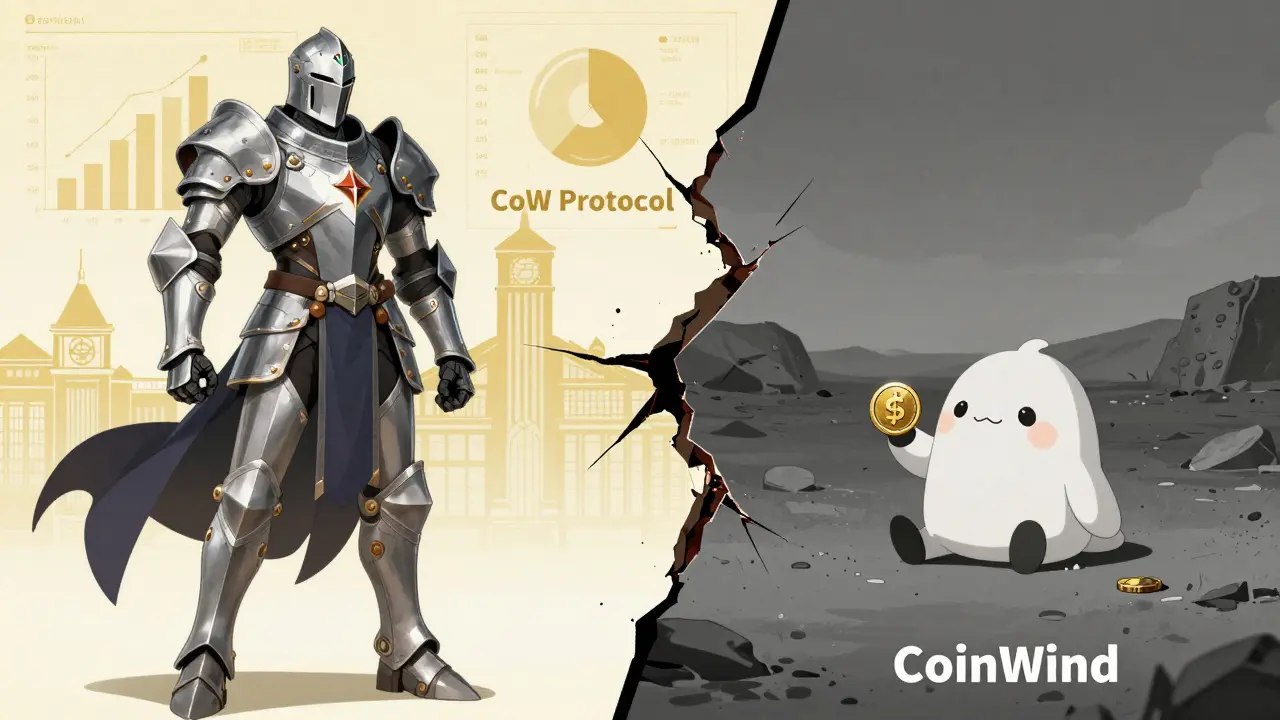
Here is where things get tricky, and where many newcomers make costly mistakes. The ticker symbol "COW" is shared by two completely different projects. Confusing them can lead to serious financial errors.
CoW Protocol a decentralized exchange protocol using batch auctions to protect traders from MEV is a well-established player in the DeFi space. It has raised $23 million in funding from reputable investors like 0x Labs and 1kx. Its market capitalization sits near $98.59 million, and it offers genuine utility through MEV (Maximal Extractable Value) protection and optimized trading execution. This is a serious infrastructure project.
In contrast, CoinWind a separate, lower-cap cryptocurrency project with limited technical documentation lacks this backing, utility, and market presence. Despite sharing the same three-letter ticker, they are unrelated. Always check the contract address and the full project name before interacting with any token labeled "COW." Mistaking CoinWind for CoW Protocol is a common pitfall that can result in holding worthless assets instead of valuable ones.
Risks Associated with Low-Tier Airdrops
Participating in airdrops isn’t inherently bad, but the quality varies wildly. High-profile airdrops from established protocols often reward early users with significant value. Low-tier airdrops like CoinWind’s carry different risks that you must weigh against the potential reward.
- Liquidity Traps: As noted, with zero trading volume, you may not be able to sell your tokens. Holding them becomes a digital souvenir rather than an investment.
- Opportunity Cost: The time spent completing social media tasks-following accounts, joining groups, retweeting-could be invested in learning higher-value skills or participating in more credible ecosystems.
- Phishing and Scams: Many fake airdrop campaigns mimic legitimate ones. Always verify links through official channels. Never connect your primary wallet to unverified dApps claiming to distribute airdrops.
- Data Privacy: Engaging with Telegram groups and Twitter accounts exposes you to spam, scams, and potential data harvesting. Be cautious about sharing personal information or connecting wallets unnecessarily.
The crypto airdrop landscape added over $4 billion in value to the ecosystem in recent years, but that wealth didn’t come from thousands of micro-tokens worth pennies. It came from selective participation in high-potential projects.
Missing Information: Due Diligence Gaps
If you’re considering investing in or holding CoinWind beyond the airdrop, you’ll notice a glaring absence of fundamental data. Unlike mature projects, CoinWind does not appear to publish comprehensive whitepapers, detailed roadmaps, or team disclosures. Key questions remain unanswered:
- Who is behind the development?
- What technology stack powers the token?
- What is the long-term use case beyond speculation?
- Are there any strategic partnerships?
Without this information, assessing the project’s future viability is nearly impossible. In the crypto world, transparency builds trust. When a project hides its fundamentals, it’s wise to proceed with extreme caution.
Final Thoughts: Is It Worth Your Time?
The CoinWind COW airdrop serves as a reminder to look beyond the hype. Free tokens sound appealing, but their value depends entirely on market demand and utility. With CoinWind showing minimal trading activity, negligible market cap, and confusion with a more prominent project, the practical benefit of participating is low.
If you already completed the tasks, keep the tokens in a secure wallet and monitor for any changes in liquidity or project updates. However, don’t expect immediate returns. For future airdrop hunting, prioritize projects with clear utility, active communities, and transparent teams. Your time and attention are valuable resources-spend them wisely.
Is CoinWind (COW) the same as CoW Protocol?
No, they are completely different projects. CoW Protocol is a well-funded DeFi exchange protocol with a large market cap and institutional backing. CoinWind (COW) is a separate, low-cap token with minimal trading activity and no known connection to CoW Protocol. Always verify the contract address to avoid confusion.
How much is the CoinWind COW token worth?
As of the latest data, COW trades at approximately $0.002837 USD. Given the extremely low trading volume and market cap, the actual liquidation value may be even lower or nonexistent due to lack of buyers.
Can I sell my CoinWind COW tokens?
Selling may be difficult. With reported 24-hour trading volume at $0, there is likely no active market on major exchanges. You might need to find a private buyer or wait for the token to be listed on a new platform, which is not guaranteed.
Was the CoinWind airdrop legitimate?
The airdrop appeared to be a standard marketing campaign hosted via CoinMarketCap, requiring social media engagement. However, the low value of the tokens and lack of project transparency suggest it was primarily a visibility stunt rather than a substantial user reward.
What are the risks of participating in such airdrops?
Risks include wasting time on low-value rewards, exposure to phishing scams through unofficial links, privacy concerns from joining Telegram groups, and holding illiquid tokens that cannot be easily sold. Always research the project’s fundamentals before engaging.







Drew M
July 13, 2026 AT 10:13 AMOh, the sheer tragedy of it all! 😩 To think that one might actually believe in the intrinsic value of a token with zero volume is simply... beneath us. 🙄 I suppose some people enjoy the aesthetic of holding digital dust. It’s almost poetic, in a pathetic sort of way. The pretension of calling this an 'investment' makes my soul weep. 📉💔
Deep Rahman
July 14, 2026 AT 08:33 AMOne must consider the deeper philosophical implications of participating in such trivial engagements for rewards that are essentially non-existent, as it raises questions about the nature of value itself and whether our modern society has become so detached from tangible worth that we are willing to exchange our precious time and attention for mere digital tokens that hold no real utility or substance in the broader economic landscape.
Melissa Beckwith
July 14, 2026 AT 13:11 PMYou really need to understand that liquidity is not just a metric but the very lifeblood of any financial instrument, and when you see zero volume, it means there is literally no market mechanism in place to facilitate trades, which implies that the asset is effectively dead weight on your balance sheet, and anyone suggesting otherwise is either ignorant of basic market microstructure or deliberately misleading you for their own gain, so please do your due diligence before throwing away your time on these vanity projects.
Josephine Finlayson
July 15, 2026 AT 15:38 PMI appreciate the detailed breakdown here! It’s important to stay safe out there. Please be careful with your personal information, and don’t let the hype get to you. Take care of yourself first! ❤️✨
Hazel Fruitman
July 17, 2026 AT 02:23 AMits honestly immoral how these projects exploit people's hope for free money while knowing full well the tokens are worthless. they should be ashamed of themselves for creating such deceptive campaigns that prey on the uninformed.
Autumn Story
July 18, 2026 AT 20:48 PMI totally agree with the caution here!! Its scary how easy it is to get tricked, but I still think its nice to try new things sometimes? Just make sure you dont connect your main wallet tho! Stay safe everyone!!! 💖🌈
Ella Collinson
July 20, 2026 AT 16:58 PMThe alpha decay on this token is absolute garbage. The FDV-to-market-cap ratio is nonsensical because the market cap is null, indicating a complete failure of price discovery mechanisms. This is a classic pump-and-dump precursor structure designed to harvest social capital without providing any actual protocol revenue streams or sustainable tokenomics. Pure alpha bleed.
Alicia Hull
July 21, 2026 AT 00:13 AMWhy would anyone even bother with this? It is clearly a waste of time. You are better off learning how to code smart contracts than chasing these pennies. Stop being lazy and do something productive with your life instead of clicking links for bots.
Johan Otto
July 22, 2026 AT 03:38 AMBoring post. Everyone says crypto is dead but then complains when they lose money on shitcoins. Wake up sheeple. 🙄
Anuj Kashyap
July 23, 2026 AT 12:44 PM😂 Oh, look at us, judging people for trying to get free stuff. How noble. But seriously, if you can't tell the difference between CoW Protocol and CoinWind, maybe stick to saving cash under your mattress. It’s safer than trusting random Telegram groups. 🤷♂️
DJ Maleko
July 25, 2026 AT 10:06 AMDid you check your private keys after joining those Telegram groups? Because I did, and let me tell you, it’s a nightmare. They are harvesting wallets left and right. Don’t act like you’re safe just because you got 8 cents. Your data is already sold. 🕵️♂️💸
Erika Pozzetto
July 25, 2026 AT 18:47 PMIt is imperative that we recognize the structural deficiencies inherent in such promotional distributions, as they fail to provide any substantial utility or long-term value proposition for participants, thereby rendering the entire exercise futile from an investment perspective and potentially detrimental to one’s overall financial health and strategic portfolio allocation.
Russ Fincham
July 27, 2026 AT 02:50 AMLook, I’m not gonna sugarcoat it. This project is trash. The metrics are fake, the team is anonymous, and the token is illiquid. If you bought in, you got played. Simple as that. No amount of retweeting is going to fix a broken product.
Linda Hilliard
July 27, 2026 AT 12:59 PM:| Only amateurs fall for this. Real investors know that zero volume equals zero interest. It’s embarrassing to see grown adults celebrating 8 cents. Do some research before you embarrass yourself further. The smart money is nowhere near this dumpster fire. 📉🚫
Winston Lacewing
July 27, 2026 AT 22:35 PMI can’t believe people are still defending this! It’s a scam plain and simple! You guys are enabling bad actors by giving them attention. Shame on you all! 😡👎 How can you sleep at night knowing you helped spread this nonsense?