Imagine holding a currency that actually becomes scarcer every day. Unlike the cash in your wallet, which loses purchasing power as central banks print more of it, certain digital assets are engineered to disappear over time. This isn't just theoretical economics; it is the core design of deflationary cryptocurrencies. These assets use specific technical mechanisms to reduce their total supply, creating artificial scarcity that can drive up value if demand stays steady or grows.
You might wonder why this matters right now. With traditional fiat currencies facing inflation pressures globally, investors are looking for alternatives that protect wealth through scarcity rather than growth. By June 2026, deflationary tokens have become a dominant force in the crypto market, representing nearly half of the total market capitalization. Understanding how these mechanisms work-and which coins actually deliver on their promises-is crucial for anyone navigating the modern financial landscape.
How Deflationary Mechanisms Actually Work
To understand why some coins go up while others stagnate, you need to look under the hood at the code. Deflationary cryptocurrencies don't just "hope" to become scarce; they enforce it through three primary technical methods: capped supply, periodic halvings, and active token burning.
Bitcoin introduced the concept of a hard cap. There will never be more than 21 million BTC. But Bitcoin also uses halving events, where the reward for mining new blocks is cut in half roughly every four years. The most recent halving in April 2024 reduced the block reward from 6.25 to 3.125 BTC. This slows down the rate at which new coins enter circulation, making the asset increasingly scarce over time.
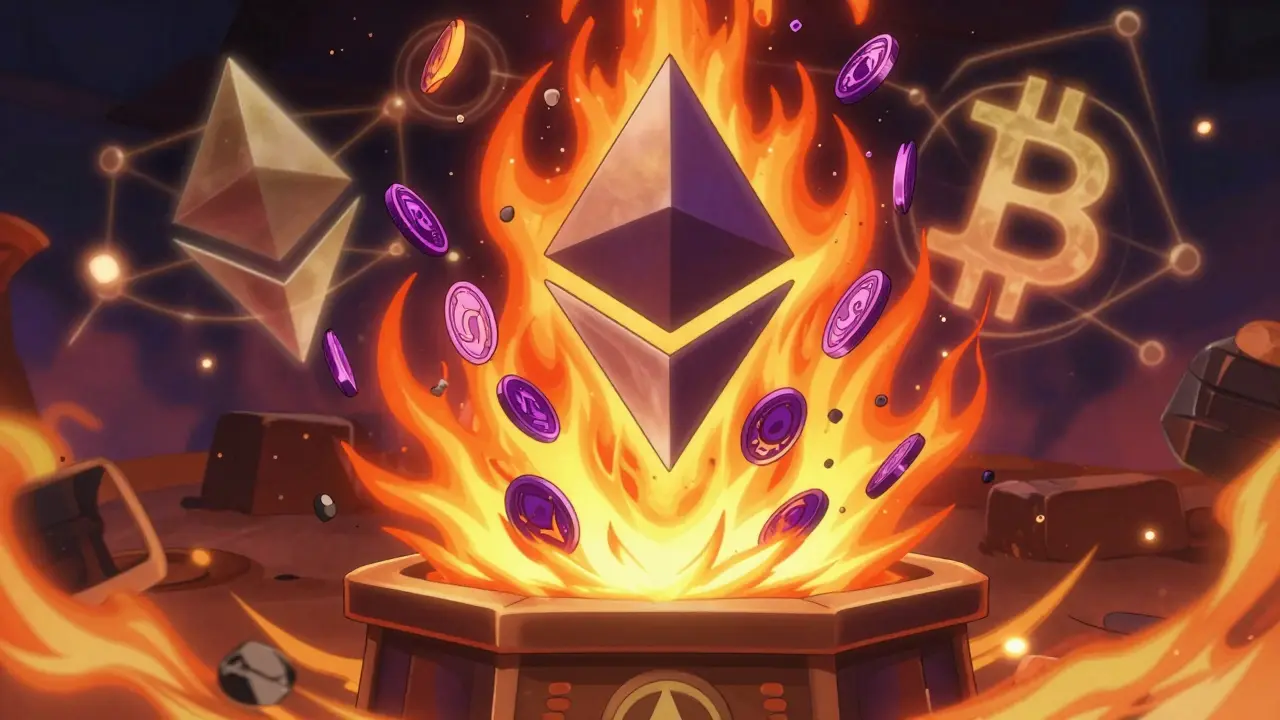
Other projects take a more aggressive approach with token burning. This involves permanently removing tokens from circulation by sending them to an inaccessible address. Binance Coin (BNB) pioneered this with quarterly burns funded by platform profits. Meanwhile, Ethereum implemented EIP-1559 in August 2021, which automatically burns a portion of every transaction fee. If network activity is high enough, Ethereum actually destroys more ETH than it creates, turning it into a truly deflationary asset during busy periods.
Top Deflationary Cryptocurrency Examples
Not all deflationary coins are created equal. Some rely on predictable schedules, while others depend on user behavior. Here are the most significant examples shaping the market today.
| Cryptocurrency | Primary Mechanism | Supply Cap / Burn Target | Predictability |
|---|---|---|---|
| Bitcoin (BTC) | Halving & Hard Cap | 21 Million BTC | High (Fixed Schedule) |
| Ethereum (ETH) | Transaction Fee Burning | No Hard Cap (Dynamic) | Medium (Depends on Usage) |
| Binance Coin (BNB) | Quarterly Profit Burns | 50% Reduction Goal | High (Scheduled Events) |
| Solana (SOL) | Inflationary but Low Rate | ~81 Billion (Initial) | Low (Still Inflationary) |
Bitcoin remains the gold standard for deflationary design. Its 21 million limit is absolute. As we approach 2140, when the last Bitcoin is expected to be mined, the annual supply growth drops below 1%. This makes it a powerful hedge against fiat inflation. However, its deflation is slow and steady, not sudden.
Ethereum offers a different dynamic. Since the EIP-1559 upgrade, Ethereum has burned millions of ETH. Data from EtherScan shows that between August 2021 and late 2023, over 2.5 million ETH were destroyed. During peak usage, Ethereum can burn thousands of ETH per hour. This means Ethereum’s scarcity is directly tied to its utility-the more people use the network, the scarcer the coin becomes.
Binance Coin (BNB) takes a centralized approach. Binance uses 20% of its quarterly profits to buy back and burn BNB until 100 million tokens (half of the original supply) are gone. As of late 2023, nearly 49 million BNB had already been burned. This creates a clear roadmap for scarcity, though it relies entirely on Binance’s business performance.
The Risks of Hoarding and Market Volatility
Scarcity sounds great, but it comes with psychological and economic traps. One major risk is the hoarding effect. When people believe an asset will only go up because supply is shrinking, they stop spending it. They hold onto it indefinitely. While this drives price appreciation, it kills liquidity. You can’t use money effectively if no one wants to sell it.
Economist Nouriel Roubini has warned that widespread adoption of deflationary assets could exacerbate economic downturns. If everyone holds their crypto waiting for higher prices, transaction volume dries up. This was seen in smaller deflationary tokens like SafeMoon, where high transaction fees designed to burn tokens made trading impractical for many users. Investors found themselves trapped, unable to exit positions without paying prohibitive costs.
Another risk is unpredictability. Ethereum’s burn rate fluctuates wildly. On quiet days, it might burn only 200 ETH per hour. On busy days, that number jumps to 1,200+. This volatility makes it hard to predict long-term supply changes compared to Bitcoin’s rigid schedule.

Investment Strategies for Deflationary Assets
If you’re considering adding deflationary cryptocurrencies to your portfolio, timing and strategy matter. Here’s how experienced investors approach these assets:
- Dollar-Cost Averaging (DCA): Instead of trying to time the market, buy small amounts regularly. This smooths out volatility and ensures you accumulate assets regardless of short-term price swings.
- Monitor Network Activity: For Ethereum, watch gas prices and transaction volumes. High activity means more burning, which supports price floors. Tools like Ultrasound.money track net issuance in real-time.
- Understand Burn Schedules: For BNB, mark your calendar for quarterly burns. Price often reacts positively in the weeks leading up to these events due to anticipated scarcity.
- Watch Halving Cycles: Bitcoin historically sees bull runs 6-18 months after each halving. The 2024 halving set the stage for potential gains through 2025 and beyond.
Be cautious of newer tokens promising aggressive burns. Many lack the ecosystem utility of BNB or the security of Bitcoin. Always check if the burn mechanism is transparent and verifiable on-chain.
Regulatory Landscape and Future Outlook
As deflationary cryptocurrencies gain mainstream attention, regulators are taking notice. The European Union’s MiCA framework treats many of these tokens as asset-referenced tokens, requiring strict disclosures. In the US, the SEC continues to scrutinize whether burn mechanisms constitute investment contracts under the Howey Test.
Despite regulatory uncertainty, adoption is accelerating. By 2027, industry analysts predict that 65% of the top 100 cryptocurrencies will incorporate some form of deflationary mechanism. Central banks are even studying these models for potential CBDC designs, with 68% expressing interest in incorporating scarcity principles.
The future points toward a hybrid model. We may see more assets combining Bitcoin’s predictability with Ethereum’s dynamic utility. As scalability upgrades like Ethereum’s Dencun improve throughput, burn rates could increase significantly, further tightening supply.
What is the best deflationary cryptocurrency to buy?
There is no single "best" option, as it depends on your goals. Bitcoin is ideal for long-term wealth preservation due to its fixed supply and proven track record. Ethereum suits those who want exposure to a growing ecosystem with dynamic scarcity. Binance Coin offers a middle ground with scheduled burns and strong utility within the Binance exchange. Always do your own research and consider diversification.
How does token burning affect price?
Token burning reduces the total supply of a cryptocurrency. According to basic supply and demand principles, if demand remains constant or increases while supply decreases, the price should rise. However, this is not guaranteed. If demand drops faster than supply, the price can still fall. Burning works best when combined with strong utility and network adoption.
Is Bitcoin really deflationary?
Yes, Bitcoin is deflationary in the sense that its supply growth rate continuously decreases. It has a hard cap of 21 million coins, and new coins are issued at a slower rate after each halving event. Once all 21 million are mined, no new bitcoins will ever be created, making it perfectly deflationary in terms of supply issuance.
Can Ethereum become fully deflationary?
Ethereum can become deflationary on a daily basis if network activity is high enough. Since the EIP-1559 upgrade, a portion of transaction fees is burned. When gas prices are high, the amount burned exceeds the new ETH issued to validators, resulting in net negative issuance. This has happened on over 60% of trading days since the upgrade.
What are the risks of investing in deflationary tokens?
Key risks include hoarding behavior reducing liquidity, unpredictable burn rates (especially for Ethereum), and regulatory uncertainty. Some smaller tokens use aggressive burn fees that make trading difficult. Additionally, past performance does not guarantee future results, and market sentiment can override supply dynamics in the short term.