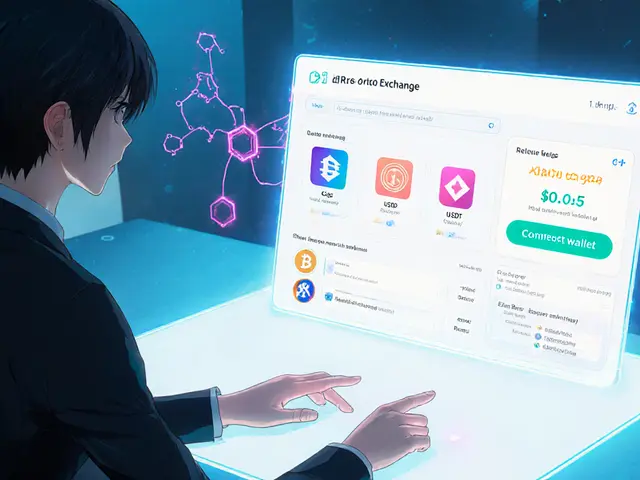
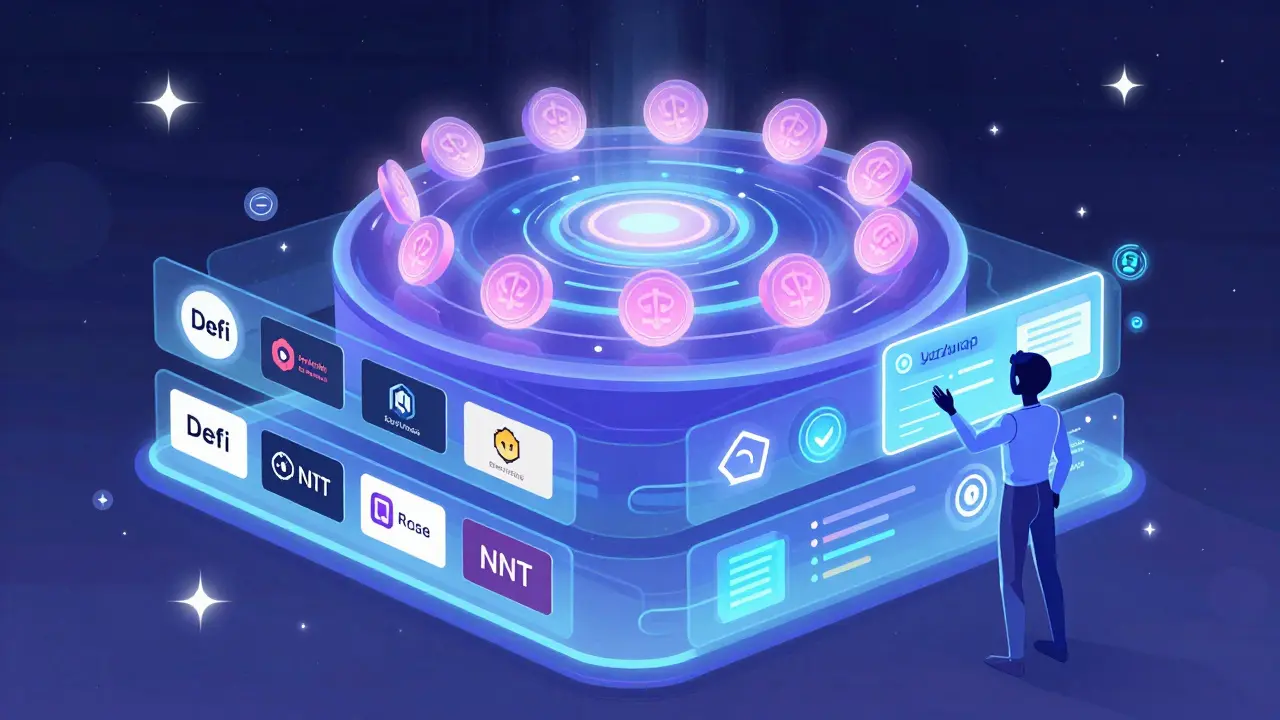
There is no exchange called "Oasis." That’s the first thing you need to understand if you’re searching for a crypto exchange named Oasis. Instead, Oasis Network is a blockchain platform built for privacy, scalability, and decentralized finance - and it’s where the ROSE token lives. If you’re looking to trade ROSE or use privacy-focused DeFi tools, you’re not shopping for an exchange. You’re exploring a whole new kind of crypto infrastructure.
What Is the Oasis Network?
Oasis Network isn’t a centralized platform like Binance or Coinbase. It’s a Layer 1 blockchain designed to solve two big problems in crypto: slow speeds and zero privacy. Most blockchains treat every transaction the same - whether it’s sending $5 or running a complex financial contract. Oasis separates those tasks into two layers: the Consensus Layer and the ParaTime Layer.
The Consensus Layer handles security and agreement between nodes using Proof of Stake (PoS). Validators lock up ROSE tokens to earn rewards and keep the network running. The ParaTime Layer is where all the real work happens - smart contracts, DeFi apps, data processing - and it runs in parallel. That means one ParaTime can handle a privacy-preserving loan while another runs an NFT marketplace, without slowing each other down.
This architecture lets Oasis process thousands of transactions per second at low cost. It’s not just faster - it’s built for applications that need confidentiality. In healthcare, for example, hospitals can use Oasis to share patient data for research without exposing names or records. In finance, users can get loans without revealing their full transaction history. That’s why developers are building serious DeFi tools here.
The ROSE Token: More Than Just a Crypto Asset
ROSE is the native token of Oasis Network. It’s not just for trading. It’s the fuel, the security deposit, and the voting power. You need ROSE to pay for transactions. You stake ROSE to become a validator or delegate to one. And you use ROSE to vote on network upgrades.
There’s a hard cap of 10 billion ROSE tokens. As of mid-2025, the market cap sits in the top 50 cryptocurrencies, driven by growing adoption in DeFi and data tokenization. Unlike some tokens that spike and crash, ROSE has shown steady growth because its value is tied to real usage - not hype.
You can buy ROSE on major exchanges like MEXC, KuCoin, and Gate.io. These platforms offer high liquidity and low fees, making them the go-to for traders. But if you want to use ROSE for staking or DeFi, you’ll need to move it to a wallet that connects to Oasis.
YuzuSwap: The DeFi Hub on Oasis
YuzuSwap is the first and most popular decentralized exchange on Oasis. It runs on Emerald, Oasis’ EVM-compatible ParaTime. That means if you’ve used Uniswap or PancakeSwap before, YuzuSwap feels familiar.
Here’s how it works:
- Swap ROSE for other tokens like ETH, USDT, or native Oasis-based assets
- Provide liquidity to pools and earn YUZU tokens as rewards
- 20% of all trading fees go to a community treasury, voted on by YUZU holders
- Low gas fees - often under $0.01 per trade
When YuzuSwap launched, it dropped 50,000 YUZU tokens in an airdrop to early users. That helped bootstrap liquidity and attract developers. Today, it’s the primary way to interact with Oasis DeFi. You won’t find margin trading or futures here - yet. But for simple swaps and yield farming, it’s fast, cheap, and private.
How to Store and Stake ROSE Safely
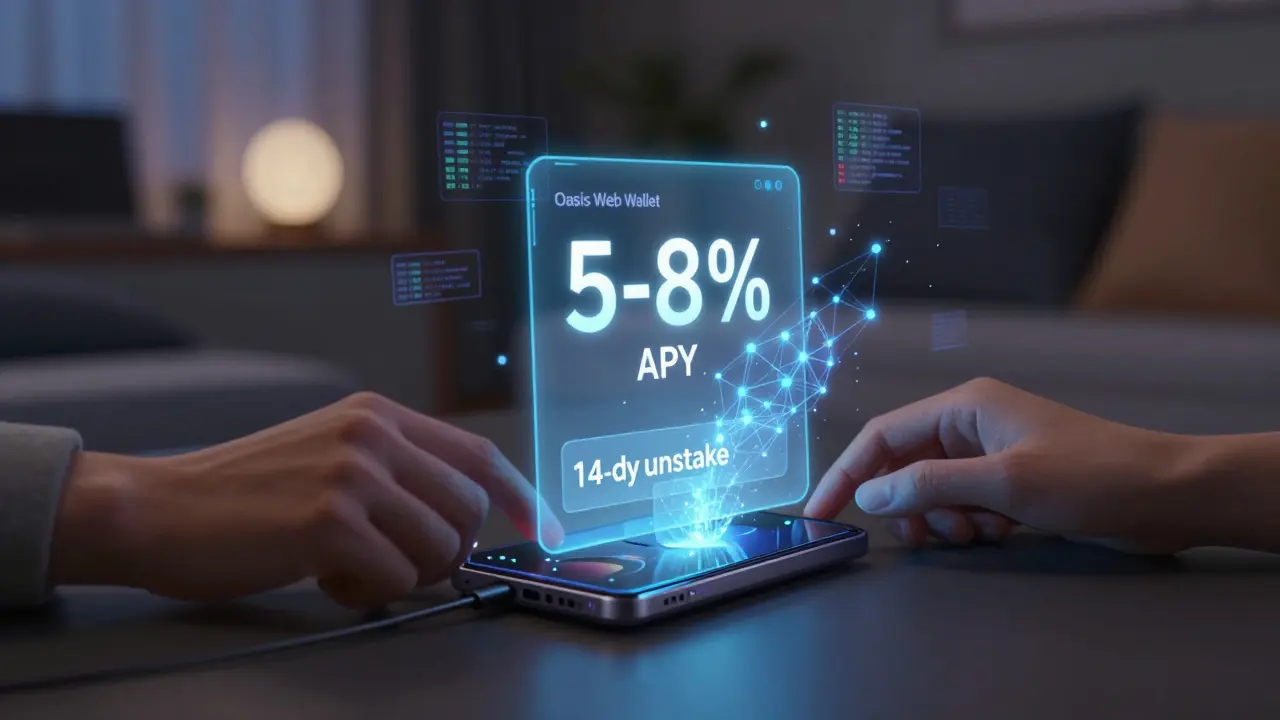
You can’t stake ROSE on centralized exchanges. To earn rewards, you need a non-custodial wallet. The official Oasis Web Wallet is the easiest option. It’s a browser extension or mobile app that connects directly to the network. You control your keys. No middleman.
For maximum security, use a Ledger Nano S or Nano X. Oasis supports Ledger hardware wallets, so you can sign transactions offline. This is critical if you’re holding more than a few hundred dollars worth of ROSE. Even if your computer gets hacked, your private keys stay safe on the device.
Staking is simple: connect your wallet, choose a validator, and delegate your ROSE. You’ll earn around 5-8% APY depending on network conditions. Rewards are distributed every 24 hours. You can unstake anytime, but there’s a 14-day waiting period before you can withdraw your tokens.
Tokenized Data: The Real Innovation
Oasis isn’t just about money. It’s about turning your data into an asset. The network introduced "Tokenized Data" - a system where you can earn ROSE by letting apps use your anonymized data.
Imagine this: you allow a health app to analyze your fitness tracker data. The app runs the analysis on Oasis’ privacy layer. No one sees your name, heartbeat, or location. But you get rewarded in ROSE for contributing to the dataset. This model is being tested by research institutions and wellness startups.
This isn’t theoretical. Companies are already using Oasis to build data marketplaces where users control access and get paid. It’s a new kind of economy - one where you’re not the product, you’re the owner.
Who Is Oasis For?
Oasis isn’t for everyone. If you just want to buy Bitcoin and hold it, stick with Coinbase or Kraken. But if you care about:
- Privacy in your financial transactions
- Low fees for frequent DeFi trading
- Supporting blockchain innovation beyond speculation
- Using your data to earn passive income
Then Oasis is one of the most promising networks today. It’s not the biggest. It’s not the flashiest. But it’s one of the few building real solutions to crypto’s biggest weaknesses.
Where to Trade ROSE
Since Oasis isn’t an exchange, you need to use third-party platforms to buy ROSE. Here are the top options as of 2025:
| Exchange | ROSE/USDT Pair | Trading Fees | Withdrawal Support | Best For |
|---|---|---|---|---|
| MEXC | Yes | 0.2% | Yes (Oasis Network) | Beginners and active traders |
| KuCoin | Yes | 0.1% | Yes (Oasis Network) | Low-cost trading |
| Gate.io | Yes | 0.2% | Yes (Oasis Network) | High liquidity |
| YuzuSwap | Yes | 0.3% | No (on-chain only) | DeFi users already on Oasis |
Always double-check the withdrawal network. Sending ROSE via Ethereum or BSC will lose your funds. Only use the Oasis Network (ERC-20 is not supported - it’s a native chain).
Is Oasis Network Safe?
Yes - but only if you follow best practices. Oasis has never been hacked. Its dual-layer design makes attacks harder. The consensus layer is secured by over 150 validator nodes globally. The ParaTime Layer is isolated, so a bug in one app doesn’t break the whole network.
But your wallet? That’s your responsibility. Never share your seed phrase. Use hardware wallets. Avoid phishing sites pretending to be "Oasis Exchange" or "Oasis Wallet". The real Oasis Web Wallet is only available at oasis.app. Everything else is fake.
What’s Next for Oasis?
Oasis is expanding fast. In late 2025, they launched a new ParaTime for GameFi, allowing developers to build NFT games with private player stats. Another ParaTime is being tested by a European bank for confidential loan approvals. The team is also working on cross-chain bridges to Ethereum and Solana.
They’re not chasing trends. They’re solving real problems. If privacy becomes a standard requirement in DeFi - not a bonus - Oasis will be one of the few platforms ready for it.
Is Oasis a crypto exchange?
No, Oasis is not an exchange. It’s a blockchain network. You trade ROSE on centralized exchanges like MEXC or KuCoin, and use YuzuSwap for decentralized trading on the Oasis network itself.
Can I stake ROSE on Coinbase or Binance?
No. Neither Coinbase nor Binance supports staking ROSE. You must use the official Oasis Web Wallet or a Ledger hardware wallet connected to the Oasis network to earn staking rewards.
What’s the difference between ROSE and YUZU?
ROSE is the native token of the Oasis Network used for staking, fees, and governance. YUZU is the token of YuzuSwap, the DEX on Oasis. YUZU is earned by providing liquidity and used for voting on fee distribution, not for network security.
Is Oasis better than Ethereum for DeFi?
It depends. Ethereum has more users and apps. Oasis has lower fees, faster speeds, and built-in privacy. If you want confidential DeFi - like private loans or data-driven financial tools - Oasis is ahead. For general DeFi, Ethereum still leads.
Can I use Oasis for NFTs?
Yes. Several NFT marketplaces are live on Oasis, especially for games and collectibles that require privacy. You can mint, trade, and store NFTs without exposing your transaction history or wallet balance to the public.
How do I get started with Oasis?
Buy ROSE on MEXC or KuCoin, transfer it to the Oasis Web Wallet, then connect to YuzuSwap to swap or stake. Start with small amounts to learn the system before committing more.