
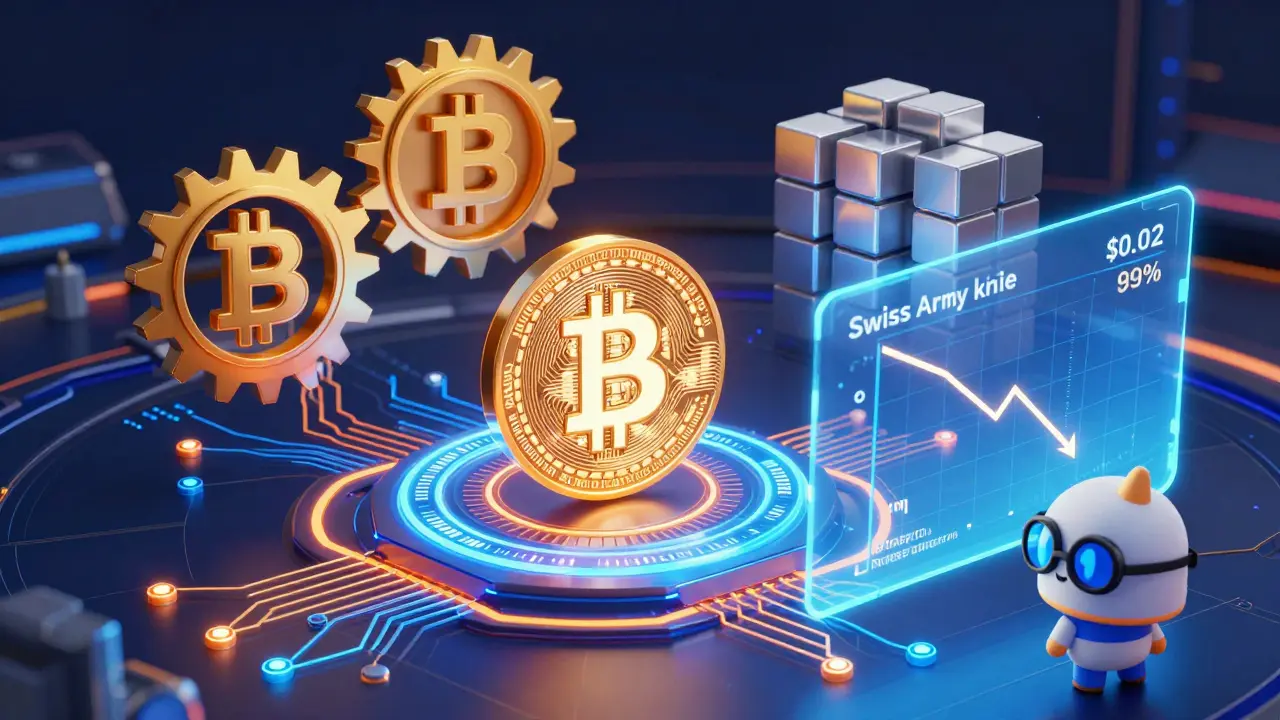
You’ve probably seen the ticker ORBI pop up in a chat group or on a low-volume exchange list. It promises to bridge the gap between Bitcoin’s rigid network and modern development needs. But if you are looking at the charts right now, you might be scratching your head. The numbers look tiny. The volume looks thinner than air. So, what exactly is Orbital7, and why did it crash so hard after its launch?
This isn’t just another hype coin. It’s a specific toolset built for a very niche problem: making Bitcoin easier to work with. However, understanding what it *is* requires understanding why it has struggled to gain traction since its debut in 2024.
The Core Concept: Building Tools for Bitcoin
To understand Orbital7, you first have to understand the problem it tries to solve. Bitcoin is secure, but it is notoriously difficult to build complex applications on top of. Unlike Ethereum, which was designed from day one as a programmable computer, Bitcoin is primarily a ledger for value transfer.
Over the last few years, developers have found clever ways to create tokens on Bitcoin using protocols like Runes and BRC-20. These allow users to issue fungible tokens directly on the Bitcoin blockchain. But here is the catch: managing these assets is messy. You need different tools for Runes, different tools for BRC-20, and yet different methods for standard Bitcoin transactions.
Orbital7 positions itself as a unified suite of development tools. Think of it as a Swiss Army knife for Bitcoin-centric networks. Instead of building separate solutions for each protocol, developers can use Orbital7’s infrastructure to create, manage, and utilize digital assets across these fragmented ecosystems. The goal is omnichain compatibility-removing the isolation that usually keeps blockchains from talking to each other effectively.
Technical Architecture: Why BNB Smart Chain?
If Orbital7 is about Bitcoin, why does the token live on the BNB Smart Chain? This is a common point of confusion. The answer lies in cost and speed.
Building directly on Bitcoin is expensive and slow. Transactions take time to confirm, and fees can spike unpredictably. By launching the ORBI token as a BEP-20 asset on the BNB Smart Chain (also known as BSC), the project leverages Binance’s high-speed, low-cost infrastructure. This allows for rapid development and cheap interactions for users holding the governance or utility token.
The technical stack relies on "Tier 0" technology concepts, utilizing sequence numbers to optimize asset creation. Essentially, Orbital7 acts as the control layer. You interact with the ORBI token on BSC, but the underlying logic helps streamline operations on Bitcoin-layer protocols. It’s a hybrid approach: the convenience of an EVM-compatible chain (like BSC) paired with the security narrative of Bitcoin.
| Attribute | Details |
|---|---|
| Token Symbol | ORBI |
| Blockchain | BNB Smart Chain (BEP-20) |
| Total Supply | 2,000,000,000 (2 Billion) |
| Launch Date | May 9, 2024 |
| Primary Use Case | Development toolkit for Bitcoin-centric networks (Runes, BRC-20) |
| Mining | No (Not mineable) |
Market Reality Check: The 2026 Landscape
Here is where things get serious. If you are reading this in late 2025 or 2026, you need to look at the data without rose-colored glasses. Orbital7 launched with significant hype in May 2024. Like many new projects, it saw a massive spike in interest shortly after release.
On June 19, 2024, just weeks after launch, ORBI hit its all-time high (ATH). Depending on the data source, this peak ranged between $0.0168 and $0.0215. For a micro-cap token, that is a respectable run. But crypto markets are brutal, especially for niche utility tokens that haven’t achieved widespread adoption.
By mid-2025, the price had collapsed. We are talking about a decline of over 99% from those peak levels. As of recent reports in 2025 and early 2026, the price hovers around fractions of a cent-often below $0.0001. The market capitalization has shrunk to single-digit thousands of dollars in some metrics, ranking it outside the top 8,000 cryptocurrencies by market cap.
Why the drop? Two main factors:
- Liquidity Issues: With daily trading volumes often dipping below $30,000, there isn’t enough money flowing in and out to support a higher price. Large sells crush the price easily.
- Adoption Lag: While the idea of unifying Bitcoin tools is sound, the actual developer adoption hasn’t matched the initial hype. Without a surge in active developers using Orbital7’s suite, the utility demand for the token remains low.

Tokenomics: Understanding the Supply
When analyzing any crypto, you must know how many tokens exist. Orbital7 has a fixed total supply of 2 billion ORBI tokens. There is no inflationary mining mechanism; you cannot mine ORBI. Tokens are acquired through exchanges or ecosystem rewards.
However, the circulating supply-the number of tokens actually available for public trading-is a bit of a mystery due to inconsistent reporting across platforms. Some aggregators report around 63 million in circulation, while others suggest closer to 1 billion. This discrepancy is common in lower-tier coins where liquidity pools are small and token locks may be releasing gradually or being reported differently by various data providers.
For an investor, this uncertainty is a risk. If a large portion of the 2 billion supply is held by insiders or locked in vesting contracts that are about to unlock, it could put downward pressure on the price. Always check the latest on-chain data via BscScan to verify current holder distribution before buying.
Is Orbital7 Safe and Legitimate?
Let’s address the elephant in the room: Is this a scam? Based on available technical audits and platform listings, Orbital7 operates as a legitimate project on the BNB Smart Chain. It is not a rug pull in the traditional sense where developers drain the liquidity pool and disappear overnight. The contract is verified, and the project maintains a development roadmap.
However, "legitimate" does not mean "safe investment." In crypto, there is a huge difference between a functional product and a profitable asset. Orbital7 is a functional toolset, but its financial viability is currently weak. The low market cap means it is highly volatile. A small buy order can pump the price 10%, and a small sell order can dump it 10%. This makes it unsuitable for conservative investors.
The project benefits from operating within the BNB Smart Chain ecosystem, which provides a level of technical oversight and security standards that isolated, unknown chains do not offer. But remember: smart contract security doesn’t protect you from poor market performance.
Who Should Care About ORBI?
Orbital7 is not for everyone. Here is who might find value in it:
- Bitcoin Developers: If you are building dApps that interact with Runes or BRC-20 tokens, Orbital7’s SDKs and tools could save you time by abstracting away the complexity of Bitcoin’s scripting language.
- High-Risk Traders: Those who specialize in "deep dip" trading might see the 99% drop from ATH as a speculative entry point, betting on a future resurgence in Bitcoin L2 narratives.
Who should avoid it?
- Mainstream Investors: If you are looking for stable growth or blue-chip assets, ORBI is too obscure and illiquid.
- Passive Holders: Without active engagement in the ecosystem, holding ORBI offers little utility compared to staking major assets like ETH or BTC.
Future Outlook: Can It Recover?
The recovery of Orbital7 depends entirely on the broader adoption of Bitcoin-native DeFi. If the Bitcoin ecosystem continues to grow, and more developers seek easy ways to issue tokens on Bitcoin, Orbital7’s position as a unified toolkit becomes more valuable.
However, competition is fierce. Other Layer-2 solutions and sidechains are also vying for dominance in the Bitcoin space. For ORBI to regain its former glory, it needs to demonstrate tangible usage metrics-not just price pumps. Look for announcements regarding major partnerships, increased developer grants, or integration with larger wallets and exchanges.
Until then, treat ORBI as a high-risk, experimental asset. Do your own research, monitor the on-chain activity on BscScan, and never invest more than you can afford to lose completely.
What is the current price of Orbital7 (ORBI)?
As of mid-2025 and into 2026, the price of ORBI has dropped significantly from its all-time high. It typically trades in the range of $0.00002 to $0.0001, depending on the exchange and liquidity conditions. Prices vary widely between platforms like Gate.io, CoinMarketCap, and CryptoRank due to low trading volume.
Can I mine Orbital7 (ORBI) tokens?
No, you cannot mine ORBI. The token operates on the BNB Smart Chain (BEP-20 standard) and has a fixed total supply of 2 billion tokens. New tokens are not created through mining; they are distributed via sales, exchanges, or ecosystem rewards.
Why is Orbital7 listed on BNB Smart Chain instead of Bitcoin?
Orbital7 uses the BNB Smart Chain for its token because it offers faster transaction speeds and lower fees compared to the Bitcoin mainnet. This allows for efficient governance and utility functions. However, the tools provided by Orbital7 are designed to help developers build on Bitcoin-centric networks like Runes and BRC-20.
Is Orbital7 a safe investment?
While the project appears legitimate and operates on a secure blockchain, it carries extreme financial risk. The token has lost over 99% of its value from its peak, has very low liquidity, and ranks outside the top 8,000 cryptocurrencies. It is considered a high-risk speculative asset, not a safe long-term hold for most investors.
What is the total supply of ORBI?
The total supply of Orbital7 (ORBI) is fixed at 2,000,000,000 (2 billion) tokens. There is no maximum supply cap distinct from this total, meaning no additional tokens can be created beyond this amount.









Christina Pearce
May 30, 2026 AT 17:29 PMhey everyone, just wanted to say thanks for breaking this down so clearly. it’s really helpful to see the distinction between a legit project and a safe investment. i’ve been watching ORBI since early 2024 and it’s wild how fast the hype died down. the technical stuff about BSC vs Bitcoin is spot on too.
Barclay Chantel
May 31, 2026 AT 03:03 AMOh, please. Another piece of digital confetti masquerading as innovation. The fact that you’re even discussing 'tokenomics' for a coin that has lost 99% of its value is laughable. It’s not a 'niche toolset,' it’s a graveyard of bad decisions. The pretension of calling it a 'Swiss Army knife' when it can’t even cut through its own liquidity issues is rich. Stick to blue chips if you have any sense left in your head.
trisya hazriyana
June 1, 2026 AT 11:55 AMlol Barclay always so salty about the little guys. look at the data though. the tech stack is actually interesting. tier 0 sequence numbers? yeah maybe overkill but it shows they tried something different. why do we only care about price action and not utility? philosophy of value is shifting. people are waking up to the fact that BTC L2s are the future regardless of current market cap. don't let the FUD get you down.
Barclay Chantel
June 2, 2026 AT 12:07 PMUtility without adoption is just code rotting in a repository. You speak of 'philosophy' while ignoring basic economics. If no one uses it, it has zero value. It’s not 'salty,' it’s realistic. Your 'waking up' narrative is just a coping mechanism for holding a bag of worthless tokens. Enjoy the ride to zero, I suppose.
Miss Masquer
June 4, 2026 AT 10:27 AMI think what Trisya is getting at, which is a very valid point considering the broader context of blockchain evolution, is that we often judge these projects by their immediate financial performance rather than their long-term architectural potential, and while I agree that the current liquidity situation is dire, we must also consider that the development team is still active and pushing updates, which suggests that perhaps there is a strategic patience required here that many retail investors simply do not possess or understand fully.
Joshua Alcover
June 6, 2026 AT 07:39 AMThe fundamental flaw in this entire discourse is the reliance on foreign infrastructure like BNB Smart Chain for a project claiming Bitcoin sovereignty. This is a betrayal of the core ethos of decentralization. We should be building sovereign tools on sovereign chains, not relying on centralized entities like Binance to facilitate our 'freedom.' The pseudo-intellectual arguments about 'cost efficiency' ignore the existential risk of depending on a hostile central bank-adjacent entity. True security requires true isolation, not hybrid compromises that dilute the integrity of the network.
Diana Morris
June 6, 2026 AT 18:19 PMstop overthinking it Josh. just buy low sell high. nobody cares about your political ranting. the chart is dead. move on. life is short. dont waste breath on dead coins.
Dianne Wright
June 6, 2026 AT 22:27 PMi feel so drained reading all this negativity honestly. why does everyone have to be so mean? i just wanted to learn about the token. now i feel anxious. cant we just talk about the good parts? like how it helps developers? i miss the old reddit where people were nicer. this place is toxic lately. makes me want to cry sometimes
Debbie Lewis
June 9, 2026 AT 12:30 PMyeah chill out everyone. i’m just observing from the sidelines. looks like a tough one. probably best to avoid unless you’re a dev.
Joe Clements
June 10, 2026 AT 05:20 AMHey Debbie, totally get where you're coming from. It’s definitely a high-risk play. I’ve been following Orbital7 because I’m curious about the Runes integration. It’s cool to see them trying to simplify Bitcoin dev. Just gotta keep expectations low, right?
Rosie Morris
June 11, 2026 AT 12:46 PMim with joe on this one. its kinda neat tech wise even if the price is trash. hope they figure it out. my spelling is bad sorry but i think its worth watching.
lorna erni
June 11, 2026 AT 18:08 PMListen up folks! This coin is sleeping giant! I’m telling you, the dip is massive opportunity! Don’t let the haters tell you otherwise! Buy the fear! Sell the greed! But seriously, check the volume. It’s thin. Be careful but bold! Who’s with me? Let’s pump this discussion! Energy is key! Wake up!
stalin brian
June 13, 2026 AT 13:06 PMlorna calm down a bit lol. im just asking questions here. is it really a sleeping giant or just a coma patient? i hear good things about the sdk though. anyone used it? seems like it could save time if you know what ur doing. just wondering.
saradee dee
June 13, 2026 AT 15:23 PMOh my goodness, this is such a dramatic story! From high hopes to crashing down! It’s like a movie plot! I’m so sad for the holders but also amazed by the technology. Maybe it will rise again like a phoenix? Or maybe it’s gone forever? The uncertainty is thrilling yet terrifying! Please tell me more about the future outlook!
Craig Swanson
June 14, 2026 AT 18:44 PMSaradee, try to stay grounded. Drama won’t help your portfolio. Look, I’m here to help you navigate this. The reality is harsh: low liquidity means you can’t exit easily. That’s the biggest risk. Don’t fall for the emotional rollercoaster. Focus on facts. Check BscScan. Verify holder distribution. Protect yourself first. Aggressive trading needs aggressive knowledge. Do you have that?
Dana Rapoport
June 15, 2026 AT 13:18 PMWe must reflect on the nature of value itself. Is it purely speculative, or is there intrinsic merit in solving a difficult engineering problem? Orbital7 attempts to bridge a significant gap in the Bitcoin ecosystem. While the market punishes failure harshly, history is filled with innovators who were initially misunderstood. Perhaps the silence of the charts is merely the quiet before a paradigm shift. We should observe with patience and wisdom.
Hadleigh Edwards
June 15, 2026 AT 20:04 PMI truly believe that every setback is just a setup for a comeback, and while the current state of Orbital7 might seem daunting to some, it’s important to remember that great things take time to build, especially in the crypto space where volatility is the norm, and if the team continues to deliver on their roadmap and improve the developer experience, there’s a chance that the community will eventually recognize the value they’re providing, leading to a resurgence that rewards those who stayed loyal through the tough times.