
Imagine logging into your favorite trading platform only to see a red warning banner blocking your deposits. You check the terms, and suddenly, that "decentralized" label feels like a marketing trick. This is exactly what happens when users in certain regions try to access dYdX, a leading platform for crypto derivatives. Despite its reputation as a decentralized exchange (DEX), it enforces strict geographic restrictions on dozens of countries. Why does a platform built on blockchain technology act so much like a traditional bank? The answer lies in the complex web of global regulations that even DeFi giants cannot escape.
The Core Contradiction: Decentralization vs. Compliance
To understand why dYdX restricts access, we first need to look at how it actually works. True decentralization means no single entity controls the network. If a protocol were fully decentralized, it would be nearly impossible to ban a specific country because there is no central server to block an IP address or a central database to flag a wallet. However, dYdX operates with a hybrid architecture. While its core trading engine runs on the Cosmos SDK and utilizes smart contracts, the user interface and frontend services are managed by centralized entities. Specifically, dYdX Operations Services Ltd. (DOS) handles the frontends and implements the geographic blocking technology. This setup allows the platform to comply with Anti-Money Laundering (AML) and Counter-Terrorism Financing (CTF) protocols, which are mandatory for many financial institutions but often ignored by pure DeFi projects.
Which Countries Are Blocked?
The list of restricted jurisdictions is extensive and can change based on shifting international sanctions. As of mid-2026, the most notable exclusions include major economic powers and sanctioned regions. If you reside in these areas, accessing the platform may trigger compliance actions:
- United States: Often excluded due to CFTC and SEC regulatory complexities regarding perpetual futures.
- United Kingdom: Restricted under FCA oversight for specific derivative products.
- Canada: Limited access due to provincial securities laws.
- Sanctioned Regions: Iran, Cuba, North Korea, Syria, Myanmar, Crimea, Donetsk, and Luhansk.
- Other High-Risk Areas: Iraq, Libya, Mali, Democratic Republic of Congo, Cote D'ivoire, Nicaragua, Somalia, Sudan, Yemen, and Zimbabwe.
Interestingly, some countries typically banned on other platforms remain accessible on dYdX. For instance, traders from China, Russia, South Korea, Japan, and Vietnam can often use the service without issue. This suggests a selective compliance strategy rather than a blanket conservative approach. The platform claims availability in over 180 countries, but the fine print in the Terms of Service dictates who is truly eligible. Users must not be residents, citizens, or agents of any restricted territory, nor should they be designated on prohibited lists maintained by the U.S. Department of Treasury's Office of Foreign Asset Control (OFAC).
How Enforcement Works: Close-Only Mode
What happens if you are in a restricted country and still manage to connect your wallet? The system doesn't just kick you out immediately. Instead, it activates a mechanism known as "close-only mode." This is a critical feature for understanding the practical impact of these restrictions. When a user's location is flagged via IP address or device data, their account enters this state. In close-only mode, you can cancel existing orders and reduce or close open positions using reduce-only orders. You can also withdraw funds from the chain. However, you cannot deposit new funds, transfer assets between subaccounts, or open new positions. All new orders default to reduce-only status, effectively freezing your ability to expand your portfolio.
If a wallet remains in close-only mode for seven consecutive days, it transitions to "Blocked" status. At this stage, access to subaccounts and trading history is prevented. You lose the ability to trade or withdraw via the frontend entirely. The only option left is exporting your Secret Recovery Phrase to move funds manually through a third-party wallet. This tiered enforcement shows that while the backend is on-chain, the control mechanisms are highly centralized and responsive to real-time data.
The Regulatory Drivers Behind the Restrictions
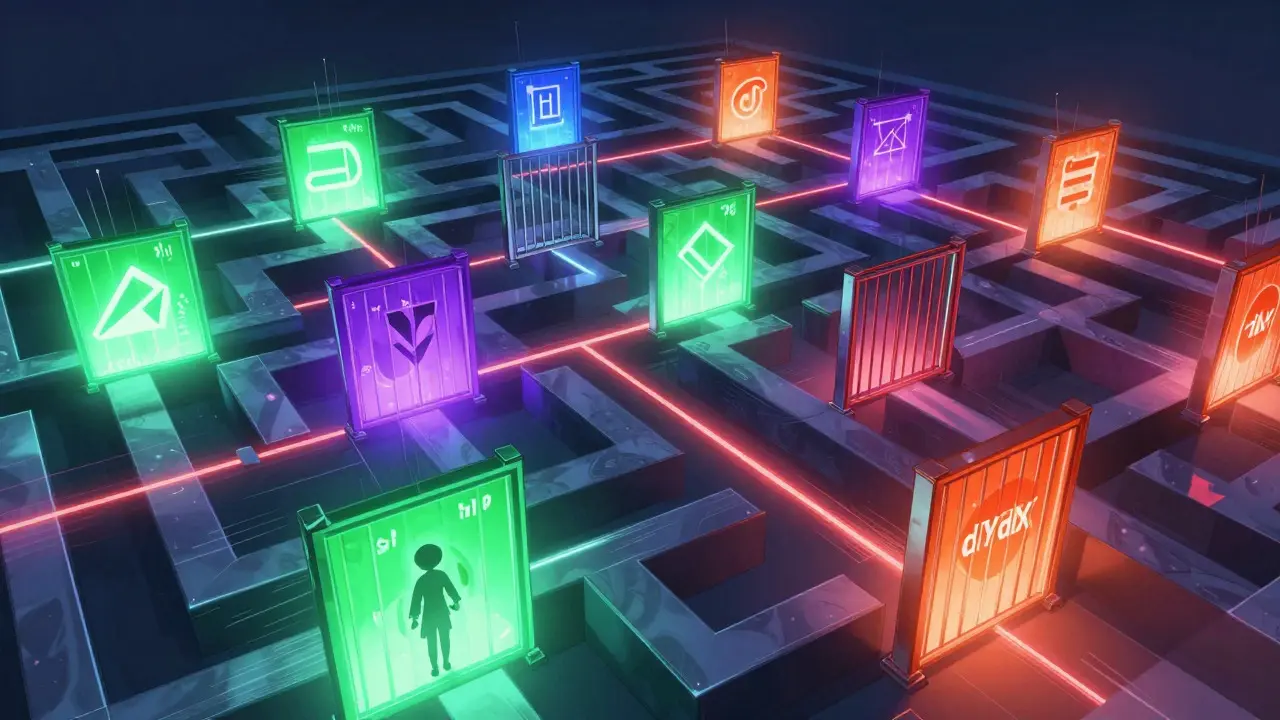
These restrictions aren't arbitrary; they stem from powerful legal frameworks. The primary driver is the U.S. Bank Secrecy Act and OFAC requirements. Even though dYdX has roots in Switzerland (via the dYdX Foundation in Zug) and corporate presence in New York (via dYdX Trading Inc.), it navigates a global regulatory landscape. To operate legally and maintain banking relationships, the platform must enforce these geographic blocks. This creates a paradox: the more compliant the platform becomes, the less "decentralized" it appears to purists. Yet, this compliance is what allows millions of users outside restricted zones to trade derivatives safely without fear of sudden shutdowns or asset freezes by regulators.
Comparison: dYdX vs. Other Derivatives Platforms
How does dYdX compare to its competitors in terms of accessibility? The table below highlights the differences in geographic reach and operational structure among major crypto derivatives exchanges.
| Platform | Architecture Type | Key Restricted Regions | Access Mechanism |
|---|---|---|---|
| dYdX | Hybrid (Centralized Frontend) | USA, UK, Canada, Sanctioned Zones | IP/Wallet Flagging + Close-Only Mode |
| Binance Futures | Centralized (CEX) | USA, Sanctioned Zones, Various EU Nations | Strict KYC + Geo-Blocking |
| Gymnasium (GMX) | Decentralized (DEX) | Varies by Jurisdiction (Arbitrum/Avalanche) | Smart Contract Access (Less Centralized Control) |
| Coinbase Advanced Trade | Centralized (CEX) | Limited Global Reach (Primarily USA/EU) | Full KYC + Regional Licensing |
Notice that GMX offers a more purely decentralized experience, meaning fewer geographic hurdles but potentially higher risk regarding regulatory clarity. In contrast, Binance uses heavy KYC (Know Your Customer) processes, making entry harder but providing a different layer of security. dYdX sits in the middle, offering a balance of on-chain transparency and off-chain compliance.

Practical Tips for Traders in Gray Zones
If you live in a country that isn't explicitly banned but feels "gray," here are some practical steps to ensure smooth trading:
- Check Your IP Address: Before connecting your wallet, verify your public IP using a tool like ipinfo.io. If you're using a VPN, ensure it routes through a permitted country, but note that some platforms detect VPN usage.
- Read the Latest Terms: The restricted list changes. Always review the "Eligibility" section in the dYdX Terms of Service before opening large positions.
- Monitor Account Status: Keep an eye out for red banners. If you enter close-only mode, act quickly to close positions if market conditions turn against you, as you won't be able to adjust your strategy with new orders.
- Use Non-Custodial Wallets: Since dYdX is non-custodial, your funds are always technically yours. If blocked, export your recovery phrase to move assets to a standard wallet like MetaMask or Ledger.
Frequently Asked Questions
Is dYdX really decentralized if it bans countries?
It is partially decentralized. The trading engine and order matching happen on-chain, but the user interface and compliance checks are controlled by centralized entities. This hybrid model allows for regulatory compliance while maintaining on-chain settlement.
Can I use a VPN to bypass dYdX restrictions?
Technically yes, but it carries risk. The platform monitors IP addresses and wallet activity. If detected, you may be placed in close-only mode. It is safer to confirm your jurisdiction is eligible before trading.
What happens if my account is blocked?
You will lose access to the frontend for trading and withdrawals. However, since it is non-custodial, you can still export your Secret Recovery Phrase and move your funds to another wallet directly from the blockchain.
Why is the United States restricted on dYdX?
The U.S. has complex regulations around perpetual futures, overseen by the CFTC and SEC. To avoid legal battles and ensure compliance, dYdX currently limits direct access for U.S. residents, although this may change as regulations evolve.
Does dYdX require KYC?
No, dYdX does not require traditional KYC (ID verification) for basic usage. Instead, it relies on geographic filtering and wallet monitoring. This makes it faster to start trading but places the burden of compliance on the user to know their local laws.