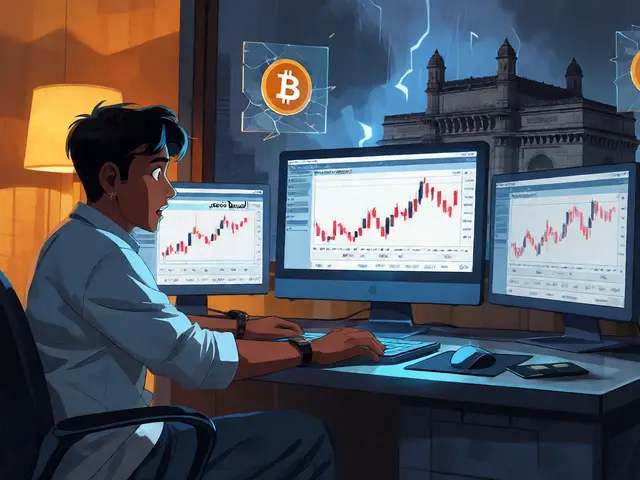

You just watched another centralized exchange collapse, freezing your funds while executives jet off to the Bahamas. Sound familiar? It’s a recurring nightmare in crypto that drives many traders toward Decentralized Exchanges, or DEXs. These platforms aren't just a trend; they represent a fundamental shift in how we own and trade digital assets. By removing the middleman, DEXs offer something traditional finance rarely does: true control.
But why should you care if you’re already comfortable with Binance or Coinbase? The answer lies in risk management and financial sovereignty. In the first five months of 2025 alone, DEXs handled 7.6% of all global crypto trading volume. That’s more than double what it was in 2023. This surge isn't accidental. It reflects a growing desire for security, privacy, and access to assets that haven’t yet made it to major centralized platforms. Let’s break down exactly what you gain by switching-or at least, why you should have a DEX account ready.
The Core Advantage: You Hold the Keys
The biggest selling point of any DEX is non-custodial trading. When you use a centralized exchange (CEX), you deposit your crypto into their wallet. They hold the private keys. If they get hacked, go bankrupt, or decide to freeze your account, your money is gone or stuck. On a DEX, you connect your personal wallet-like MetaMask or Best Wallet-and trade directly from it. Your funds never leave your possession until the moment the swap executes.
This setup eliminates the single point of failure that plagues CEXs. Remember the FTX disaster? Billions vanished because users didn’t actually own the tokens they thought they did. With a DEX, that scenario is technically impossible unless you lose your own seed phrase. Yes, this means higher responsibility. If you forget your password or click a phishing link, there’s no customer support agent to reset it for you. But for many, the peace of mind knowing no CEO can gamble away their savings is worth the extra caution.
Privacy Without Compromise
We live in an era where every transaction is tracked. Centralized exchanges require strict Know Your Customer (KYC) protocols. You upload your passport, take a selfie, and provide your home address before making your first trade. For some, this is fine. For others, especially those in jurisdictions with restrictive financial laws, it’s a barrier.
DEXs generally don’t ask for your name, address, or ID. You connect a wallet, approve a transaction, and trade. That’s it. This anonymity protects you from data breaches at the exchange level. If a CEX gets hacked, hackers often steal user databases containing sensitive personal info. On a DEX, there’s no central database of user identities to leak. Your activity is public on the blockchain, but it’s tied to a wallet address, not your legal identity.
This privacy-first approach also appeals to users who value financial freedom. You can trade during hours when local banks are closed, move assets across borders without intermediary delays, and avoid unnecessary surveillance. It aligns perfectly with the original ethos of cryptocurrency: peer-to-peer electronic cash without permission.
Access to Hidden Gems and Early Tokens
If you want to buy Bitcoin or Ethereum, any exchange will do. But what if you’re hunting for the next big altcoin? Centralized exchanges are slow to list new projects. They charge hefty listing fees and conduct lengthy due diligence. By the time a token appears on Binance, the initial explosive growth phase is often over.
DEXs are different. Any developer can launch a token and add liquidity to a pool immediately. Platforms like Uniswap or Raydium host thousands of assets that may never appear on a CEX. This gives you early access to emerging projects. You can spot trends before the mainstream crowd arrives. However, this comes with a caveat: lower liquidity and higher volatility. Some tokens might be rug pulls. Always check contract addresses and liquidity locks before diving in. Tools like DexScreener help you verify these details quickly.

Earn While You Sleep: Liquidity Provision
Trading isn’t the only way to make money on a DEX. You can become a market maker. Traditional stock markets have designated market makers who ensure there’s always someone willing to buy or sell. On DEXs, this role is open to everyone through Liquidity Pools.
Here’s how it works: You deposit two tokens into a smart contract pool (e.g., ETH and USDC). Other traders swap against this pool. Every time they trade, they pay a fee. A portion of that fee goes to you, the liquidity provider. Depending on the platform and pair, annual percentage yields (APYs) can range from 5% to over 100%. It’s passive income generated by providing utility to the network.
| Feature | Centralized Exchange (CEX) | Decentralized Exchange (DEX) |
|---|---|---|
| Custody | Exchange holds funds | User holds funds |
| KYC Required | Yes (ID verification) | No (Wallet connection) |
| Asset Variety | Limited (Curated lists) | Unlimited (Permissionless) |
| Security Risk | Hacks, insolvency | Smart contract bugs, user error |
| Transparency | Opaque reserves | On-chain auditability |
Of course, it’s not free money. You face "impermanent loss." If one token in your pair skyrockets while the other stays flat, you might have earned more by simply holding them separately. But for stable pairs or long-term holders, the fees can outweigh the losses. It’s a sophisticated strategy, but modern interfaces have made it accessible to beginners.
Global Accessibility and Transparency
Not everyone lives in a country with easy access to banking services. In parts of Southeast Asia, Africa, and Latin America, getting a bank account can be difficult. Even if you have one, cross-border transfers are slow and expensive. DEXs ignore borders. As long as you have an internet connection and a compatible wallet, you can trade.
This accessibility democratizes finance. You don’t need credit checks or minimum balance requirements. Furthermore, transparency is absolute. Every trade, every liquidity addition, and every fee payment is recorded on the blockchain. You can audit the entire history of a pool in seconds. Unlike CEXs, which publish quarterly proof-of-reserves reports (often after a crisis), DEXs offer real-time visibility into their health.

Overcoming the Learning Curve
Let’s be honest: DEXs can feel intimidating at first. Gas fees, slippage tolerance, and connecting wallets confuse newcomers. If you’ve ever sent funds to the wrong chain and lost them, you know the pain. But the landscape has changed. Modern wallets like Best Wallet integrate DEX aggregators, finding the best price across multiple platforms automatically. Interfaces are cleaner, and educational resources are abundant.
Start small. Try swapping a tiny amount of stablecoins to understand the flow. Learn how to adjust gas fees during network congestion. Understand what slippage means-if you set it too low, transactions fail; too high, and you lose money to front-runners. Within a few weeks, most users find the process intuitive. The community support is robust, too. Reddit threads and Discord servers often provide faster answers than official support tickets.
Key Takeaways
- Self-Custody: You retain control of your private keys, eliminating counterparty risk from exchange insolvency.
- Privacy: No KYC requirements mean greater anonymity and protection from data breaches.
- Early Access: Trade new tokens instantly upon launch, bypassing slow centralized listing processes.
- Passive Income: Earn trading fees by providing liquidity to pools, though beware of impermanent loss.
- Transparency: All transactions are verifiable on-chain, offering real-time auditability.
Are DEXs safer than centralized exchanges?
Generally, yes, regarding fund custody. Since you hold your own keys, you're immune to exchange hacks or insolvencies. However, you assume full responsibility for wallet security. Smart contract risks still exist, so using audited platforms is crucial.
Do I need to pass KYC to use a DEX?
Most DEXs do not require KYC. You simply connect a crypto wallet. Some hybrid models or fiat-on-ramps integrated into DEXs may request identification, but pure token swaps usually remain permissionless.
What are gas fees on a DEX?
Gas fees are payments to network validators (miners/stakers) to process your transaction on the blockchain. Costs vary by network congestion. Ethereum mainnet can be expensive, while Layer 2 solutions like Arbitrum or networks like Solana offer much lower fees.
Can I lose money on a DEX even if the price doesn't change?
Yes, primarily through slippage (executing a trade at a worse price than expected) or impermanent loss if you provide liquidity. Additionally, interacting with malicious smart contracts can lead to drained funds, so always verify contract addresses.
Which DEX is best for beginners?
For Ethereum users, Uniswap is the standard. For Solana, Jupiter or Raydium are popular. Aggregators like 1inch or built-in wallet features can simplify finding the best rates, reducing complexity for new users.