
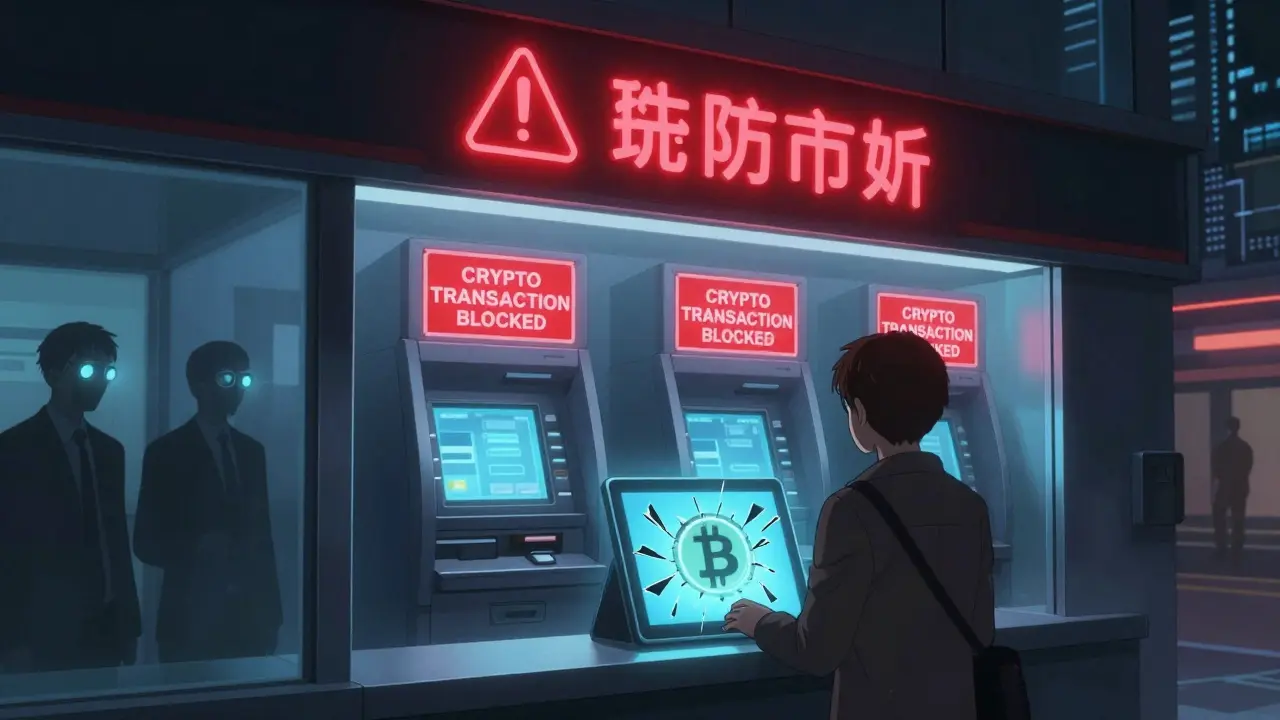
If you try to withdraw cryptocurrency to fiat money through a bank in China, you won’t get a simple ‘no’-you’ll get an account freeze, a government investigation, and possibly a long-term financial lockdown. It’s not just discouraged. It’s treated as a serious financial crime. Since September 2021, Chinese banks have been legally forbidden from handling any cryptocurrency-related transactions, including converting Bitcoin, Ethereum, or any stablecoin into yuan. And they’re not just following the rules-they’re actively hunting for anyone who tries.
It’s Not Just a Rule-It’s a Legal Crime
China doesn’t just ban crypto transactions. It classifies them as illegal financial activities. The People’s Bank of China (PBoC), along with nine other government agencies, issued Circular No. 237 in September 2021, making it clear: no bank, payment processor, or financial institution in mainland China can open accounts, process payments, or settle funds tied to cryptocurrency. This isn’t a gray area. It’s black and white. Even holding crypto isn’t illegal-but turning it into cash through a bank is.
Before this, China was a giant in crypto. In 2021, it handled 23% of global crypto trading and 65% of Bitcoin mining. Today, those numbers are nearly zero inside the country. But the demand didn’t disappear. Millions of Chinese citizens still own crypto. And many still want to cash out. That’s where banks step in-not as helpers, but as enforcers.
How Banks Detect Crypto Transactions
Chinese banks don’t wait for you to deposit Bitcoin. They monitor everything. Every transaction, every transfer, every withdrawal. Their systems are trained to spot patterns that scream ‘crypto.’
- Wallet address matching: Banks use a blacklist of over 14,273 known crypto wallet addresses. If your bank transfer goes to or from one of these, your account gets flagged.
- Speed and pattern: If you send five small transfers in 10 minutes, then withdraw the total amount as cash, that’s a red flag. It looks like you’re breaking up a large crypto cash-out into smaller pieces to avoid detection.
- IP and location tracking: 68% of flagged transactions are linked to IP addresses tied to crypto exchanges or mining pools-even if you’re using a VPN.
- Foreign currency movement: The State Administration of Foreign Exchange limits individuals to $50,000 in foreign currency transfers per year. If you suddenly send $45,000 to a Hong Kong account, that triggers a review.
These aren’t guesses. They’re algorithm-driven triggers. Banks use AI models trained on years of enforcement data. One bank in Guangdong froze 217 accounts in April 2025 after spotting identical patterns across dozens of users-all linked to offshore exchanges.
What Happens When You Get Caught
It’s not a warning. It’s not a fine. It’s immediate action.
- Account freeze: Your account is locked within hours. You can’t deposit, withdraw, or transfer money. Initial freeze lasts 72 hours. In 89% of cases, it’s extended beyond 30 days.
- Investigation: The bank reports the case to the China Anti-Money Laundering Monitoring and Analysis Center (CAMLMAC) and the local PBoC branch. They can demand your transaction history, phone records, and even travel logs.
- Asset seizure: In the first half of 2025 alone, Chinese authorities froze ¥2.1 billion ($290 million) tied to crypto transactions. That money doesn’t come back unless you prove it’s legal-which you can’t, if it came from crypto.
- Criminal risk: If you’re part of a network that moves crypto funds for others, you could face criminal charges. Senior bank officers who ignore these rules risk losing their licenses-or going to jail.
One man in Shenzhen tried to convert $12,000 in Bitcoin into yuan by wiring small amounts to five different bank accounts. All five were frozen. His identity was confirmed through facial recognition at a bank branch. He lost his savings. And he was banned from opening new accounts for five years.

Why Hong Kong Is the Escape Hatch-And Why It Doesn’t Help
Hong Kong has its own rules. Since August 2025, it allows licensed stablecoin operators. But here’s the catch: mainland Chinese banks are strictly forbidden from interacting with Hong Kong’s crypto market. Any transfer over HK$50,000 ($6,400) to a Hong Kong account now requires extra reporting. And if that money came from crypto? The bank will freeze it anyway.
Some people try to use Hong Kong as a bridge-buy crypto in Hong Kong, then move it to mainland accounts. That doesn’t work. Banks monitor cross-border flows. They know the patterns. And they’re trained to see them.
The Real Cost: More Than Just Money
Chinese banks aren’t just losing money on crypto-they’re spending millions to stop it. Since 2022, they’ve invested $350-400 million annually on crypto monitoring systems. That’s 15-20% of their compliance budgets. Frontline staff must complete 16 hours of crypto AML training every year. Compliance officers now specialize in blockchain forensics.
And yet, the problem grows. In July 2025, the PBoC reported that 12.7 million Chinese citizens still hold crypto-mostly on offshore exchanges. That’s nearly 1% of the population. And they’re still trying to cash out.
That’s why informal networks have exploded. FinCEN estimates that Chinese citizens moved $8.2 billion through underground money transfer networks in 2024, up from $5.7 billion in 2023. These networks use cash deposits, fake e-commerce transactions, and trusted couriers to move money. But even these are being tracked. If you deposit more than ¥200,000 ($27,500) in cash, the bank must report it. And if the timing matches your crypto sale? You’re in trouble.

What About the Digital Yuan?
China is building its own digital currency: the digital yuan (e-CNY). It’s not crypto. It’s not decentralized. It’s a state-controlled, fully traceable version of the yuan. The PBoC says it’s designed to replace cash, not crypto. And it’s working-over 300 million people now use it for daily payments.
But here’s the key: the digital yuan doesn’t let you convert crypto. It doesn’t interact with blockchain. It’s a separate system. And the government has made it clear: crypto and the digital yuan will never merge. In fact, the digital yuan’s rollout is part of why crypto bans won’t loosen until at least 2028. Once 30% of retail payments happen through e-CNY, officials say they’ll feel confident enough to reconsider-but don’t expect that soon.
Bottom Line: Don’t Try It
If you’re in China and you hold crypto, you’re not breaking the law by owning it. But if you try to turn it into cash through a bank, you’re inviting serious consequences. Account freeze. Investigation. Asset loss. Potential legal trouble. The system is designed to catch you. It’s not a question of if-it’s a question of when.
There’s no legal path. No loophole. No workaround that works long-term. The banks aren’t your friends here. They’re your gatekeepers. And they’ve been trained to lock the door.
Can I legally hold cryptocurrency in China?
Yes, you can legally hold cryptocurrency in China. The government doesn’t ban ownership. But you cannot convert it to fiat currency through banks, exchanges, or any financial institution. The ban applies only to transactions that turn crypto into yuan or foreign currency. Holding Bitcoin or Ethereum in a private wallet is not illegal-but trying to cash out is.
What happens if I use a friend’s bank account to withdraw crypto?
Using someone else’s account won’t help. Chinese banks track the source of funds, not just the account holder. If the money came from a crypto wallet, the transaction pattern will be flagged. The bank will freeze both accounts, investigate the link between you and your friend, and report the activity to authorities. You could both face financial penalties and legal scrutiny.
Can I withdraw crypto to fiat using a foreign bank account?
Technically, yes-if you’re outside China. But if you’re inside China and try to send money from a foreign bank back into your Chinese account, it’s risky. Banks monitor incoming transfers. If the source is linked to crypto, or if the amount exceeds annual foreign exchange limits ($50,000), the transfer will be flagged. The bank may freeze your account and require proof the funds are legal-which you can’t provide if they came from crypto.
Do Chinese banks cooperate with international regulators?
Yes, but selectively. China participates in global anti-money laundering efforts through the Financial Action Task Force (FATF). However, they don’t share data on crypto cases unless it involves cross-border criminal networks. If you’re using a foreign exchange, Chinese banks won’t help foreign authorities track you. But they will freeze your account if they detect crypto-related activity, regardless of where the exchange is based.
Is there any way to cash out crypto in China without getting caught?
There is no safe, legal, or reliable way to cash out crypto in China through formal channels. Some use informal networks-cash dealers, e-commerce scams, or peer-to-peer trades-but these carry high risks. You might lose your money, get scammed, or be reported to authorities. The government is actively dismantling these networks. In 2025, over 127 cross-border crypto networks were shut down. The odds of getting caught are high. The penalties are severe.
China’s crypto ban isn’t going away. It’s getting stronger. Banks aren’t just following orders-they’re building tools to catch you before you even try. If you’re thinking of converting crypto to cash in China, don’t. The system is watching. And it’s ready.










jonathan swift
March 6, 2026 AT 07:42 AMLMAO they think they can stop crypto?? 😂 China's gonna wake up one day and realize they just made the world's biggest black market. Bitcoin doesn't care about borders or bank accounts. They're fighting the internet with fax machines. 🤡🚀 #CryptoIsFreedom
Rachel Rowland
March 7, 2026 AT 07:25 AMI get why they're scared. Money is power and crypto takes that away from the state. But freezing accounts? That's not security-that's fear. People just want to use their own money. We need better solutions, not more prison bars. 💪
Bonnie Jenkins-Hodges
March 8, 2026 AT 00:55 AMThis is what happens when you let anarchists run wild. China did the RIGHT thing. Crypto is a scam. It's digital chaos. And if you're trying to cash out? You deserve to lose everything. 🇨🇳🔥
Jamie Hoyle
March 8, 2026 AT 21:28 PMOh wow so banks are using AI to hunt down people who own Bitcoin?? That's not a banking system-that's a surveillance state with a ledger. They're building the dystopia they claim to be protecting us from. And now they're training tellers in blockchain forensics?? Bro. 🤯
Jeffrey Dean
March 10, 2026 AT 04:08 AMThe real question isn't whether you can cash out. It's whether the state should have the right to define what 'value' means. If I mine a Bitcoin and it's worth $50k, why does the PBoC get to say it's worthless? This isn't about crime. It's about control. And control is the oldest form of tyranny.
Leah Dallaire
March 10, 2026 AT 05:59 AMThey think they're stopping crypto by freezing accounts. But they're just creating a black market so massive it'll make the Prohibition era look like a bake sale. The more they clamp down, the more people will find ways. It's not about legality-it's about inevitability.
prasanna tripathy
March 10, 2026 AT 22:47 PMI'm from India and we have similar issues. People here use crypto too. But the government just says 'don't use banks' and lets P2P thrive. China's approach is brutal. People aren't criminals for wanting to use their money. Just... different.
Bill Pommier
March 11, 2026 AT 01:51 AMThe systemic risk posed by decentralized finance to sovereign monetary policy cannot be understated. The People's Bank of China has enacted a necessary and proportionate measure in accordance with Article 12 of the Anti-Money Laundering Act of 2020. Any deviation from this framework constitutes a material breach of financial sovereignty.
Olivia Parsons
March 12, 2026 AT 14:06 PMWait so holding crypto is legal but cashing out isn't? That's like saying owning a gun is fine but buying bullets is illegal. How is that even enforceable? I'm confused.
Nick Greening
March 13, 2026 AT 22:49 PMThey banned crypto but made a digital yuan? That's like banning the internet but giving everyone a government-approved browser. The digital yuan is just crypto with a badge and a leash. They're not fighting crypto-they're replacing it with something worse.
Datta Yadav
March 14, 2026 AT 18:09 PMLet me break this down for you like you're five: China banned crypto because they're scared of losing control. They used to be the biggest miners and traders. Now they're the biggest enforcers. They built a wall around money because they can't control what's inside. The irony? Millions still have crypto. And they're still cashing out. Through cash couriers. Through fake Amazon orders. Through your cousin in Bangkok. The system is rigged, but the people are smarter. The banks are just paper tigers with AI eyes. They think they're winning. But they're just building the next revolution with their own hands.
Lydia Meier
March 15, 2026 AT 03:12 AMThe article is well-researched but lacks a counterpoint regarding the potential for illicit capital flight and its destabilizing effect on macroeconomic policy. The PBoC's actions are not punitive but preventive. There is no moral equivalence between individual financial autonomy and systemic financial integrity.