
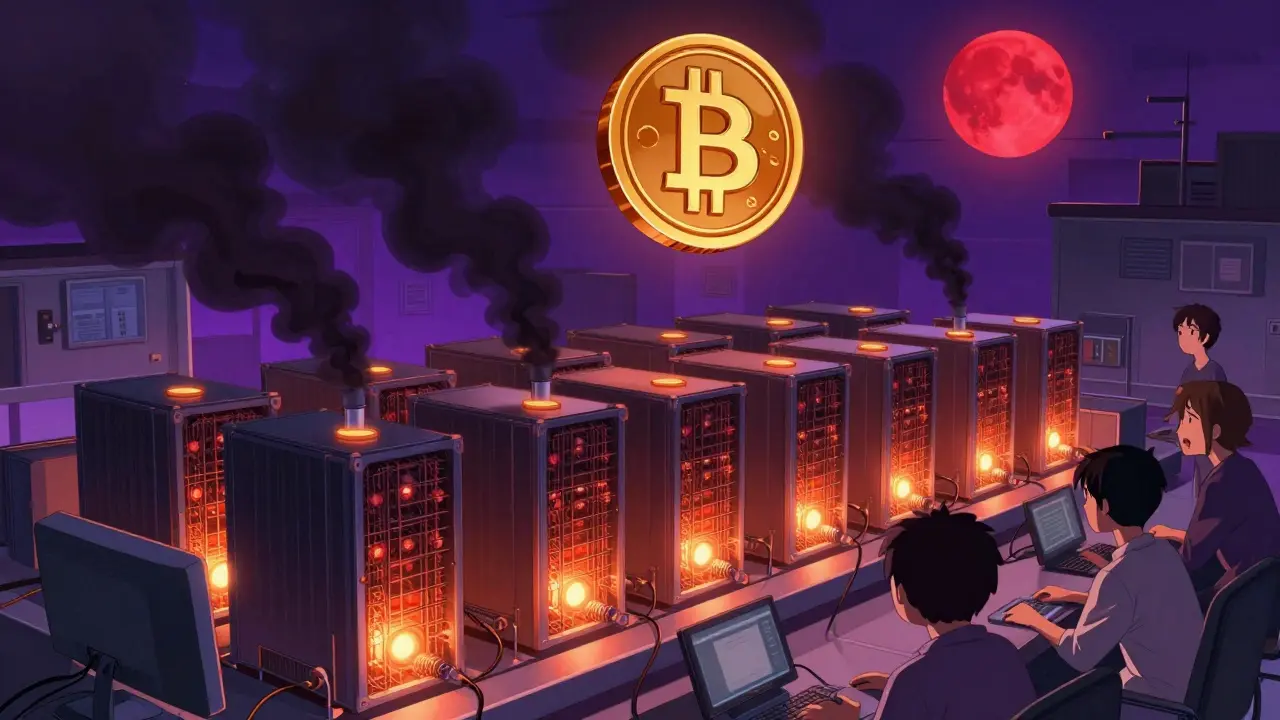
In the weeks after Bitcoin's April 2024 halving, over 20% of the global mining network shut down. This mass exodus wasn't random-it was a direct result of the economic squeeze known as miner capitulation. Every four years, Bitcoin's block reward cuts in half, and this time it left thousands of miners scrambling. Why does this happen? Who gets hit hardest? And how do the survivors keep going? Let's break it down.
Miner capitulation is when inefficient or underfunded mining operations shut down because they can't cover costs after Bitcoin's block reward is halved. This happens automatically as part of Bitcoin's design to control supply and maintain scarcity.
What is Bitcoin halving?
Bitcoin halving is a scheduled event where the reward for mining Bitcoin drops by 50%. It occurs roughly every four years, or after every 210,000 blocks. When Bitcoin launched in 2009, miners earned 50 BTC per block. After the first halving in 2012, it dropped to 25 BTC. The next halvings in 2016 and 2020 reduced it to 12.5 BTC and 6.25 BTC, respectively. The most recent one in April 2024 brought it down to 3.125 BTC per block.
This mechanism is built into Bitcoin's code to prevent inflation. With only 21 million Bitcoin ever to be created, halvings make new coins scarcer over time. As of 2026, about 94% of all Bitcoin has been mined, leaving just 1.35 million left to be discovered.
The economic crunch: why 50% less reward hurts so much
Miners earn money from two sources: the block reward (new Bitcoin) and transaction fees. But the block reward is the main income for most miners. When it halves, their revenue drops instantly-without any change to their costs. For example, a miner with 100 terahashes of power used to earn about $5.50 per day before the 2024 halving. Afterward? Just $2.75. That's a 50% revenue loss overnight.
Energy costs make up over 60% of a miner's expenses. If you're paying $0.08 per kilowatt-hour (kWh) for electricity-typical for retail rates-you're already in trouble. After the halving, you'd need Bitcoin's price to jump above $54,000 just to break even. Most miners can't wait that long.
Who gets hit hardest?
Not all miners are affected equally. Smaller operations with outdated hardware and high energy costs get crushed first. For instance, miners using older Antminer S19 models (which consume about 3,250 watts per terahash) struggle when electricity costs exceed $0.05 per kWh. Meanwhile, big companies like Bitdeer reported a 31% drop in Bitcoin production in May 2024 compared to April. But they still stayed operational because they had:
- Access to cheaper energy contracts (often below $0.04 per kWh)
- Latest-gen ASIC hardware (like Antminer S21 at 200 TH/s per 3,000W)
- Large cash reserves to weather the downturn
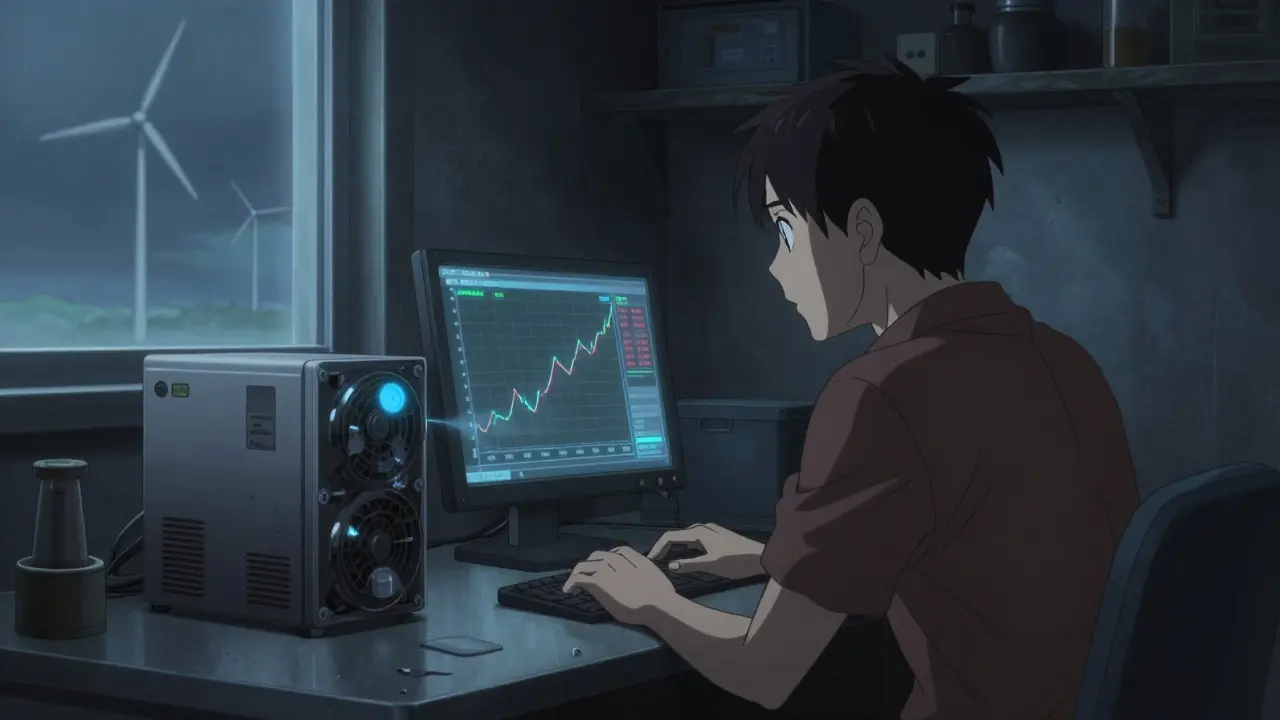
Independent miners or those using older machines (like S9s from 2016) often shut down immediately. Reddit mining forums in May 2024 were full of posts from individuals who couldn't cover their electricity bills. One user in Texas wrote: "I paid $0.09 per kWh. After the halving, I lost $100 a day. No choice but to turn off the machines."
Survival strategies for miners
Miners who want to survive need to focus on three things:
- Upgrade hardware: Newer ASICs like the Antminer S21 or WhatsMiner M56S++ are 25% more efficient. They produce more hash power for the same electricity cost.
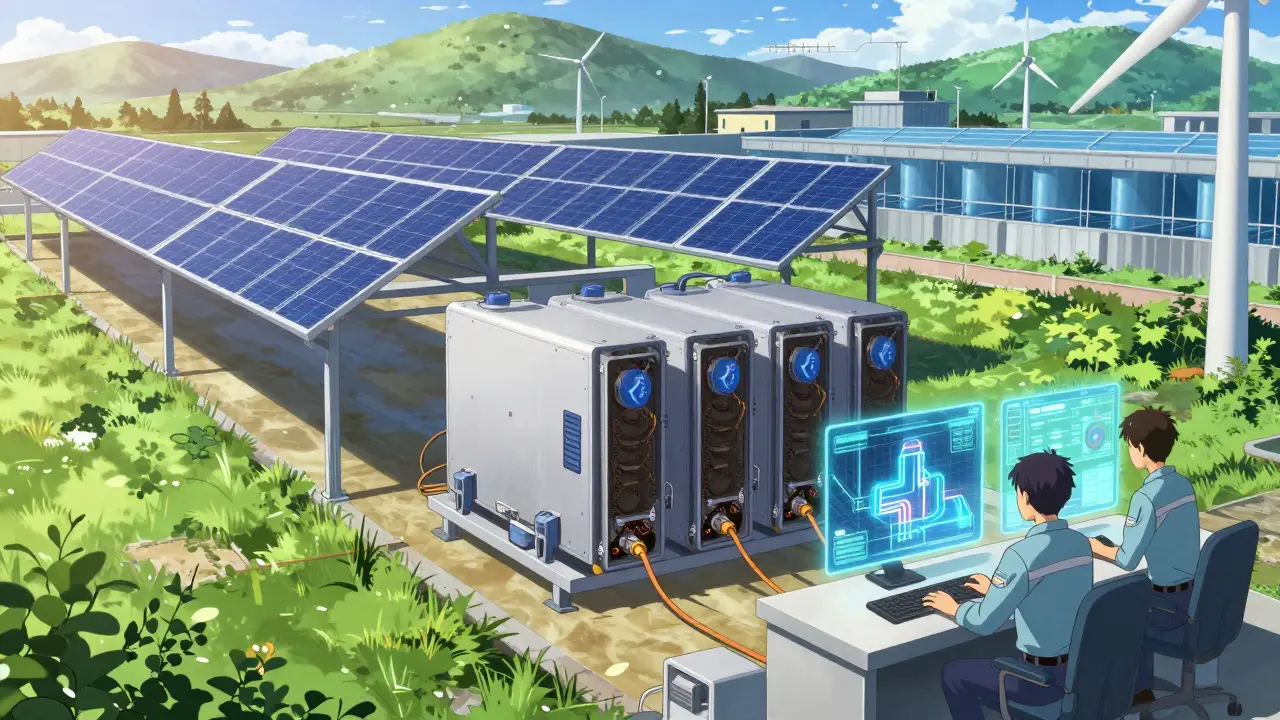
- Negotiate better energy deals: Top miners secure contracts with renewable energy providers. For example, some in Texas use wind farms at $0.03 per kWh. Others move to places like Quebec or Iceland where hydroelectric power is cheap.
- Build cash reserves: Successful miners keep 6-12 months of operating costs in reserve. This lets them ride out the slump while Bitcoin's price adjusts.
Some are even adding new revenue streams. Mining pools now optimize transaction fees by prioritizing high-fee transactions. Others participate in Bitcoin's layer-2 networks like the Lightning Network to earn extra fees.
Energy costs vs. profitability
| Energy Cost per kWh | Hardware Generation | Profitability Post-Halving |
|---|---|---|
| Below $0.04 | Latest ASIC (e.g., Antminer S21) | Highly profitable |
| $0.05-$0.08 | Older ASIC (e.g., Antminer S19) | Break-even or slight loss |
| Above $0.08 | Any outdated hardware | Unprofitable |
What happened after the 2024 halving?
The immediate aftermath of the April 2024 halving was brutal. Global hash rate dropped by 15% in the first month. By June, it had fallen another 5% as smaller miners shut down. However, Bitcoin's price didn't rise as quickly as some expected. It hovered around $60,000 for months-just enough to keep some miners afloat but not enough for everyone.
Big mining companies used this time to buy up distressed assets. Marathon Digital acquired a Texas mining facility at a 40% discount. Bitfarms bought energy contracts in Canada for $0.03 per kWh. Meanwhile, cloud mining services like Genesis Mining saw a 200% spike in new customers as small miners rented hash power instead of running their own rigs.
Here's the key takeaway: the market corrected itself. Miners who couldn't adapt left the network. The remaining ones became more efficient, and Bitcoin's security didn't weaken. In fact, the network's hash rate has since rebounded to new highs-thanks to better equipment and smarter energy use.
The future of mining post-halving
Analysts predict the next halving in 2028 will be even tougher. With only 1.35 million Bitcoin left to mine, competition will intensify. Only miners with access to electricity below $0.03 per kWh and cutting-edge hardware will survive long-term. This could lead to a more centralized mining landscape dominated by industrial-scale operations.
But Bitcoin's design includes a built-in safeguard: the difficulty adjustment. Every two weeks, the network checks how much hash rate has been lost and adjusts the difficulty downward. This makes mining easier for the remaining operators, helping the network rebalance. However, this process takes 3-6 months, which is why the post-halving period is so critical.
For investors, the key is to understand that miner capitulation isn't a threat-it's a feature. By forcing out inefficient players, Bitcoin's network becomes more secure and decentralized. As Fidelity Digital Assets noted: "Halvings are painful for miners, but they're essential for Bitcoin's long-term value proposition."
Frequently Asked Questions
What triggers miner capitulation?
Miner capitulation is triggered when the block reward is halved, reducing miners' revenue by 50% while their operational costs stay the same. If miners can't cover electricity and maintenance costs, they shut down operations. This usually happens within weeks or months after a halving event, especially for those with high energy costs or outdated hardware.
How long does it take for miners to shut down after halving?
The timeline varies. Smaller miners with high electricity costs often shut down within days or weeks. Larger operations with reserves can last 3-6 months. For example, after the April 2024 halving, the global hash rate dropped 20% in three months as inefficient miners left the network. The exact time depends on Bitcoin's price movement and how well miners prepared.
Can miners survive without upgrading hardware?
It's possible but difficult. Miners with very low energy costs (below $0.04 per kWh) might survive with older hardware, but they'll have slim profit margins. However, without upgrading to newer ASICs, they can't compete with more efficient operators. Most successful miners upgrade hardware within 6-12 months after a halving to maintain profitability.
What role does Bitcoin's price play in miner capitulation?
Bitcoin's price is critical. After a halving, miners need the price to rise quickly to offset the reduced block reward. For instance, with current hardware, miners need Bitcoin above $54,000 to break even. If the price stays flat or falls, even efficient miners face losses. Historically, Bitcoin prices have risen 6-12 months after halvings, but the timing is unpredictable.
Why do big mining companies handle halvings better?
Big companies have advantages like access to cheaper energy (often through long-term renewable contracts), latest-generation ASIC hardware, and large cash reserves. For example, Bitfarms secured hydroelectric power at $0.03 per kWh in Canada, while Marathon Digital has over $200 million in reserves. They also buy distressed assets from failing miners during downturns, making them stronger long-term.








Brendan Conway
February 6, 2026 AT 09:06 AMBitcoin halving is like nature's way of keeping things balanced. Miners who cant adapt get weeded out. Its not bad-it's how the system stays strong. Simple math, simple design. Makes sense to me.
Katie Haywood
February 7, 2026 AT 04:21 AMOh sure, 'nature's way of keeping things balanced'-sounds like a TED Talk. But reality is messier. Miners shutting down isn't 'balanced'-it's brutal for those who can't afford upgrades. Maybe 'survival of the fittest' is a nicer way to say 'the rich get richer'.
Matt Smith
February 7, 2026 AT 17:31 PMMiner capitulation? More like Bitcoin's 'survival of the fittest' is a joke. Only big corps win, and small miners get crushed. It's all rigged. 💀😂
Jesse Pasichnyk
February 7, 2026 AT 19:43 PMStop being a drama queen. The US has the best miners, we're adapting fast. Other countries? Not so much. We're winning this. 🇺🇸🔥
Kieren Hagan
February 9, 2026 AT 11:15 AMWhile the situation is challenging for smaller miners, the network's health is paramount. It's important to recognize that the current system ensures long-term security. Resources should focus on sustainable solutions rather than short-term grievances.
sachin bunny
February 11, 2026 AT 10:06 AMHalving is just the beginning. The real agenda? Central banks want control. Miners are being forced out to make way for centralized mining pools. The system is rigged. 🌍🔥
Olivette Petersen
February 13, 2026 AT 00:02 AMHey, let's stay positive! Yes, there are challenges, but Bitcoin's design is resilient. Every miner who adapts becomes stronger. We're all part of this journey. Keep going! 💪✨
Nathaniel Okubule
February 14, 2026 AT 00:36 AMEncouraging words, but practical steps matter. Miners need to focus on efficiency and cost management. Small steps lead to big changes. Keep pushing forward.
Shruti Sharma
February 14, 2026 AT 17:28 PMMiners are just tech bros who dont know what they're doing. 😂
Robin Ødis
February 16, 2026 AT 11:06 AMActually, it's not just 'tech bros'-it's a systemic issue.
The entire mining industry is built on a fragile foundation.
Without proper regulation and oversight, the network is vulnerable.
People need to wake up and realize this isn't just about Bitcoin-it's about global economic stability.
And no, the 'self-correcting' narrative is naive.
The system is rigged against small players, and it's only getting worse.
But hey, what do I know? 😏
Also, let's not forget about the environmental impact.
Mining consumes massive amounts of energy, and the push for greener solutions is often ignored.
Governments worldwide are starting to take notice, but the industry is resistant to change.
This isn't just about miners; it's about the future of our planet.
And let's not even get into the geopolitical implications.
The concentration of mining power in certain regions could lead to serious conflicts.
It's a complex web of issues that needs addressing.
The fact that so many people are ignoring this is troubling.
We need more transparency and accountability.
Otherwise, this whole thing could collapse.
And then what? 😅
Brittany Novak
February 17, 2026 AT 21:10 PMThe system is rigged. 🕵️♀️
Jacque Istok
February 18, 2026 AT 11:24 AMLet's get real. Miners shutting down isn't 'natural selection'-it's a market correction. If you can't handle the math, don't play the game. Simple as that. 💁♀️
David Bain
February 18, 2026 AT 15:29 PMWhile market correction is a valid perspective, the underlying economic incentives are more nuanced.
The halving mechanism serves as a deflationary pressure point, which, when coupled with network effects, creates a self-reinforcing cycle of value appreciation.
However, the assumption that 'simple math' suffices overlooks the complex interplay of externalities, including regulatory environments and technological adoption curves.