
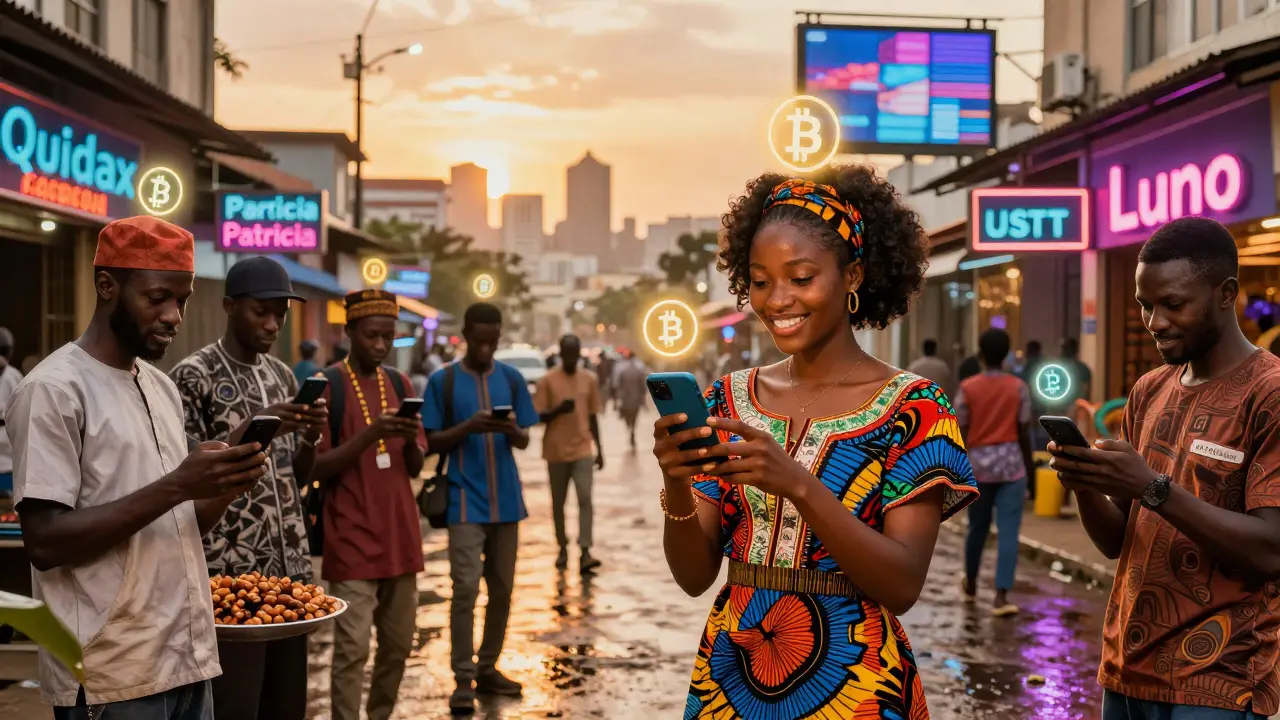
Nigeria isn't just using crypto-it's redefining how the world sees it
Most countries talk about cryptocurrency as a future possibility. Nigeria is living it. While governments elsewhere debate whether to ban or regulate digital money, Nigerians have already built an entire financial system around peer-to-peer (P2P) crypto trading. It’s not a trend. It’s survival. And it’s working.
In 2024, Nigeria processed over $59 billion in crypto transactions. That’s more than most developed economies. By 2025, an estimated 22 million Nigerians-roughly 10% of the population-were using crypto regularly. That’s higher than crypto adoption rates in Japan, Germany, or Canada. And none of it happened because of government support. It happened because the system failed them.
The banking system broke. People built their own
In 2017, the Central Bank of Nigeria told commercial banks: stop dealing with crypto companies. No accounts. No transfers. No exceptions. The goal? To stop what they saw as risky speculation. Instead, they pushed the entire market underground.
What followed was one of the most organic financial innovations in modern history. Nigerians didn’t stop using crypto-they just stopped using banks. They turned to P2P platforms like Quidax, a Nigerian cryptocurrency exchange that allows users to buy and sell Bitcoin and other digital assets directly with naira, Patricia, a local crypto platform offering naira-to-crypto trading with low fees and mobile-first design, and Luno, an international exchange adapted for Nigerian users with local payment options. Instead of waiting for bank approvals, people traded directly with each other. A buyer in Lagos pays a seller in Abuja via bank transfer. The seller sends Bitcoin. Done. No middlemen. No delays. No fees.
This isn’t just convenient. It’s life-changing. Before crypto, sending money to family abroad cost up to 8% in fees. With P2P crypto? Often under 2%. A nurse in London sending $500 home to her parents in Enugu used to lose $40. Now she loses $8. That’s $32 saved every month. Multiply that by millions of families, and you’re looking at billions in recovered income.
Crypto isn’t for speculation-it’s for saving
Many outsiders think Nigerians buy Bitcoin to get rich quick. They’re wrong. Most aren’t day traders. They’re savers.
Since 2016, the naira has lost more than 75% of its value against the US dollar. Inflation hit 24% in 2023. People’s salaries bought less every month. Banks offered interest rates of 1%-while prices rose 24%. That’s a guaranteed loss.
So they turned to crypto. Not because it’s flashy. Because it’s stable. Bitcoin and USDT (Tether) became digital savings accounts. A farmer in Kano buys $100 worth of USDT every payday. He doesn’t trade it. He holds it. When he needs to pay for school fees or medicine, he sells it for naira. He doesn’t make a profit. He avoids a loss.
According to Chainalysis, Nigeria leads the world in crypto usage for remittances and value preservation. Not speculation. Not gambling. Basic financial protection.

How it actually works: A day in the life of a Nigerian crypto user
Let’s say you’re a freelance graphic designer in Port Harcourt. You land a job with a client in Canada. They pay you $800 via PayPal. But PayPal doesn’t let you withdraw to a Nigerian bank account. Traditional wire transfers take days and cost $50.
Here’s what you do instead:
- You log into Quidax and verify your ID (takes 15 minutes).
- You create a Bitcoin wallet inside the app.
- You ask your client to send $800 in USDT (Tether) to your wallet address.
- Within 10 minutes, the USDT arrives.
- You sell the USDT on Quidax for naira.
- You withdraw the naira to your phone number via P2P transfer-no bank needed.
Total time: under 30 minutes. Total cost: less than $5.
This is the new normal. No one in Nigeria waits for banks anymore. They wait for crypto confirmations.
Regulation finally caught up-and it changed everything
For years, the government treated crypto like a problem. Then, in late 2023, they changed their mind.
The Central Bank of Nigeria lifted its ban on banks servicing crypto businesses. Why? Because they saw what was happening. They couldn’t stop it. So they tried to control it.
By 2025, Nigeria passed the Investments and Securities Act, a national law that officially recognizes cryptocurrency as a financial security and requires exchanges to register and comply with anti-money laundering rules. Suddenly, crypto wasn’t illegal-it was regulated. And that made a huge difference.
Now, licensed exchanges like Quidax and Patricia can partner with banks. The Nigeria Inter-Bank Settlement System (NIBSS) even integrated with Zone’s blockchain network, a decentralized ledger system designed to improve transparency and reduce fraud in interbank transactions. This isn’t the end of P2P trading-it’s its next phase. The grassroots movement is now being layered with institutional infrastructure.

It’s not perfect-but it’s working
There are risks. Scams still exist. Early adopters remember Bitconnect and MMM-Ponzi schemes that lost people millions. Some still fear crypto because of that.
Security is a concern. Not everyone knows how to protect their private keys. Wallet hacks happen. But the community has responded. Telegram groups, WhatsApp channels, and local meetups teach new users how to stay safe. YouTube tutorials in Pidgin English and Yoruba explain how to set up two-factor authentication. Schools in Lagos now run crypto literacy workshops.
Volatility is still a problem. But most users aren’t trying to time the market. They’re using crypto as a tool-not a gamble. They buy, hold, and sell based on need, not hope.
What this means for the rest of the world
Nigeria didn’t get here because of Wall Street. It got here because people had no other choice.
And that’s the lesson. When traditional systems fail, people innovate. Nigeria’s crypto ecosystem isn’t an anomaly-it’s a blueprint. Countries with high inflation, weak banking access, or restricted foreign exchange (like Argentina, Turkey, or Vietnam) are watching closely.
What Nigeria shows is that crypto adoption isn’t about technology. It’s about trust. When people lose trust in their currency and banks, they find alternatives. And when they do, they don’t just adopt-they rebuild.
The future of money isn’t in Zurich or New York. It’s in Lagos, Abuja, and Port Harcourt-where millions wake up every day and choose crypto because it works.
What’s next for Nigeria’s crypto scene?
The growth isn’t slowing. Fintech startups like Moniepoint, a Nigerian fintech company that enables small businesses to accept payments and has reached unicorn status with a $1 billion valuation are now integrating crypto into their platforms. Google invested in Moniepoint because they saw the future: digital money that bypasses broken systems.
Analysts predict Nigeria will become Africa’s largest crypto economy by transaction volume within two years. The real question isn’t whether crypto will grow here-it’s whether the rest of the world will finally pay attention.
Why is Nigeria #1 in P2P crypto adoption?
Nigeria leads because its traditional banking system failed people. High inflation, currency devaluation, and restricted access to foreign money pushed millions to find alternatives. P2P crypto offered a way to save, send money abroad, and earn income without relying on banks. The result? A grassroots crypto economy that now processes over $59 billion annually.
Is crypto legal in Nigeria?
Yes. While the Central Bank of Nigeria banned banks from dealing with crypto in 2017, that ban was lifted in late 2023. In 2025, Nigeria passed the Investments and Securities Act, officially recognizing cryptocurrency as a financial security. Licensed exchanges now operate legally, and banks can work with them again.
What cryptocurrencies do Nigerians use the most?
Bitcoin is the most popular for savings and remittances. But USDT (Tether) is the most traded because it’s pegged to the US dollar, making it stable. Other coins like Dash and Ripple are used too, but Bitcoin and USDT dominate because they’re reliable and widely accepted on P2P platforms.
How do Nigerians buy crypto without a bank account?
Many use P2P platforms that accept cash deposits, mobile money, or bank transfers. Sellers on platforms like Quidax or Patricia accept payments via ATM deposits, mobile wallets, or even direct cash handovers. Buyers then receive crypto instantly. No bank account needed-just a phone and a trusted seller.
Is crypto safe in Nigeria?
It’s as safe as you make it. Scams exist, especially targeting new users. But most people learn quickly through community groups, YouTube tutorials, and local workshops. Using reputable exchanges, enabling two-factor authentication, and keeping private keys offline are standard practices now. The community has become its own watchdog.
Can I use Nigerian crypto platforms from outside Nigeria?
Some platforms like Luno and Binance allow international users, but local exchanges like Quidax and Patricia are designed for Nigerian users. They support naira deposits, local ID verification, and P2P matching with Nigerian traders. If you’re outside Nigeria, you can still buy crypto from Nigerian sellers via global platforms-but you’ll need to find someone willing to trade with you.
What’s the biggest challenge for Nigerian crypto users?
Regulatory uncertainty remains. While rules have improved, sudden policy shifts are still possible. Also, internet access and electricity reliability can disrupt trading. But the biggest hurdle is education-many still don’t know how to secure their assets. Community-led training is helping, but it’s an ongoing effort.
How does Nigeria compare to other African countries in crypto adoption?
Nigeria is far ahead. Kenya and South Africa have strong crypto communities too, but Nigeria’s transaction volume, user base, and innovation scale are unmatched. It’s not just about numbers-it’s about how deeply crypto is woven into daily financial life. In Nigeria, crypto isn’t an option. For millions, it’s the only option.









Jack Petty
February 1, 2026 AT 17:03 PMThis isn't innovation. It's collapse with a blockchain overlay. They're not adopting crypto-they're fleeing a failed state. The CBN didn't ban crypto because it was risky. They banned it because they couldn't control it. Now they're trying to tax it. Welcome to the future, where your savings are encrypted and your government is just another middleman with a license.
Brianne Hurley
February 2, 2026 AT 21:55 PMI mean... wow. Like, I'm not even mad. I'm just impressed. Like, people in Lagos are using crypto like it's a grocery list. Meanwhile, my cousin in Brooklyn is still waiting for her bank to 'verify her identity' for 14 days. It's wild. And honestly? Kinda beautiful. Like, the people built this. No one gave it to them. They just... did it. 🤯
christal Rodriguez
February 4, 2026 AT 06:46 AMThe real story is the CBN’s panic. They didn’t lift the ban because they changed their mind. They lifted it because they lost.
Tressie Trezza
February 4, 2026 AT 16:32 PMIt’s kind of poetic, really. When institutions fail, people don’t wait for permission to survive. They just start building. No grand speeches. No press releases. Just people trading Bitcoin for naira on their phones, sending money home, keeping their savings from evaporating. It’s not about tech. It’s about dignity.
Mark Ganim
February 4, 2026 AT 23:16 PMI mean-think about it-this isn’t just adoption. This is REBIRTH. A nation, crushed under inflation, under bureaucracy, under corruption, under the weight of a currency that no longer means anything-SO THEY BUILT A NEW MONEY. WITH THEIR HANDS. WITH THEIR PHONES. WITH THEIR TRUST IN CODE, NOT CROWN. THIS ISN’T A TREND. THIS IS A REVOLUTION. AND WE’RE WATCHING IT LIVE.
mary irons
February 4, 2026 AT 23:47 PMThey say crypto is decentralized. But what if it’s just another way for the elite to profit off the desperation of the poor? Who owns the P2P platforms? Who sets the fees? Who gets the data? This looks like liberation, but I’ve seen this movie before. It always ends with someone else owning the keys.
Wayne mutunga
February 6, 2026 AT 08:30 AMI think what’s missing from most discussions is how quiet this revolution is. No rallies. No hashtags. Just a nurse in London sending $500 home and saving $32. A farmer in Kano holding USDT like it’s gold. No fanfare. Just survival. That’s the real power here-not the numbers, but the dignity in silence.
Gavin Francis
February 8, 2026 AT 05:33 AMThis is what happens when people are forced to be creative! 🙌 Nigeria didn’t wait for permission. They just DID IT. And now the world’s watching. If you’re still stuck in banking bureaucracy, take a note. The future isn’t coming-it’s already here. And it’s got a Nigerian SIM card.
Dylan Morrison
February 8, 2026 AT 08:36 AMI’ve been thinking about this a lot. In the U.S., we talk about financial freedom like it’s a product. In Nigeria, it’s a necessity. And that changes everything. Crypto isn’t a gamble there-it’s a lifeline. And honestly? That’s the most powerful kind of adoption there is. 💙
josh gander
February 10, 2026 AT 08:31 AMLet me tell you something-this isn’t just about money. It’s about agency. Imagine waking up every day knowing your paycheck isn’t going to vanish by Friday. Knowing you can send your mom medicine without paying 8% to Western Union. Knowing you don’t have to beg a bank for permission to exist. That’s not crypto. That’s freedom. And Nigeria? They didn’t ask for it. They took it. And now the whole world is trying to catch up. We’re not just watching history-we’re living in its shadow.
laurence watson
February 10, 2026 AT 15:31 PMI love how the community self-polices now. No one’s waiting for a regulator to fix scams. People are teaching each other in WhatsApp groups, in Pidgin, in Yoruba, on YouTube. It’s grassroots education at its finest. And honestly? That’s the real win here-not the transaction volume, but the fact that millions are learning to protect themselves. That’s resilience.
Pamela Mainama
February 11, 2026 AT 13:10 PMThis is what happens when necessity meets ingenuity. No hype. No ICOs. Just people surviving. Simple. Powerful.