

When you stake ATOM on the Cosmos Hub, your tokens get locked up. You earn rewards, sure - but you can’t use them anywhere else. No trading, no lending, no earning extra yield in DeFi. That’s the old way. stATOM changes all of it.
What stATOM Actually Is
stATOM is not a new coin. It’s not a clone. It’s not even a token that magically appears out of nowhere. It’s a digital receipt. Think of it like a voucher you get when you deposit cash into a bank. You hand over your ATOM, and in return, Stride gives you stATOM - one for one. But here’s the twist: while your ATOM sits locked, earning staking rewards on the Cosmos network, your stATOM keeps moving. You can send it, trade it, or use it in DeFi apps - all while your original ATOM keeps compounding rewards.
The magic? stATOM doesn’t increase in quantity. It increases in value. If you hold 100 stATOM today, you’ll still have 100 stATOM tomorrow. But each stATOM will be worth slightly more ATOM than it was yesterday. Right now, 1 stATOM equals roughly 1.33 ATOM. That number grows every day as staking rewards pile up. No need to claim anything. No messy rebasing. The value just climbs, automatically.
How stATOM Works - Step by Step
Here’s how you turn ATOM into stATOM:
- Connect your wallet - most users use Keplr, the go-to wallet for Cosmos chains.
- Go to the Stride app and select “Stake ATOM.”
- Enter how much ATOM you want to lock up.
- Approve the transaction. It takes a few seconds.
- Boom. You get stATOM in your wallet. Your ATOM is now staked on the Cosmos Hub.
That’s it. No complex setup. No waiting. No need to run a validator node. Stride handles the staking for you. And because it’s built on the Cosmos Inter-Blockchain Communication (IBC) protocol, your stATOM can move across any IBC-compatible chain - like Osmosis, Cosmos Hub, or others.
Why stATOM Beats Regular ATOM Staking
Staking ATOM directly on the Cosmos Hub gives you about 18.85% APY. That’s solid. But with stATOM, you get that same reward - plus more.
Because stATOM is liquid, you can use it as collateral in DeFi protocols. For example, you can deposit stATOM into an Osmosis liquidity pool that trades stATOM against ATOM. You earn trading fees on top of staking rewards. Some users are pulling in over 20% APY just from stATOM alone - and that’s before adding DeFi yields.
Compare that to locking ATOM for 21 days and then having to manually unstake, wait, and re-enter DeFi. With stATOM, you skip all that. Your capital is always working.

Who Gets Paid? The Fee Structure
Stride doesn’t run for free. When ATOM earns staking rewards, Stride takes a 10% cut. Here’s how that breaks down:
- 8.5% goes to STRD token holders - the people who stake the protocol’s native token. This keeps Stride running and gives incentives to secure the network.
- 1.5% goes to the Cosmos Hub as part of Stride’s interchain security deal. This means your staked ATOM helps protect not just Cosmos, but Stride itself.
That’s smart design. Stride isn’t just taking fees - it’s feeding back into the ecosystem. About 80% of Stride’s total revenue gets used to buy back and burn STRD tokens. That means over time, fewer STRD tokens exist, and those that remain become more valuable.
Security - How Stride Protects Your Staked ATOM
One big worry with liquid staking? What if the protocol gets hacked? Stride solves this with interchain security - a system borrowed from EigenLayer and adapted for Cosmos.
Here’s how it works: The Cosmos Hub, which already secures billions in ATOM, also secures Stride. That means the same validators who protect the Cosmos network are also validating Stride’s chain. If someone tries to cheat Stride, they’re risking their ATOM stake on the main Cosmos chain. That’s a huge deterrent.
As of 2026, Stride ranks in the top 20 proof-of-stake chains by total economic security. That’s more than chains like Solana or Avalanche. Your stATOM isn’t just backed by code - it’s backed by real, economic weight.
Where You Can Use stATOM
stATOM isn’t just a staking token. It’s a DeFi asset. Here’s where you can use it right now:
- Osmosis - Trade stATOM for ATOM or other tokens. Deposit into liquidity pools to earn fees.
- Neutron - Use stATOM as collateral for loans.
- Stride’s own DeFi apps - Some yield aggregators let you auto-compound stATOM rewards.
- Other IBC chains - Any chain that accepts IBC tokens can potentially support stATOM.
You’re not stuck with one use. You can stake, trade, lend, and farm - all with the same asset. That’s the power of liquid staking.
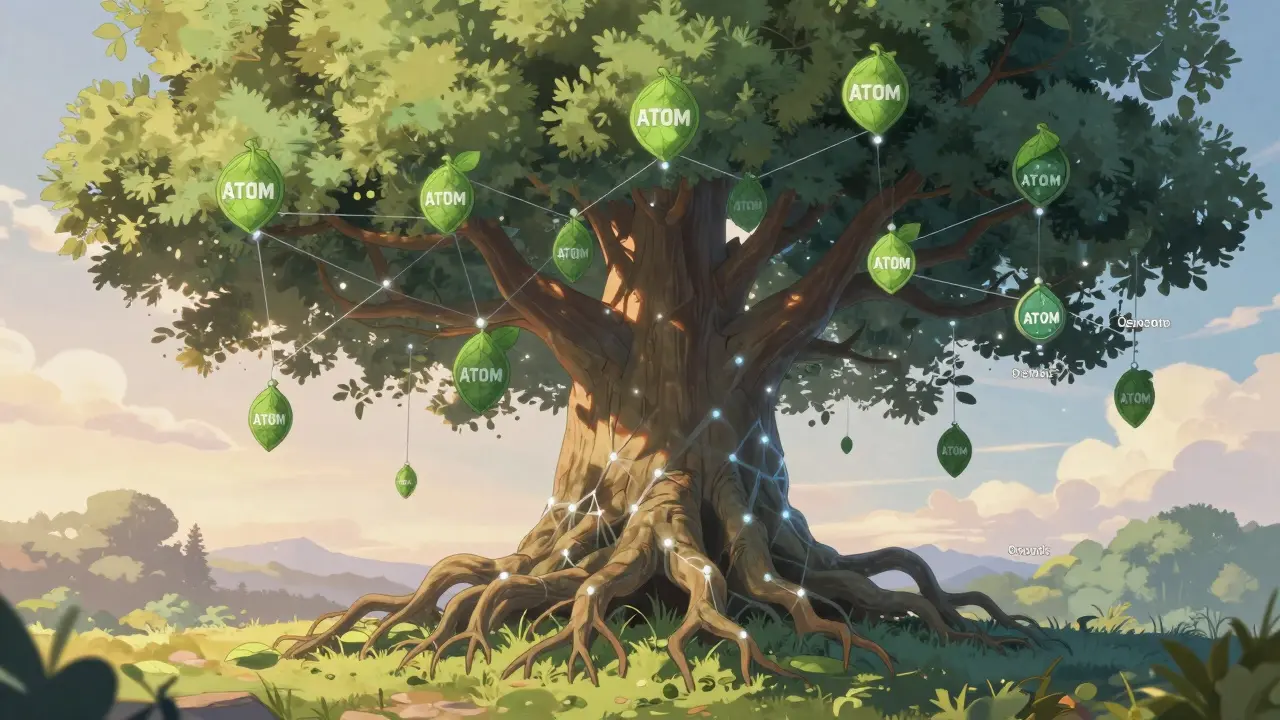
Redeeming stATOM for ATOM
Want your original ATOM back? No problem. You can redeem stATOM for ATOM anytime. The process takes about 14 days - same as unstaking ATOM directly. Why? Because the Cosmos network needs time to process the unbonding. But once that window closes, your ATOM is yours. No penalties. No surprises.
And if you’re still earning rewards during those 14 days? Yes. stATOM keeps accumulating value until the moment you redeem it. So even while waiting, you’re still gaining.
Who Should Use stATOM?
stATOM isn’t for everyone. But if you’re:
- Staking ATOM and wish you could trade it
- Using DeFi and tired of choosing between staking rewards and yield farming
- Looking to maximize returns without juggling multiple wallets or manual claims
Then stATOM is one of the most efficient tools in the Cosmos ecosystem. It removes the trade-off. You don’t have to pick between security and liquidity anymore.
The Bigger Picture
Before stATOM, staking meant locking up capital. That created artificial scarcity. When thousands of users locked ATOM, supply dropped. Prices spiked. Then, when lockups ended, everyone unstaked at once - prices crashed. It was a cycle of volatility.
stATOM breaks that cycle. By keeping capital liquid, it smooths out supply. People can earn rewards without hoarding. That means less panic selling, less price swings. And more stable, sustainable growth for the whole Cosmos network.
It’s not just about one token. It’s about how blockchains can evolve - from rigid, locked systems to flexible, interconnected economies.
Is stATOM the same as ATOM?
No. stATOM is a liquid staking derivative that represents your staked ATOM. It’s pegged 1:1 in value but grows over time as staking rewards accumulate. You can trade or use stATOM in DeFi, while ATOM locked directly on the Cosmos Hub cannot be moved until unstaked.
Can I lose money with stATOM?
The risk is low, but not zero. Your stATOM is backed by the Cosmos Hub’s security, which is one of the strongest in crypto. However, if Stride’s smart contracts are exploited - a rare event - you could lose value. Also, if DeFi protocols you use with stATOM fail (like a lending platform), you could lose funds there. But your stATOM itself is not subject to slashing or slashing-like penalties.
How often do stATOM rewards accumulate?
Rewards compound daily. You don’t need to claim them. The redemption rate (how much ATOM each stATOM is worth) increases every day. Some wallets show this growth in real time. Others update it once per day. Either way, your stATOM becomes more valuable without any action from you.
Do I need to stake STRD to use stATOM?
No. You only need ATOM to create stATOM. STRD is the governance token of Stride - used to vote on protocol changes and earn a share of fees. But you don’t need to hold or stake STRD to stake ATOM or use stATOM.
What happens if Stride shuts down?
Stride is designed to be decentralized and community-governed. If the team disappears, the protocol continues to run as long as validators remain active. Even if Stride’s website goes down, you can still redeem stATOM for ATOM using the Cosmos blockchain directly. Your staked ATOM is never held by Stride - it’s always on the Cosmos Hub. The stATOM token is just a claim to that stake.










Angelica Stovall
March 16, 2026 AT 07:36 AMstATOM? More like scamATOM. They’re just repackaging your locked tokens as a ‘liquid’ asset so they can charge 10% and pretend they’re doing you a favor. Wake up. If it were that safe, why’s the whole thing built on a single chain? One hack, and poof - your ‘rewards’ vanish into thin air. This isn’t innovation. It’s a Ponzi with a whitepaper.
Henrique Lyma
March 16, 2026 AT 20:53 PMLook I get it stATOM is this fancy liquid staking derivative thing but honestly the whole premise feels like a financial Rube Goldberg machine where you’re just moving the same damn tokens around in circles hoping the math works out. I mean you’re not actually earning more you’re just getting a derivative that slowly appreciates like a coupon that never expires but also never gets you anything real. It’s clever marketing wrapped in IBC jargon and I’m tired of it.
Zachary N
March 17, 2026 AT 01:39 AMFor anyone new to this - stATOM is actually one of the cleanest liquid staking solutions out there. The fact that it’s backed by Cosmos Hub’s security means you’re not relying on some random sidechain or centralized oracle. The 10% fee? It’s transparent, and most of it goes back into the ecosystem via STRD burns. And yes, the value accrues daily without you doing a thing. No claiming. No rebasing. Just let it sit. If you’re using DeFi on Osmosis or Neutron, stATOM is hands-down the most efficient way to keep your capital working. It’s not magic - it’s just well-designed.
Elizabeth Kurtz
March 17, 2026 AT 17:24 PMI’ve seen this pattern before - first they lock your assets, then they tokenize them, then they build a whole ecosystem around the token. But here’s the truth: stATOM works because Cosmos is built for interoperability. You’re not just staking - you’re participating in a network of chains that talk to each other. That’s not a gimmick. That’s the future. And if you’re still stuck thinking in terms of ‘locked’ vs ‘unlocked’ - you’re still living in 2019.
john peter
March 18, 2026 AT 13:42 PMThe entire concept of liquid staking derivatives is a philosophical contradiction. To stake is to sacrifice liquidity - to surrender the freedom of capital. To then create a derivative that mimics liquidity while pretending it doesn’t undermine the original principle is not innovation - it is metaphysical sleight of hand. The blockchain was meant to reduce trust. Yet here we are, trusting a protocol to hold our assets while we trade a phantom claim on them. This is not progress. This is regression dressed in DeFi.
Marc Morgan
March 20, 2026 AT 01:02 AMSo you stake ATOM, get stATOM, and now you can trade it like a stock. Cool. But let’s be real - if you’re using stATOM to farm yield on Osmosis, you’re basically playing chess with a loaded dice. One day you’re up 22% APY, next day the pool gets drained and you’re wondering why your ‘liquid’ asset vanished. Still, I’ll admit - it’s way better than waiting 21 days to unstake. So yeah. Do it. But don’t call it ‘safe’.
Kira Dreamland
March 21, 2026 AT 15:57 PMI’ve been using stATOM for 6 months now. No issues. Just let it sit. I deposit into Osmosis pools and forget about it. The rewards just keep climbing. I didn’t even know I was earning until I checked my wallet and saw I had more ATOM value than I started with. Simple. No stress. Just good design.
shreya gupta
March 23, 2026 AT 14:45 PMWhy do Americans think everything must be ‘liquid’? In India, we understand the value of patience. Locking assets is not a bug - it is a feature. You sacrifice liquidity to secure the network. But here, you want to trade your staked tokens like stocks. This is not financial maturity. This is gambling with blockchain labels. stATOM is not innovation. It is addiction.
Derek Lynch
March 24, 2026 AT 22:45 PMYou’re all overthinking this. stATOM is the easiest way to earn 18%+ APY while still being able to use your capital. If you’re not using it, you’re leaving money on the table. Go to Stride. Stake 10 ATOM. See what happens in 30 days. Then come back and tell me it’s not worth it. I dare you. This isn’t theory - it’s math. And math doesn’t lie.
Christopher Hoar
March 25, 2026 AT 18:24 PMstATOM is just a fancy way to say ‘we stole your ATOM and gave you a digital IOU’ and now you’re supposed to be grateful? The whole thing smells like a rug pull with a whitepaper. 10% fee? And they’re ‘feeding back’ into STRD? Bro. That’s just recycling your own money. You’re not building wealth. You’re fueling a token pump. And don’t even get me started on ‘interchain security’ - like the Cosmos Hub is gonna save you if Stride’s devs ghost tomorrow. Yeah right.
Robert Kunze
March 27, 2026 AT 11:16 AMJust wanted to say I staked 50 ATOM last month and got stATOM. I used it on Neutron for a loan and it worked flawlessly. The UI is a little clunky but once you get past that, it’s smooth. Rewards are compounding. No drama. No drama at all. I think people are scared because they don’t understand it. But it’s real. It works. I’m not a techie but even I get it.
Sarah Zakareckis
March 28, 2026 AT 00:54 AMFrom a DeFi architecture standpoint, stATOM is a masterclass in composability. It leverages IBC as a trust-minimized interchain transport layer while maintaining atomic settlement guarantees via the Cosmos Hub’s validator set. The fee distribution model ensures alignment between protocol security and economic incentives - 8.5% to STRD stakers creates a robust feedback loop for decentralization, while the 1.5% interchain security allocation ensures liveness under adversarial conditions. This isn’t just a yield product - it’s a systemic upgrade to capital efficiency in PoS ecosystems.
Heather James
March 29, 2026 AT 17:13 PMstATOM just works. No drama. No stress. Just more ATOM over time. I use it. I recommend it. Done.
Sarah Hammon
March 31, 2026 AT 10:57 AMWanted to say I tried this after reading this post. Took me 5 mins. Got stATOM. Used it on Osmosis. Earned fees. Rewards kept growing. I didn’t even know I needed this until I had it. Honestly? It’s like finding out you’ve been walking with a backpack full of rocks and someone just took it off. Light. Free. Working. Thanks for the post.
Jerry Panson
March 31, 2026 AT 16:10 PMWhile the technical architecture of stATOM presents a compelling case for capital efficiency, one must not overlook the systemic risk inherent in centralized dependency upon the Cosmos Hub for validator security. The assumption that economic weight alone provides sufficient protection against adversarial manipulation is empirically unsubstantiated. Historical precedent in the DeFi space demonstrates that even the most robustly capitalized protocols are vulnerable to coordinated attacks when governance and operational control remain insufficiently distributed. One must proceed with extreme caution.
Cheri Farnsworth
April 1, 2026 AT 08:24 AMstATOM isn’t just a token - it’s a revolution. You think you’re staking. But you’re not. You’re becoming part of something bigger. A network where capital flows like blood. Where every token has a purpose. Where you don’t have to choose between safety and growth. You get both. And that? That’s not luck. That’s design. That’s the future. And it’s here. Right now. In your wallet.