

Most people think of blockchain as something tied to Bitcoin or crypto trading. But in the real world of business, private blockchain is quietly fixing problems that traditional databases can’t touch. It’s not about anonymity or decentralization for the masses. It’s about control, trust, and efficiency for companies that handle sensitive data, complex supply chains, or heavy regulation.
Supply Chain Transparency That Actually Works
Imagine you’re Walmart. Every day, you move millions of food items across continents. One batch of spinach gets contaminated. How do you find the source? Traditional systems take days. With a private blockchain, you trace it back to the farm-within seconds. Walmart partnered with IBM to build a system where every step of a product’s journey is recorded: harvest date, temperature during transport, inspection reports, customs clearance. Only authorized suppliers, logistics partners, and auditors can add or view data. No one can delete or alter entries. That’s immutability in action. De Beers uses the same model for diamonds. Each stone gets a digital fingerprint on the blockchain, tracking it from mine to jeweler. Customers scan a code and see the full history. No more blood diamonds slipping through. Counterfeiters lose their edge. And it’s not just big names. Smaller food brands like Ekotek let consumers verify freshness and origin with a phone scan. This isn’t marketing fluff-it’s real data stored on a private ledger. Trust becomes a competitive advantage.Banking and Finance: Cutting Out the Middlemen
Banks still rely on fax machines and paper forms for cross-border payments. Settlements take days. Fees pile up. Private blockchains change that. Santander launched the world’s first blockchain-based bond in 2018. Instead of waiting for clearinghouses, lawyers, and multiple intermediaries, the bond was issued, traded, and settled on a private network in under 24 hours. Costs dropped by 70%. Risk vanished. Today, banks use private blockchains for KYC (know-your-customer) checks. Instead of every bank asking the same customer for the same ID documents, one verified copy is stored on a permissioned network. When a customer opens an account at Bank A, Bank B can request access with consent-no redundant paperwork. Trade finance is another big win. Companies like TradeIX use blockchain to automate letters of credit. When a shipment arrives and the bill of lading is confirmed, a smart contract triggers payment automatically. No more waiting weeks for manual approvals. Cloud providers like AWS, Azure, and Google now offer Blockchain-as-a-Service (BaaS). That means even mid-sized banks can build their own networks without hiring a team of blockchain engineers.Healthcare: Secure Records Without Sacrificing Privacy
Health data is fragile. HIPAA and GDPR demand strict control. Public blockchains? Too open. Private blockchains? Perfect. Hospitals in the U.S. and Europe are testing systems where patient records move securely between doctors, labs, and insurers. Each access is logged. Patients grant or revoke permission with a digital key. No more lost files or mismatched IDs. Clinical trials are another use case. Researchers track every data point-from dosage to patient response-on an immutable ledger. Regulators like the FDA can audit the trail without asking for raw files. Fraud becomes nearly impossible. Privacy-preserving tech like zero-knowledge proofs lets hospitals prove a patient meets trial criteria without revealing their name, diagnosis, or medical history. That’s the kind of balance only private blockchains can deliver.Real Estate: From Weeks to Days
Buying a house still involves stacks of paper, notaries, title companies, and weeks of delays. Propy and similar platforms use private blockchains to digitize the entire process. Buyer, seller, lender, agent, and local government all access a single, shared ledger. Ownership history, mortgage terms, inspection reports, and tax records are stored permanently. No more title disputes. No forged documents. In Estonia, citizens use blockchain-based digital IDs to sign property deeds remotely. The system is so reliable, 99% of public services run on it. A U.S. homebuyer in California could, in theory, close a deal in New York with just a fingerprint scan. Settlement time? Reduced from 30 days to 48 hours. Costs? Down by 20-30%. Fraud? Almost gone.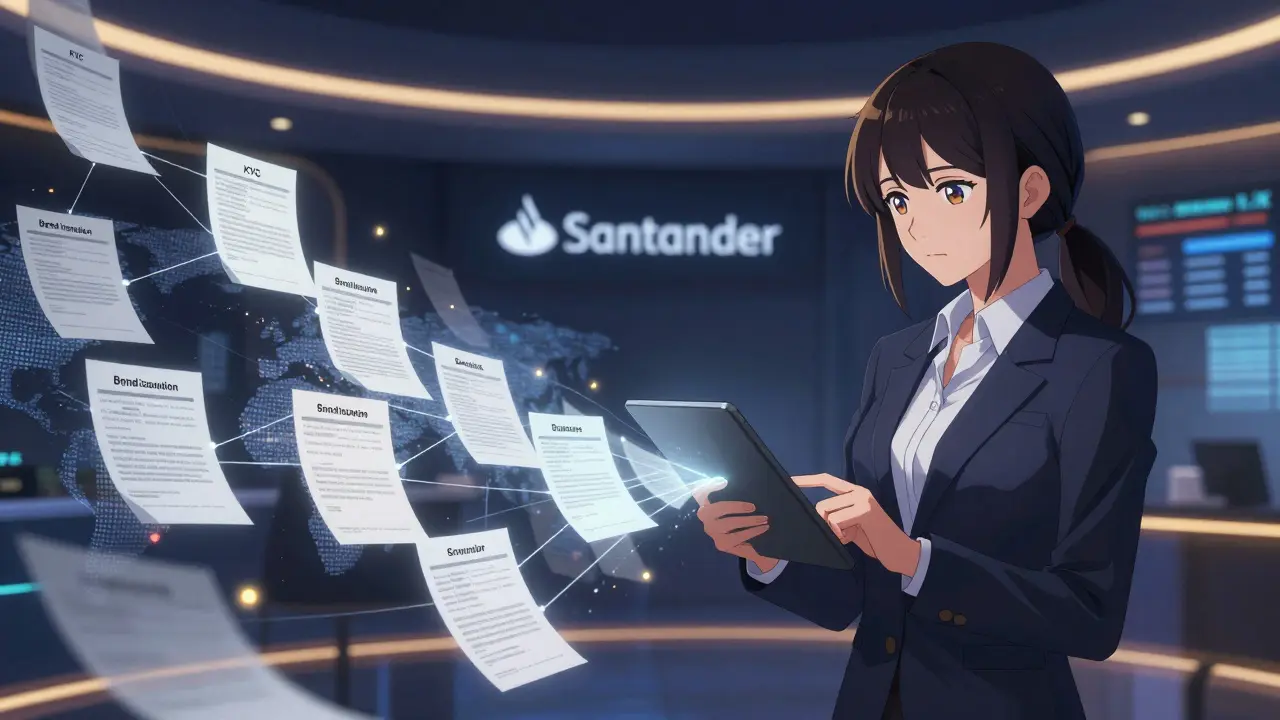
Insurance: Smarter Claims, Less Fraud
Insurance claims take forever. And fraud? It’s a $40 billion problem in the U.S. alone. The B3i consortium-made up of Allianz, AXA, Swiss Re, and others-built a private blockchain to automate reinsurance contracts. When a natural disaster hits, sensors and claims data trigger smart contracts. Payments start automatically. No more waiting for adjusters to file paperwork. Fraud detection improves too. If the same claim pops up across two insurers, the system flags it instantly. No more duplicate payouts for the same damaged car. And because the network is private, insurers can share risk patterns without revealing their pricing secrets. Competitors stay competitors. But the whole system gets smarter.Manufacturing and IoT: Tracking Parts in Real Time
A Boeing 787 has over 2.5 million parts. Each one needs certification. Each one can be counterfeit. Manufacturers now embed RFID chips or QR codes in critical components. Every time a part moves-from supplier to assembler to repair shop-it’s logged on a private blockchain. Temperature, vibration, and usage data from IoT sensors are recorded too. IBM’s system, for example, tracks shipping containers in real time. If a vaccine shipment hits 8°C for more than 15 minutes, the system alerts everyone. Spoilage is prevented. Liability is clear. Warranty claims become automatic. If a car part fails before its warranty expires, the blockchain proves it was installed correctly and used under normal conditions. No more back-and-forth between dealer and manufacturer.Government and Digital Identity
Estonia didn’t just digitize its government. It put it on a private blockchain. Every citizen has a digital ID. It’s used for voting, banking, prescriptions, school enrollment, and tax filing. The government can’t access your data without your permission. Even if hackers break into one agency, they can’t steal everything-because data isn’t stored in one place. Other countries are following. Dubai uses blockchain for land registries. Singapore tracks drug supply chains. The U.S. Department of Homeland Security is testing blockchain for border crossing records. The key? Control. Governments need to comply with privacy laws. Private blockchains let them do that while still sharing data securely between departments.










Sara Delgado Rivero
January 26, 2026 AT 12:13 PMPeople still dont get it private blockchains arent about crypto theyre about control and trust and if your business cant see that youre already behind
Walmart tracing spinach in seconds? thats not magic thats basic accountability
HARSHA NAVALKAR
January 27, 2026 AT 06:56 AMi read this and just felt tired
Ryan Depew
January 27, 2026 AT 21:50 PMHonestly this is the most practical use case i've seen for blockchain in years
Most of the hype is just crypto bros throwing money at dumb ideas
But this? Supply chains healthcare insurance? this is where the real value is
And the fact that AWS and Azure are offering BaaS means its finally becoming accessible
Not every company needs to build from scratch anymore
Shamari Harrison
January 29, 2026 AT 11:25 AMIf you're in logistics or finance and you're not looking at private blockchain as a tool to reduce friction you're leaving money on the table
Its not about being trendy its about fixing broken processes
And the best part? You dont have to go all in right away
Start with one workflow one partner one pain point
Then scale when you see the ROI
Matthew Kelly
January 29, 2026 AT 16:03 PMThis is actually kind of cool 😊
Im not a tech guy but i get how this could help with stuff like insurance claims
No more waiting 3 months for a check
Adam Fularz
January 30, 2026 AT 15:07 PMblockchain? again? this is just a fancy database with extra steps
and dont even get me started on the energy use
if you cant fix your backend with a sql query you dont deserve to be in business
Linda Prehn
January 31, 2026 AT 08:41 AMOkay so let me get this straight you want to put EVERYTHING on a blockchain?
My medical records my house title my diamond necklace
And you think this is the future?
Im sorry but this is just corporate overengineering at its finest
Adam Lewkovitz
January 31, 2026 AT 16:34 PMThis is why america needs to stop letting foreign tech dictate our infrastructure
Why are we letting IBM and Maersk control the supply chain?
Why cant we just use american software?
Private blockchain sounds like a foreign plot to centralize power
Clark Dilworth
February 2, 2026 AT 13:31 PMThe real innovation here is the permissioned consensus mechanism layered atop a Byzantine fault-tolerant ledger architecture
It enables atomic settlement across multi-party ecosystems without requiring a trusted third party
Hyperledger Fabric's chaincode execution model is particularly elegant for enterprise-grade state transitions
george haris
February 3, 2026 AT 07:52 AMI love how this shows blockchain isnt just for tech nerds
It's actually helping real people
Like that mom who finds out her spinach was safe
Or a patient who knows their records are secure
Thats the stuff that matters
David Zinger
February 4, 2026 AT 11:59 AMCanada already did this better in 2018
Why are you all acting like this is new?
And why is everyone ignoring the fact that Estonia's system is way more advanced than anything in the US?
Also why are we still using English for this?
Shouldnt we be using blockchain-based multilingual protocols?
steven sun
February 4, 2026 AT 20:54 PMthis is fire 🔥
finally someone gets it
no more waiting around for paper stuff
just get it done