

Imagine you have Bitcoin, but you want to use it in a DeFi app on Ethereum - like lending it to earn interest or trading it on a decentralized exchange. The problem? Bitcoin and Ethereum don’t talk to each other. That’s where wrapped tokens come in. They let you use your Bitcoin on Ethereum, your Ethereum on Solana, or your Binance Coin on Avalanche - all without selling anything. Think of them as digital IOUs that act like the real thing, but on a different blockchain.
How Wrapped Tokens Work
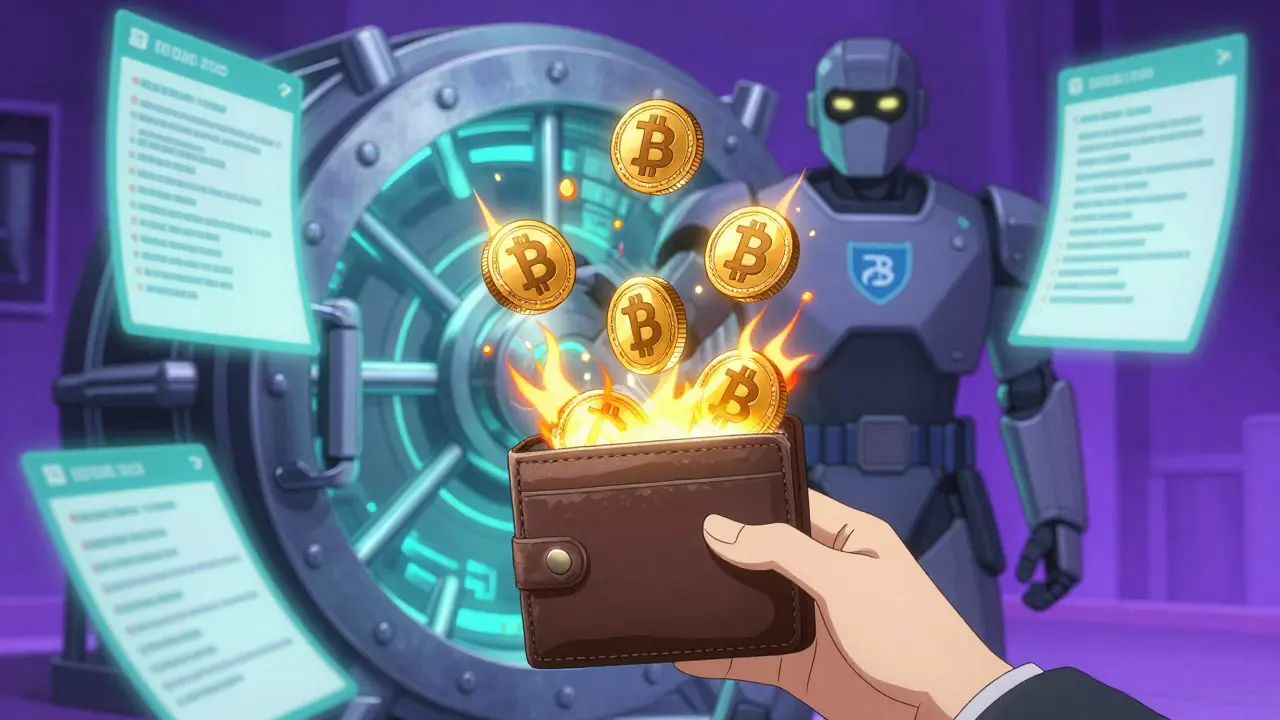
A wrapped token is a 1:1 representation of a cryptocurrency on a different blockchain. For example, Wrapped Bitcoin (WBTC) is an ERC-20 token on Ethereum that stands for one actual Bitcoin. When you wrap BTC, you’re not trading it - you’re locking it up and getting an equivalent amount of WBTC in return. To get your Bitcoin back, you burn the WBTC, and the original BTC is released.
This process is handled by smart contracts and custodians. The custodian (like BitGo for WBTC) holds your Bitcoin in a secure digital vault. Once they confirm the deposit, they mint the wrapped version on the target chain. If you want to unwrap, you send the WBTC back, the smart contract burns it, and your Bitcoin is released. It’s like depositing cash at a bank and getting a receipt - except the receipt can be used to buy things online.
For this to work, the wrapped token must follow the technical rules of the blockchain it’s on. WBTC uses the ERC-20 standard, so it works with MetaMask, Uniswap, Aave, and every other Ethereum-based app. That’s why it’s so useful - it turns Bitcoin into something that can plug directly into the DeFi world.
Why Wrapped Tokens Exist
Blockchains are like islands. Each one has its own rules, currency, and apps. Ethereum has DeFi. Bitcoin has security and trust. But if you want to earn yield on Bitcoin, you can’t do it natively - Bitcoin’s network doesn’t support smart contracts. Wrapped tokens solve that.
Before wrapped tokens, people had to sell their Bitcoin to buy Ethereum tokens. That meant paying taxes, losing liquidity, and missing out on price moves. Now, you can keep your Bitcoin and still earn 3-5% APY in DeFi. As of October 2023, WBTC alone locked over $10 billion in value - making it one of the top 20 cryptocurrencies by market cap. Without wrapped tokens, most of that DeFi activity wouldn’t exist.
Key Wrapped Tokens You Should Know
- WBTC (Wrapped Bitcoin) - The original and still the biggest. Backed 1:1 by Bitcoin. Used in Aave, Compound, and Curve.
- renBTC - Created by Ren Protocol. Uses a decentralized network of nodes instead of a single custodian. Smaller market share but more trust-minimized.
- tBTC - Built on Bitcoin’s sidechain. Uses threshold cryptography to reduce reliance on centralized custodians. Less liquid than WBTC.
- WETH (Wrapped Ether) - Not a cross-chain token, but worth mentioning. It’s Ethereum converted into an ERC-20 token so it can be used in smart contracts that only accept tokens (not ETH).
- USDC (Wrapped on other chains) - Circle wraps USDC on Solana, Polygon, and more. This lets you use stablecoins across networks without switching platforms.
WBTC dominates with over 80% of the market. But alternatives like renBTC and tBTC are growing because they reduce centralization risks. The trade-off? Less liquidity. If you want to trade $100,000 in one go, WBTC is your only real option.
Pros and Cons of Wrapped Tokens
Pros:
- Unlock DeFi on non-Ethereum assets - You can earn yield on Bitcoin, Litecoin, or Dogecoin.
- High liquidity - WBTC trades on dozens of exchanges and protocols with deep order books.
- Easy to use - Just connect your wallet, click ‘Wrap,’ and go. No need to understand complex bridges.
- Standardized - ERC-20 wrapped tokens work with every Ethereum tool out there.
Cons:
- Custodial risk - Someone holds your real Bitcoin. If they get hacked or go rogue, you lose it. WBTC uses a multi-sig wallet (needs 3-5 signatures), but it’s still not fully decentralized.
- Transaction delays - Wrapping can take 15-60 minutes. During high congestion, it might take longer.
- Fees - You pay around 0.1-0.3% to wrap or unwrap. That’s not much, but it adds up if you’re trading often.
- Smart contract bugs - In 2022, a bug in RenBridge stranded $96 million in wrapped tokens for 72 hours.
Compare this to bridge protocols like Wormhole or Multichain. They let you move assets directly between chains - but they’ve been hacked for hundreds of millions. Wrapped tokens are safer, but not perfect.
Real-World Use Cases
Most people use wrapped tokens for three things:
- Earning yield - Deposit WBTC into Aave or Compound to earn 3-5% interest. You’re not selling Bitcoin - you’re using it as collateral.
- Trading on DEXs - Swap WBTC for ETH, USDC, or other tokens on Uniswap without leaving Ethereum.
- Arbitrage - If Bitcoin’s yield is higher on one chain than another, users move wrapped tokens to capture the difference. One trader made $3,200 in 48 hours by exploiting a 1.2% APY gap between Aave and Compound.
Institutional players are using them too. Fidelity’s Bitcoin Fund now uses WBTC for Ethereum-based settlements. Circle wraps $4.2 billion in USDC across 8 blockchains. This isn’t just for retail users - it’s infrastructure for big finance.

How to Wrap a Token (Step-by-Step)
If you want to try it yourself, here’s how to wrap Bitcoin into WBTC:
- Get a non-custodial wallet like MetaMask and set it up on Ethereum.
- Buy or transfer Bitcoin to a wallet that supports wrapping (like Coinbase or BitGo’s portal).
- Go to the official WBTC website or a trusted DEX like Uniswap.
- Connect your wallet, select ‘Wrap BTC,’ and enter how much you want to wrap.
- Confirm the transaction. You’ll pay gas fees (0.005-0.02 ETH) and a small wrapping fee (~0.25%).
- Wait 15-30 minutes. Your WBTC will appear in your wallet.
To unwrap, reverse the process: burn WBTC, wait, and your Bitcoin returns.
Common mistakes? Choosing the wrong token (like wrapping ETH instead of BTC), setting slippage too low (8% of transactions fail this way), or not checking reserve proofs. Always verify the custodian’s audit reports - WBTC’s are public on their site.
The Future of Wrapped Tokens
Wrapped tokens are not the endgame. They’re a bridge - and bridges get replaced.
Projects like Chainlink’s CCIP and Ethereum’s upcoming Cancun-Deneb upgrade aim to make cross-chain transfers trustless. By 2025, we’ll likely see fewer wrapped tokens as native interoperability improves. Vitalik Buterin called them a ‘necessary evil’ - meaning they’re needed now, but not forever.
Still, for the next 3-5 years, wrapped tokens will dominate. Why? Because they work. They’re simple. They’re liquid. And until every blockchain can talk to every other one without middlemen, they’ll keep growing.
By 2028, experts predict wrapped tokens will handle just 15% of cross-chain value - down from 35% today. But right now? They’re the backbone of DeFi. Without them, Bitcoin would be stuck. Ethereum would have less liquidity. And users? They’d be locked out of earning yield on their favorite coins.
Are wrapped tokens the same as stablecoins?
No. Stablecoins like USDC or DAI are pegged to a fiat currency (usually the US dollar). Wrapped tokens are pegged to another cryptocurrency - like WBTC (1:1 Bitcoin) or WETH (1:1 Ether). Both are tokenized assets, but stablecoins maintain value against a dollar, while wrapped tokens maintain value against a crypto asset.
Can I lose my wrapped tokens?
You can’t lose them if you control your private keys. But if the custodian (like BitGo) is hacked or fails to release your underlying asset, you could lose access. That’s why it’s critical to use well-audited protocols. WBTC has undergone over 20 reserve audits since 2019 - all public. Avoid obscure wrapped tokens with no transparency.
Do I pay taxes when I wrap or unwrap a token?
In most jurisdictions, wrapping or unwrapping is treated as a taxable event - it’s seen as selling your original asset and buying a new one. For example, converting BTC to WBTC may trigger capital gains tax on any price increase since you bought the Bitcoin. Always consult a tax professional familiar with crypto in your country.
Is WBTC safe to use?
WBTC is one of the safest wrapped tokens. It’s backed by a consortium including BitGo, Kyber, and Ren, with multi-signature custody (3-5 signatures needed to move funds). All reserves are audited monthly and publicly posted. Over 1.2 million wrapping transactions have occurred since 2019 with minimal failures. Still, no system is 100% risk-free - always verify the audit status before using any wrapped asset.
Why not just use Bitcoin L2s instead of wrapped tokens?
Bitcoin Layer 2s like the Lightning Network let you transact Bitcoin faster and cheaper - but they don’t support smart contracts. You can’t lend BTC on Lightning or use it as collateral in DeFi. Wrapped tokens solve this by bringing Bitcoin into ecosystems that do support smart contracts - like Ethereum. So while L2s improve Bitcoin’s own network, wrapped tokens let Bitcoin interact with other blockchains.







Dana Sikand
March 1, 2026 AT 10:09 AMI just wrapped my first BTC into WBTC last week and honestly? Life changed. Used to sit on Bitcoin like a rock while everyone else was earning 4% on Aave. Now I’m making passive income without selling. The 0.25% fee? Worth it. My wallet’s been humming along like a little DeFi engine. No regrets.
George Suggs
March 2, 2026 AT 09:15 AMWrapped tokens are just digital IOUs. We’re trusting strangers with our crypto. That’s not innovation. That’s duct tape on a leaking boat.
Tracy Whetsel
March 3, 2026 AT 23:22 PMI love how this explains everything so clearly 🙌 I’ve been scared to touch WBTC because of custodians but now I get it - the audits are public, the structure is solid. It’s not perfect but it’s the best we’ve got right now. Thank you for breaking it down like this.
Phillip Marson
March 4, 2026 AT 15:52 PMPeople act like wrapped tokens are some revolutionary breakthrough but it’s just a glorified escrow. We’re still playing banker with BitGo’s multi-sig. The real win is that we’re finally accepting that Bitcoin can’t do everything. We’re not upgrading the chain - we’re just slapping on a band-aid and calling it progress. 🤷♂️
Elizabeth Smith
March 5, 2026 AT 15:24 PMWhy do we keep letting centralized entities hold our coins? This isn’t crypto. This is Wall Street with a blockchain logo. We’re supposed to be building a new world not recreating banks with more gas fees. If you’re using WBTC you’re already complicit in the system we claimed to overthrow.
Jan Czuchaj
March 6, 2026 AT 02:18 AMThere’s a philosophical tension here. On one hand, wrapped tokens unlock liquidity and utility - they’re bridges. On the other, they represent a surrender to interoperability through centralization. We’re trading decentralization for convenience. But is that really a trade? Or just a delay? Maybe the real innovation isn’t the token - it’s our willingness to accept temporary compromises while waiting for true cross-chain protocols. The future doesn’t need wrapped tokens. But the present does.
Samantha Stultz
March 6, 2026 AT 09:29 AMLet’s get technical. WBTC’s multisig architecture is built on a 3-of-5 threshold with BitGo, Kyber, and Ren as signers - but the custodian still holds the private keys. That’s not trustless. That’s trust-minimized. And yes, the reserve proofs are on-chain and audited monthly, but the audit firms themselves are centralized entities like Armanino and BDO. You think the blockchain is solving trust? It’s just moving the trust layer up one abstraction. The real security is in the audit trail - not the smart contract.
precious Ncube
March 7, 2026 AT 23:12 PMIf you’re using WBTC you’re not a crypto believer. You’re a yield farmer with a credit card. Stop pretending you’re building the future. You’re just trying to make 4% on Bitcoin while ignoring that the whole system is a house of cards held together by liquidity and optimism.
Alyssa Herndon
March 8, 2026 AT 08:41 AMI’m still learning but I feel like I finally get it. I used to think wrapped tokens were sketchy. Now I see they’re like a translator between two languages. Not perfect. Not ideal. But necessary. I’m glad there are options like renBTC too. Not everything has to be WBTC.
Danny Kim
March 8, 2026 AT 22:10 PMSo you’re telling me the entire DeFi ecosystem is built on a giant IOU system that depends on a handful of companies not getting hacked? And we call this innovation? I mean… I guess it works. But wow. What a fragile house of cards.
Dee Resin
March 10, 2026 AT 02:53 AMI wrapped my BTC last month. Got 0.1 ETH in gas. Waited 22 minutes. Got WBTC. Used it in Uniswap. Made a trade. Unwrapped. Got BTC back. All fine. But now I’m just waiting for the day when the custodian says ‘oops’ and we all lose everything. Then we’ll all be like ‘we knew this was risky’.
Richard Cooper
March 11, 2026 AT 23:17 PMI just use WBTC. It works. Don’t overthink it.
Tanvi Atal
March 13, 2026 AT 12:27 PMWhy bother? Just sell BTC, buy ETH, earn yield. Less steps. Less risk. Less drama.
Patrick Streeb
March 15, 2026 AT 03:40 AMThe operational integrity of wrapped token systems is predicated upon the fidelity of custodial mechanisms and the transparency of reserve attestations. While the utility is undeniable, one must acknowledge the latent counterparty risk inherent in centralized custody arrangements. A more robust solution may emerge through trust-minimized bridges, yet for the present epoch, the current paradigm remains functionally indispensable.
Cathy Sunshine
March 15, 2026 AT 15:13 PMYou all act like WBTC is some sacred artifact. It’s just a token. A glorified receipt. And you’re all acting like it’s the second coming. Meanwhile, real DeFi is happening on Solana, on Polygon, on Arbitrum. WBTC? It’s a relic. A bridge to a past that’s already fading. You’re clinging to a 2021 solution while the world moved on.
Kenneth Genodiala
March 16, 2026 AT 04:59 AMThe fact that we still need wrapped tokens proves Ethereum’s dominance is artificial. If Bitcoin had smart contracts, none of this would exist. But we didn’t build that. We built this. And now we’re stuck with it.
Tracy Whetsel
March 17, 2026 AT 03:41 AMI’m so glad someone finally said it - we’re not supposed to be trusting custodians. But until CCIP is live, this is the best we’ve got. And honestly? WBTC’s audit history is better than most banks. I’ll take 20 public audits over a ‘decentralized’ bridge that got hacked for $400M. 🙏