

Every four years, something quiet but powerful happens in the world of Bitcoin. It doesn’t make headlines like a celebrity tweet or a government ban. No one crashes a server. No CEO announces a new product. But it changes everything - Bitcoin halving.
Here’s the simple truth: Bitcoin was designed to run out. Not in a crash, not in a scam, but by design. Every 210,000 blocks - roughly every four years - the reward for mining Bitcoin is cut in half. That’s the halving. It’s not a suggestion. It’s code. And it’s been running without fail since 2009.
What Exactly Happens During a Halving?
When Bitcoin launched in 2009, miners got 50 BTC for every block they validated. That sounds like a lot. And it was. But it wasn’t meant to last. The first halving came in 2012. The reward dropped to 25 BTC. Then in 2016, it fell to 12.5 BTC. In 2020, it dropped again to 6.25 BTC. And on April 19, 2024, it halved once more - to 3.125 BTC per block.
Before the 2024 halving, about 900 new Bitcoins entered circulation every day. After? Just 450. That’s a 50% drop in new supply. And this isn’t just a one-time event. It keeps happening. The next one? Around 2028. Then 2032. And so on, until the final Bitcoin is mined - expected around the year 2140.
This isn’t just a technical detail. It’s a monetary rule. Unlike dollars or euros, which central banks can print endlessly, Bitcoin’s supply is fixed. Halving enforces scarcity. It’s the opposite of inflation. It’s programmed disinflation.
Why Does This Affect the Price?
Think of it like a limited edition sneaker. If the factory suddenly cuts production in half, but demand stays the same - or grows - prices rise. That’s basic economics. Bitcoin follows the same logic.
Before each halving, trading volume spikes. Retail investors rush in. Institutional money starts positioning. Miners scramble to upgrade hardware. Exchanges list new trading pairs. The whole market buzzes with anticipation.
Historically, Bitcoin’s price has surged 6 to 18 months after each halving. After the 2012 halving, Bitcoin went from $12 to over $1,100 in 18 months. In 2016, it rose from $600 to nearly $20,000 in 16 months. In 2020, it went from $9,000 to $69,000 in about 14 months.
But here’s the catch: the halving doesn’t cause the price rise. It sets the stage. The real driver is demand. If more people want Bitcoin after the halving - because of macro trends, adoption, or fear of inflation - then prices climb. If demand stalls? The price might not move much. That’s why some experts say: “It’s not the halving that moves the market. It’s the money that flows in afterward.”
The Ripple Effect on Altcoins
Bitcoin doesn’t move alone. When Bitcoin shifts, the rest of crypto follows - often with even bigger swings.
After the 2020 halving, Bitcoin’s breakout triggered a massive altcoin season. Ethereum, Solana, Cardano, and dozens of others saw 10x, 20x, even 100x gains. Why? Because Bitcoin’s rise pulled liquidity into the whole ecosystem. Traders used Bitcoin profits to buy altcoins. New investors saw Bitcoin’s success and jumped into the broader market.
But this isn’t guaranteed. In 2022, after Bitcoin’s 2020 rally, the market crashed hard. Altcoins lost over 90% of their value. The halving didn’t prevent the crash - it just set up the conditions for the next cycle. So while halvings often kickstart bull markets, they don’t protect you from bear markets.
What Happens to Miners?
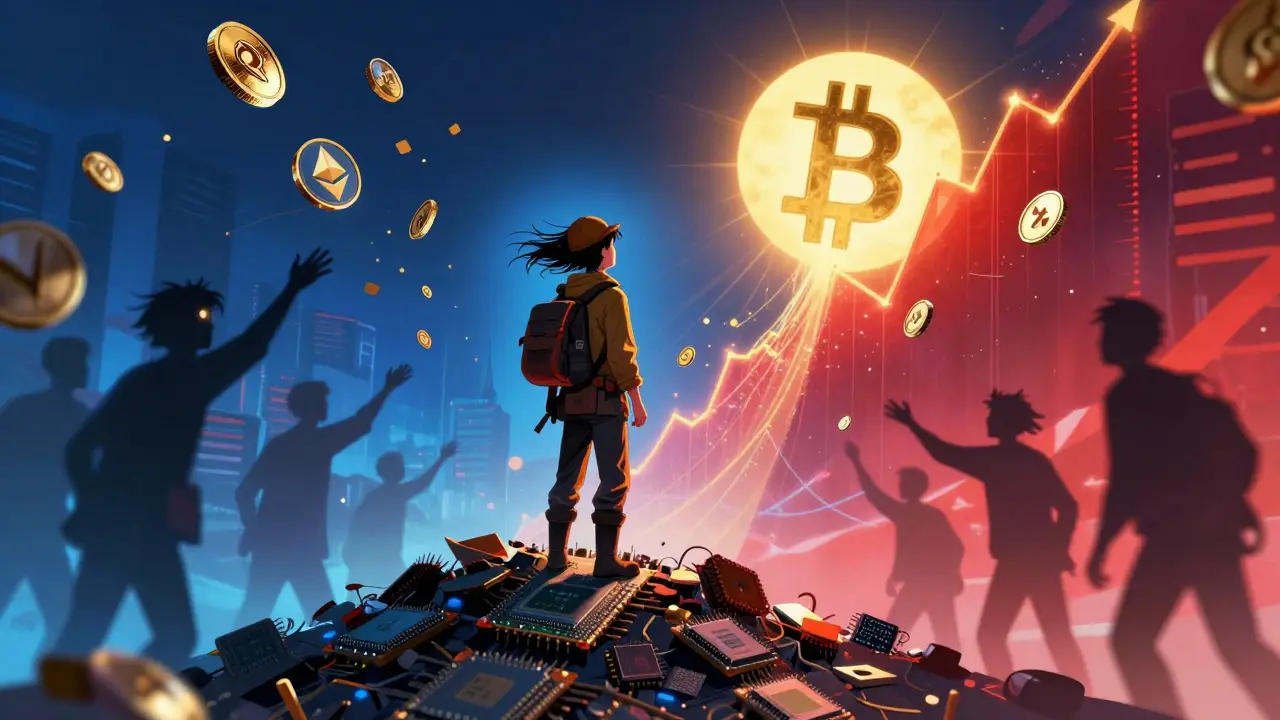
Miners are the backbone of Bitcoin. They use powerful computers to verify transactions and earn rewards. But when the reward halves, their income drops too.
After the 2024 halving, miners saw their daily earnings cut in half. For those running old or inefficient hardware, it became unprofitable. Many shut down. Some moved to regions with cheaper electricity - like Texas, Kazakhstan, or parts of Canada. Others upgraded to newer ASIC chips that use less power.
There’s a real risk here: if too many miners leave, Bitcoin’s network could become less secure. A 51% attack - where one entity controls most of the mining power - becomes more possible. But so far, that hasn’t happened. Why? Because Bitcoin’s price rose after the halving, making mining profitable again. The market self-corrects.
It’s a delicate balance. The halving forces efficiency. Only the strongest miners survive. And that’s actually good for Bitcoin’s long-term health.
How Do Traders Use This?
Professional traders don’t just wait for the halving. They build strategies around it.
- Positioning early: Many start buying 12-18 months before the halving, betting on the historical pattern.
- Volatility management: The weeks around the halving are wild. Prices swing hard. Traders use options, futures, and stop-losses to protect themselves.
- Order flow analysis: Tools like Bookmap help traders see where big orders are piling up. If you see large buy walls forming before the halving, it’s a signal.
- Altcoin rotation: Some traders hold Bitcoin leading up to the halving, then shift into altcoins during the bull phase.
But here’s the truth most beginners miss: you don’t need to time the halving perfectly to profit. The cycle lasts years. If you bought Bitcoin in 2021 - just before the halving - you still made money, even if you held through the 2022 crash. The halving isn’t a magic button. It’s a long-term trend.
What About the Broader Economy?
Bitcoin doesn’t exist in a vacuum. The 2024 halving happened during a global shift in monetary policy. Interest rates were high. Inflation was still a concern. Central banks were tightening. And people started asking: “If governments can print money, why not hold something that can’t be printed?”
That’s why the halving matters beyond crypto. It’s a real-world test of sound money. While the U.S. dollar’s supply grew by over 40% from 2020 to 2024, Bitcoin’s new supply dropped by half. That contrast isn’t theoretical. It’s why institutions like MicroStrategy and Fidelity started buying Bitcoin as a hedge.
The halving turns Bitcoin into a natural inflation hedge. Not because it’s perfect. But because it’s predictable. You know exactly how much will be issued. No surprises. No secret meetings. Just math.
Is the Pattern Real? Or Just Coincidence?
Some skeptics say: “You only have three data points. That’s not enough.” And they’re right. Three halvings isn’t a large sample size. But here’s what’s interesting: every single one followed the same pattern.
1. Price dips in the year before the halving - as early buyers take profits.
2. Price stabilizes around the halving date - hype peaks, then settles.
3. Price surges 6-18 months later - as demand catches up to reduced supply.
4. Market peaks 18-24 months after halving - then enters a long correction.
That’s not luck. It’s a rhythm. And it’s been consistent for 15 years. Even during the 2022 bear market, when everything crashed, Bitcoin still outperformed most assets. The halving didn’t stop the crash - but it set the stage for the next recovery.
What Comes Next?
The next halving is expected in 2028. By then, the block reward will drop to 1.5625 BTC. The supply reduction will be smaller in absolute terms - only 225 new BTC per day instead of 450. But the psychological impact? It’ll be just as strong.
By 2032, it’ll halve again - to 0.78125 BTC. The numbers get tiny. But the principle doesn’t change. Scarcity builds. Demand grows. The cycle continues.
What’s clear is this: Bitcoin’s halving isn’t just a technical quirk. It’s a financial revolution written in code. It’s a challenge to the old system - where money can be created out of thin air. Bitcoin says: no. There’s a limit. And that limit is what makes it valuable.
If you’re looking at Bitcoin as a long-term store of value - not a quick trade - then the halving isn’t something to watch. It’s something to build around. The next cycle is already ticking. You don’t need to predict it. You just need to be ready for it.
What exactly is a Bitcoin halving?
A Bitcoin halving is a pre-programmed event that cuts the reward miners receive for validating blocks in half. It happens every 210,000 blocks, roughly every four years. This reduces the rate at which new Bitcoin enters circulation, reinforcing scarcity. The most recent halving occurred in April 2024, reducing the block reward from 6.25 BTC to 3.125 BTC.
Why does the halving cause Bitcoin’s price to rise?
The halving doesn’t directly raise the price - it creates the conditions. By cutting new supply in half, it makes Bitcoin scarcer. If demand stays the same or grows, prices tend to rise. Historically, this has happened 6-18 months after each halving, as more people buy Bitcoin and competition for limited new coins increases.
Do altcoins also go up after a Bitcoin halving?
Often, yes. When Bitcoin rallies, it pulls liquidity into the broader crypto market. Traders use Bitcoin profits to buy altcoins, and new investors enter the space. After the 2020 halving, many altcoins surged 10x-100x. But this isn’t guaranteed - altcoins can still crash if the overall market turns bearish.
What happens to miners after a halving?
Miners earn half as much Bitcoin per block after a halving. Many with older or inefficient hardware shut down because they can’t cover electricity costs. The network becomes less crowded, but Bitcoin’s price usually rises soon after, making mining profitable again. Only the most efficient miners survive - which actually strengthens the network over time.
Is the halving pattern guaranteed to repeat?
There’s no guarantee, but it’s repeated three times with the same pattern: price dips before, stabilizes at halving, then surges 6-18 months later. While only three data points exist, the consistency suggests it’s not random. What matters most is demand - if people keep buying Bitcoin, the halving will continue to act as a catalyst for price growth.









Robin Ødis
February 9, 2026 AT 03:12 AMLook, I get that people love this halving myth, but let’s be real - it’s not magic. It’s math. And math doesn’t care about your feelings. The price went up after the last three because the market was primed - low interest rates, pandemic cash, FOMO. Not because 50% less BTC was being mined. If you think scarcity alone drives value, you’ve never studied gold. Gold’s supply doesn’t halve, and it’s been stagnant for a decade. Bitcoin’s rise isn’t about code. It’s about fiat collapse anxiety. Stop romanticizing a protocol. It’s just digital gold with a cult following.
Brittany Novak
February 9, 2026 AT 14:21 PMThey’re lying to you. The halving is a distraction. The real story? The Fed’s printing. The government’s pushing people into Bitcoin because they’re running out of options. They want you to think this is organic, but it’s not. The mining rigs? Mostly owned by hedge funds and state actors. The ‘scarcity’? Manufactured. And the price surge? Pumped. You think miners are just some guys in a basement? Nah. It’s all orchestrated. The halving is just the cover story. The real agenda? Replacing the dollar with a blockchain-controlled currency. You’re being played.
Joshua Herder
February 9, 2026 AT 17:19 PMOkay, so let me get this straight - you’re telling me that cutting a number in half somehow causes a 10x price increase? That’s not economics. That’s astrology. I mean, if you really believe this, you’d also think that if I stop eating pizza for a week, my rent will drop. The halving is a self-fulfilling prophecy, not a law of nature. It’s like a cult ritual. Everyone chants ‘halving’ and suddenly, the price moves. But why? Because people believe it. Not because the code changed. The code didn’t change. The belief did. And belief is the only thing that’s volatile here. The rest? Just noise.
Brittany Coleman
February 10, 2026 AT 16:11 PMI think the halving is beautiful in its simplicity. It’s not about price. It’s about rhythm. A quiet, predictable pulse in a world of chaos. We live in a time where everything is manipulated - interest rates, inflation, news cycles. Bitcoin just… is. It doesn’t explain itself. It doesn’t beg for trust. It just does what it says. And maybe that’s the point. Not to make us rich. But to remind us that some things can be trusted. Even if they’re just lines of code. Maybe that’s enough.
Molly Andrejko
February 11, 2026 AT 15:33 PMHey, just wanted to say - if you’re new to this, don’t stress about timing the halving. I started buying small amounts in 2021, held through the crash, and now I’m just… fine. Not rich, not broke. Just… holding. The halving isn’t a lottery ticket. It’s a long game. And if you’re in it for the long haul, you don’t need to predict anything. Just keep showing up. You don’t have to understand all the math. You just have to believe in the idea. And that’s okay.
Alisha Arora
February 11, 2026 AT 23:39 PMStop lying to yourselves. Halving doesn’t do jack. Look at 2022. Price went down. Everyone lost money. The halving didn’t save you. It didn’t help. It was just a date on a calendar. People get rich because they sell at the top. Not because they believe in magic numbers. If you’re still holding after the crash, you’re not a visionary. You’re just stubborn. And stubborn people lose money. Always.
Oliver James Scarth
February 13, 2026 AT 16:34 PMOne must observe, with the gravitas befitting a gentleman of the British Isles, that the Bitcoin halving is not merely an economic phenomenon - it is, in fact, a metaphysical assertion of order against the entropy of central banking. The British pound, since its inception, has lost over 99% of its value. The U.S. dollar, since 1913, has been systematically debased. Bitcoin, by contrast, adheres to a covenant written in immutable stone - or rather, in SHA-256. The halving is not a technicality. It is a declaration. A quiet, unyielding ‘no’ to the notion that value can be conjured from thin air. The market’s reaction? Not a reaction at all. It is merely the echo of a truth long overdue.
Olivette Petersen
February 13, 2026 AT 18:46 PMHey, I just wanted to say - I started learning about Bitcoin because my grandma asked me if it was real. She’s 78, and she said, ‘If it can’t be printed, maybe it’s the only thing that won’t disappear.’ I laughed at first. Then I bought a little. Now I check the price every morning. Not to trade. Just to remind myself that something can still be scarce. And that’s kinda beautiful. You don’t need to be a genius. Just curious. And patient.
Michelle Anderson
February 15, 2026 AT 02:59 AMHalving? Please. The only thing that moved was the FOMO. Everyone bought in 2023 because they were scared of missing out. Then they sold in 2024 because they were scared of losing. The halving didn’t cause the rally. The panic did. And now you’re all pretending it was some divine event. It wasn’t. It was fear. And fear doesn’t build wealth. It just moves money around. You’re not a investor. You’re a gambler with a spreadsheet.
Richard Kemp
February 15, 2026 AT 08:58 AMso like… the halving happens and then the price goes up? huh. weird. i just buy when it’s cheap and hold. i dont even know what a block is. but i got 0.3 btc and its been fine. chill.
Kyle Pearce-O'Brien
February 16, 2026 AT 10:39 AMLet’s transcend the superficial narrative. The halving isn’t about supply. It’s about *symbolic rupture*. It’s the blockchain’s way of saying ‘no’ to the hegemony of fiat. Each halving is a metaphysical reset - a quantum leap in the ontological architecture of value. The miners? They’re not just nodes. They’re priests of a new covenant. And the price surge? That’s not market dynamics - that’s collective consciousness aligning with a higher frequency. 🌌💎✨ You’re not investing in Bitcoin. You’re participating in a paradigm shift. The math is just the interface. The soul? That’s the real protocol.
David Bain
February 17, 2026 AT 14:33 PMIt is imperative to note that the halving mechanism operates within a closed system of finite supply - a feature which distinguishes Bitcoin from all prior monetary systems. The notion that this event is ‘predictive’ of price movement is a fallacy of correlation mistaken for causation. The true driver is liquidity injection from macroeconomic dislocation - not algorithmic scarcity. The halving merely coincides with the moment when retail investors, having absorbed years of inflationary education, finally seek an alternative. The code is elegant. The human behavior? That’s the variable.
Reda Adaou
February 19, 2026 AT 14:24 PMI’ve been reading all these comments and I just want to say - it’s okay to not have all the answers. I didn’t even know what a block was six months ago. But I started small. I asked questions. I read. I didn’t rush. And now I feel like I understand a little more. That’s enough. You don’t have to be the smartest person here. You just have to keep showing up. And that’s worth something.
Josh Flohre
February 20, 2026 AT 01:25 AMEveryone’s acting like this halving is some sacred ritual. Newsflash: it’s been happening since 2012. If you’re surprised the price went up after, you’ve been sleeping. The real story? The miners. The ones who survived the 2022 crash? They’re the ones who upgraded. The ones who didn’t? They’re gone. This isn’t about Bitcoin. It’s about survival of the fittest. And if you think you’re going to make it by buying at the peak? Good luck. You’re not a pioneer. You’re a tourist.
Jesse Pasichnyk
February 20, 2026 AT 21:32 PMLook, I’m from Ohio. I don’t know what a blockchain is. But I do know this - my buddy Mike bought Bitcoin in 2020. He didn’t know what he was doing. He just saw it on TikTok. Now he’s got a new truck. And he’s not even trying. So maybe the halving isn’t about math. Maybe it’s about dumb luck. And if dumb luck makes you rich? I’m all for it.
Robin Ødis
February 21, 2026 AT 17:06 PMWow. You really think a 78-year-old grandma understands Bitcoin? She thinks it’s like eBay for money. That’s not wisdom. That’s ignorance. And you’re celebrating it? This isn’t a spiritual awakening. It’s a pyramid scheme with better branding. If you want to believe in magic, go read fairy tales. Don’t pretend crypto is philosophy.