
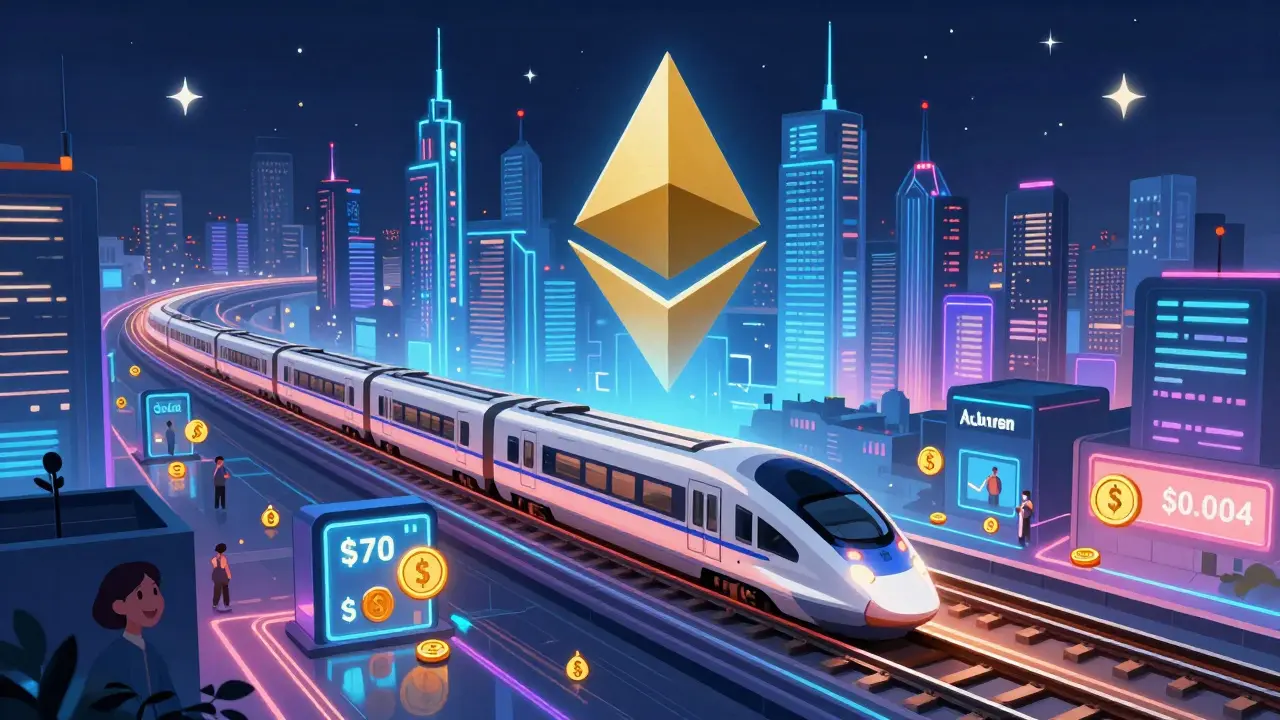
Gas fees used to be the biggest headache for anyone using Ethereum. Back in 2023, it wasn’t unusual to pay $70 just to swap a token or stake your ETH. That kind of cost shut out everyday users, made small DeFi trades pointless, and turned simple transfers into expensive gambles. But things changed - fast. By February 2025, the average gas fee on Ethereum dropped to just $0.41. That’s not a typo. It’s down over 97% from its peak. And the reason? Layer 2 solutions aren’t just helping anymore - they’re running the show.
What Even Are Gas Fees?
Gas fees are what you pay to get your transaction processed on a blockchain. Think of them like a toll booth on a highway. The more crowded the road, the higher the toll. On Ethereum, every action - sending ETH, swapping tokens, minting an NFT, or even just clicking a button in a DeFi app - costs gas. That gas goes to validators who keep the network running. After Ethereum switched to Proof of Stake in 2022, those validators aren’t mining rigs burning electricity. They’re people staking ETH, and they earn fees as rewards.
But here’s the problem: Ethereum’s main chain can only handle about 15 transactions per second. When everyone tries to trade at once - like during a new token launch or a crypto rally - the road gets jammed. Fees spike. And that’s where Layer 2s come in.
How Layer 2 Solutions Cut Costs by 99%
Layer 2s are like express lanes built on top of Ethereum. Instead of every transaction going straight to the main chain, they bundle hundreds or even thousands of transactions together, process them off-chain, and then submit one single proof back to Ethereum. It’s like mailing a box of 500 letters instead of 500 separate envelopes. The main chain only needs to verify the box, not each letter.
Networks like Arbitrum, Optimism, and Base are the leaders here. They use something called rollups - specifically, Optimistic and zk-Rollups - to do this. The result? You can swap tokens on Arbitrum for less than a penny. On Base, it’s often under $0.01. That’s 99% cheaper than Ethereum mainnet.
Here’s what that looks like in real numbers:
| Network | Average Fee (USD) | Reduction vs. Ethereum |
|---|---|---|
| Ethereum Mainnet | $0.41 | - |
| Arbitrum | $0.008 | 98% |
| Optimism | $0.006 | 98.5% |
| Base | $0.004 | 99% |
| BNB Chain | $0.05 | 88% |
That’s not just convenient - it’s revolutionary. For the first time, small transactions like tipping creators, buying digital art, or joining a DAO are no longer financially out of reach.
Why Gas Fees Still Spike - And How to Beat Them
Don’t get fooled. Layer 2s didn’t erase volatility. They just moved the problem. Ethereum mainnet still has congestion spikes. On February 19, 2025, a major NFT drop caused gas fees to jump to $50 per swap. That’s because people were rushing to bridge their assets from Ethereum to Layer 2s - and bridging costs real gas.
Here’s the catch: You need ETH on the mainnet to move money to a Layer 2. That first bridge transaction? It’s expensive. But after that? You’re golden. Most users only pay that high fee once. After that, they’re transacting on the Layer 2 for pennies.
So how do you avoid getting burned? Use tools like Etherscan’s Gas Tracker or the built-in fee estimators in wallets like MetaMask. Most users find that weekends and late-night hours (UTC) are cheapest. Avoid peak times: when Bitcoin surges, when new tokens launch, or right after major crypto news. These are when Ethereum gets flooded, and Layer 2 bridges get jammed.

The Rise of AI-Powered Gas Optimization
It’s not just about timing anymore. In 2025, smart wallets are getting smarter. Tools like GasHero and DeFiSaver AI now use machine learning to predict fee trends. They watch Ethereum’s mempool, track Layer 2 traffic, and even analyze social sentiment around token launches. Then they do three things:
- Auto-route your transaction to the cheapest path - maybe Optimism instead of Arbitrum
- Schedule your swap for 3 AM when fees are lowest
- Split large trades into smaller ones to avoid slippage and high fees
One trader in Wellington told me he cut his monthly gas spending from $45 to $2.50 just by using one AI tool. He didn’t change his strategy - he just let the AI handle the timing. That’s the new normal.
Layer 2 Adoption Is Changing How We Use Crypto
It’s not just about saving money. Layer 2s are unlocking new use cases. NFT marketplaces are now live on Base, with artists minting hundreds of pieces without worrying about $20 fees per drop. Gaming platforms are launching on Arbitrum because players can buy skins, trade items, and claim rewards without needing a credit card or bank account. Even simple things like voting in DAOs are becoming common because the cost is negligible.
And it’s not just Ethereum. BNB Chain is cutting its gas fees in half to compete. Solana’s low fees forced Ethereum to evolve. Now, the race isn’t about who has the fastest blockchain - it’s about who can deliver the cheapest, smoothest experience. That’s why Layer 2s are no longer optional. They’re the foundation of Web3.

What You Need to Know to Get Started
Using Layer 2s isn’t hard - but it’s different. Here’s how to start:
- Get ETH in your wallet (MetaMask, Rainbow, or Trust Wallet).
- Use the built-in bridge in your wallet or go to the official bridge site (like arbitrum.io or optimism.io). Never use third-party bridges unless you’ve verified them.
- Send your ETH from Ethereum mainnet to your chosen Layer 2. This costs a one-time fee - usually $1 to $5.
- Once your assets arrive (takes 5-30 minutes), you’re on the Layer 2. Now you can swap, stake, or play with near-zero fees.
- Use a Layer 2 explorer like Arbiscan or Optimism Explorer to track your transactions.
Pro tip: Always keep a little ETH on the mainnet - just enough to bridge back if you need to. If you run out, you’ll be stuck until you pay to get more ETH onto the mainnet.
The Bigger Picture: Why This Matters
The drop in gas fees isn’t just a tech win - it’s a social one. Before Layer 2s, crypto felt like a club for the wealthy. Now, someone in Kenya can trade tokens for less than a coffee. A student in Manila can earn from DeFi without needing a loan. A grandmother in New Zealand can hold NFTs without paying $30 just to send one.
Ethereum’s shift to Proof of Stake already cut its energy use by 99%. Layer 2s are doing the same for accessibility. Together, they’re making blockchain not just scalable - but human.
Looking ahead, we’ll see even more innovation: cross-chain wallets that auto-select the cheapest network, AI agents that manage your gas budget, and Layer 3s built on top of Layer 2s for ultra-specialized apps. But the core idea stays the same: reduce cost, increase access, and keep the network secure.
What’s Next?
The future of gas fees isn’t about making Ethereum faster. It’s about making it unnecessary for most transactions. Layer 2s aren’t a workaround - they’re the upgrade. And as more apps move there, Ethereum mainnet becomes a quiet, secure backbone - like the internet’s backbone, not the website you visit every day.
If you’re still paying $5 to swap tokens on Ethereum mainnet in 2026, you’re not being clever. You’re just paying more than you need to. The tools are here. The networks are ready. The cost is almost gone. It’s time to move.
Are Layer 2 solutions safe?
Yes, the top Layer 2s like Arbitrum and Optimism are built on Ethereum’s security. They use cryptographic proofs to ensure every transaction is valid before it’s posted to the main chain. If someone tries to cheat, the system can detect and penalize them. The risk isn’t in the technology - it’s in using fake bridges or trusting shady apps. Always use official tools and double-check URLs.
Do I need to pay gas fees on Layer 2 networks?
Yes - but they’re tiny. Most Layer 2s use their own tokens (like ARB or OP) to pay for gas, or they accept ETH directly. Fees are typically under $0.01, even during busy times. You’ll never pay $10 again on a Layer 2 like you used to on Ethereum mainnet.
Can I use DeFi apps on Layer 2s?
Absolutely. Most major DeFi platforms - Uniswap, Aave, Curve - now have full versions on Arbitrum and Optimism. You can lend, borrow, stake, and trade just like on Ethereum mainnet, but for 99% less. Some even offer extra rewards just for using their Layer 2 version.
What happens if Ethereum goes down?
Layer 2s are designed to keep working even if Ethereum has a short outage. Transactions continue to process off-chain. When Ethereum comes back online, the Layer 2 submits the final state. Your funds are safe. That’s why Layer 2s aren’t just cheaper - they’re more resilient.
Should I move all my crypto to a Layer 2?
For daily use - yes. Keep your long-term holdings on Ethereum mainnet if you’re not actively using them. But for trading, staking, gaming, or using DeFi apps, Layer 2s are the clear choice. They’re faster, cheaper, and just as secure. Think of Ethereum as your savings account and Layer 2s as your checking account.







John Fuller
February 26, 2026 AT 16:57 PMLayer 2s are just a bandaid. Ethereum should’ve scaled properly from day one.
Leslie Cox
February 26, 2026 AT 19:34 PMYou think this is progress? We traded one centralized power structure for ten more. Layer 2s are just corporate-controlled silos with prettier UIs. The blockchain was supposed to be decentralized. Now it’s just a branded subscription service.
Elizabeth Smith
February 28, 2026 AT 06:38 AMPeople don’t realize how much they’ve given up. The beauty of Ethereum was the friction. It forced you to think. Now everyone’s just spamming tiny transactions like they’re at a carnival game. We lost something sacred.
Kristi Emens
February 28, 2026 AT 14:55 PMI’ve been using Arbitrum for months now. My monthly gas used to be $40. Now it’s under $1.50. I’ve started tipping small artists on Base. It feels good to support people without feeling like I’m funding a luxury tax.
Andrew Hadder
March 1, 2026 AT 12:00 PMi just use meta mask’s built in bridge. it’s so easy. no need to overthink it. just send eth to arbitrum and forget about it.
Fiona Monroe
March 1, 2026 AT 21:43 PMThe empirical data presented here is statistically significant. The reduction in transactional friction has demonstrably increased user participation in DeFi ecosystems, particularly among demographics previously excluded due to cost barriers. This is not merely an engineering achievement-it is a socioeconomic enabler.
Maggie House
March 2, 2026 AT 11:45 AMI tried switching to a Layer 2 last week and was terrified I’d lose my funds. Turned out it was easier than moving money between banks. I’m so glad I did. Now I’m actually using crypto instead of just watching it.
Amanda Markwick
March 4, 2026 AT 10:29 AMThis isn’t just about fees. It’s about dignity. Before, if you had $50 in crypto, you couldn’t do anything with it without losing half to gas. Now? You can participate. You can belong. That’s not tech-that’s justice.
Vishakha Singh
March 6, 2026 AT 05:33 AMIn India, we have seen firsthand how this transformation is empowering millions. Small farmers now receive payments in crypto for their produce via Base. A student in Jaipur is earning through microtasks on Arbitrum. This is not a luxury-it is a lifeline.
Don B.
March 6, 2026 AT 09:11 AMLMAO they say '99% cheaper' like it's a miracle. Meanwhile, my wallet got hacked because I trusted some 'official' bridge. You think this is safe? Nah. It's just a new way to lose your money faster.
Daisy Boliaan
March 7, 2026 AT 18:17 PMI saw someone on Twitter say they paid $0.003 to swap tokens. I was like... wait, what? I thought we were supposed to be fighting the man, not paying pennies to do it? Something feels off. Like we got played.
Robert Conmy
March 8, 2026 AT 14:38 PMIf you’re still on mainnet in 2025, you’re not a pioneer-you’re a masochist. Get with the program. Layer 2s aren’t optional anymore. They’re the new baseline. Stop romanticizing the old system.
Cameron Pearce Macfarlane
March 9, 2026 AT 23:03 PMYeah but what about centralization? Who controls the sequencers? Who decides the fee structure? The same VC-backed teams that ran the old system. We didn’t escape the hierarchy-we just gave it a new logo.
Neeti Sharma
March 11, 2026 AT 03:43 AMIndia is the future of crypto and you all still talking about arbitrum like its god. We have our own chains. We dont need your layer 2s. We are building real stuff here. Stop acting like you invented access.
Michelle Mitchell
March 12, 2026 AT 20:37 PMi read this whole thing and still dont get why anyone wouldnt just use solana. its cheaper and faster. are we just emotionally attached to ethereum now? like its our ex we keep checking on?
Dana Sikand
March 14, 2026 AT 08:41 AMI used to hate crypto because every time I tried to do something, I got gouged. Then I found Base. Now I mint NFTs for my friends’ dog pictures for 2 cents. It’s weirdly beautiful. Like, I didn’t know blockchain could feel this... human.
Patrick Streeb
March 14, 2026 AT 15:21 PMThe architectural elegance of rollups, particularly in their cryptographic verifiability, represents a profound advancement in distributed consensus. One must acknowledge the meticulous engineering that has enabled this transition without compromising security. It is, quite frankly, a masterclass in layered system design.
Deborah Robinson
March 15, 2026 AT 08:29 AMI just started using crypto last year. My mom in Ohio didn’t believe I could send money to my cousin in Nigeria without a bank. I did it on Optimism for 3 cents. She cried. That’s the real win-not the numbers, but the people.
Lucy Simmonds
March 16, 2026 AT 14:04 PMWait… so you’re telling me the government didn’t create these layer 2s to track us better? That’s what they want us to believe. But I’ve seen the docs. They’re collecting all our on-chain data. This isn’t freedom-it’s surveillance with a smiley face.
Arya Dev
March 16, 2026 AT 20:12 PMI don’t trust any of this. Layer 2s? Rollups? Please. The mainnet is the only real blockchain. Everything else is just a shadow. And who’s to say they won’t shut it down tomorrow? I’m holding my ETH on mainnet. Forever. And I’m not afraid to say it.