
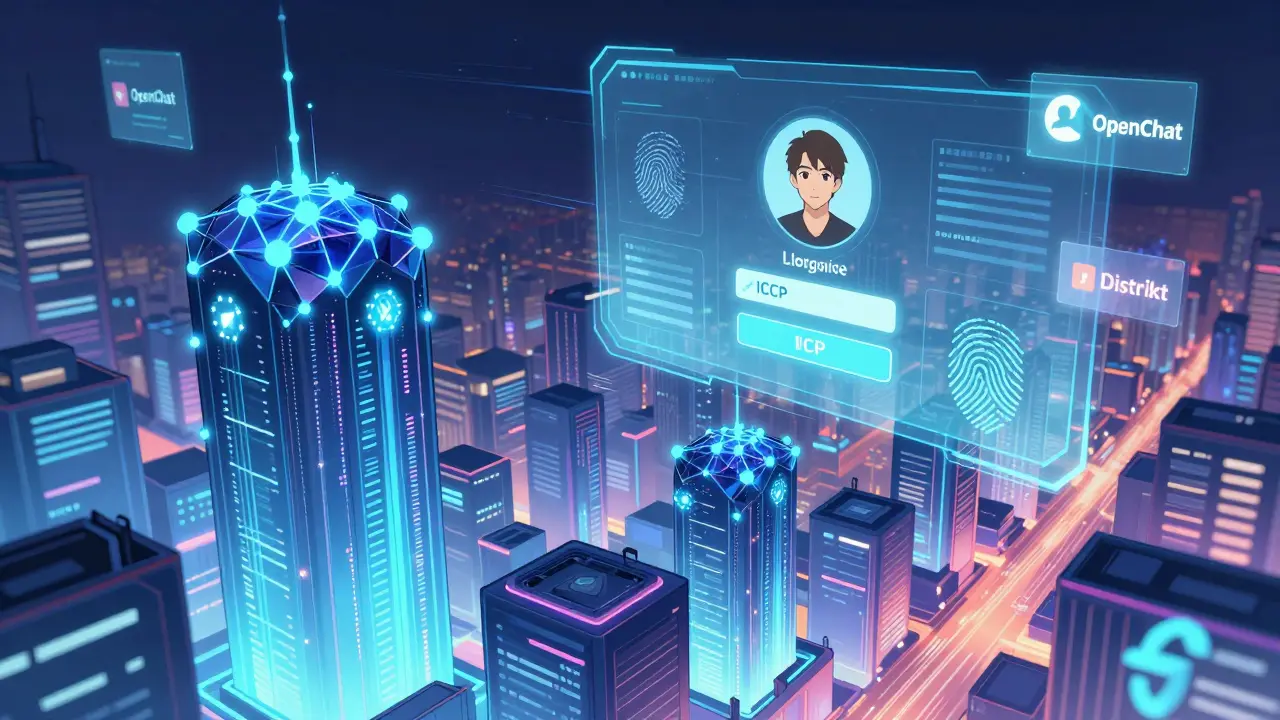
Most people think of cryptocurrencies as digital money - Bitcoin for payments, Ethereum for smart contracts. But what if the whole internet could run on a blockchain? That’s exactly what Internet Computer (ICP) is trying to do. It’s not just another coin. It’s a full rewrite of how online services work - no Amazon Web Services, no Google Cloud, no centralized servers. Instead, apps run directly on a global network of computers, owned by regular people and companies around the world.
How Internet Computer is different from other blockchains
Bitcoin stores transactions. Ethereum runs smart contracts. Solana moves fast. Internet Computer does something no other chain does: it hosts complete websites and apps - with user logins, databases, and real-time interactions - all on the blockchain. Think of it like putting Facebook, WhatsApp, or YouTube onto a decentralized network that no single company controls.
The secret? Chain key cryptography. Traditional blockchains need hundreds of nodes to verify each transaction. ICP uses a single, constantly shifting public key that all nodes agree on. This means the network can respond like a regular website - with sub-second load times - while still being fully decentralized. A social app like OpenChat, built on ICP, sends messages as fast as WhatsApp, but no one owns it. No ads. No data harvesting. No shutdowns.
What is ICP actually used for?
ICP isn’t a currency you spend at the store. It has three real jobs:
- Fuel for apps - Every time someone uses a service on ICP, like posting a message or uploading a photo, the app burns ICP to create something called ‘cycles.’ 1 ICP = exactly 10,000,000 cycles. This makes the token deflationary - as more apps grow, more ICP gets burned.
- Voting power - If you lock up your ICP in the Network Nervous System (NNS), you create a ‘neuron.’ Longer locks (up to 8 years) give you more voting weight to decide things like network upgrades, fees, and even how new money is distributed. It’s like owning shares in the internet itself.
- Store of value - Companies building on ICP can raise funds by selling ICP tokens as part of their launch. This isn’t an IPO. It’s a decentralized sale where users become stakeholders from day one.
Unlike Ethereum’s ETH, which is mostly used for gas fees and staking, ICP is deeply tied to how the system runs. You can’t use it just to pay for things. You use it to keep the whole thing alive.
Who built it and how big is it?
Internet Computer was created by the Dfinity Foundation, a Swiss nonprofit founded in 2016 by computer scientist Dominic Williams. The mainnet launched on May 10, 2021. Since then, it’s grown quietly but steadily. As of January 2026, over 130 independent data centers in 42 countries run the network. That’s more than most public blockchains.
It handles about 1.2 million transactions daily - not as many as Solana or Ethereum, but enough to power real apps. The network processes 11.3 transactions per second. That’s slower than Solana’s 4,000 TPS, but faster than Ethereum’s 15-30 TPS. What matters isn’t just speed - it’s what you can do with it. ICP apps don’t need external oracles. They can talk directly to Bitcoin, pull live weather data, or verify real-world events without third parties.

How does it compare to Ethereum, Solana, and Polkadot?
Here’s how ICP stacks up:
| Feature | Internet Computer (ICP) | Ethereum | Solana | Polkadot |
|---|---|---|---|---|
| Transaction Speed | 11.3 TPS | 15-30 TPS | 2,000-4,000 TPS | 1,000-1,500 TPS |
| App Hosting | Yes - full websites on-chain | No - needs off-chain servers | No - needs off-chain servers | No - needs parachains |
| Authentication | Face ID / fingerprint (Internet Identity) | Wallets (MetaMask, etc.) | Wallets | Wallets |
| Bitcoin Integration | Native - canisters manage Bitcoin addresses | Requires bridge or oracle | Requires bridge | Requires bridge |
| Node Hardware | Specialized machines only | Standard PCs | Standard PCs | Standard PCs |
| Decentralization | 62% of nodes run by top 10 orgs | Highly distributed | Highly distributed | Highly distributed |
ICP wins on integration and user experience. You don’t need a wallet to log in - your phone’s biometrics work. You can build a full app without touching a server. But it loses on decentralization and speed. The fact that most nodes are run by just ten companies is a red flag for purists. And if you’re building a high-frequency trading app, ICP isn’t your choice.
Why developers love it - and why they struggle
Developers who’ve built on ICP say it’s a game-changer for social apps. One developer reported building a TikTok-style app in 3 weeks on ICP - it took 12 weeks on Ethereum. Why? No backend. No database setup. No API keys. Everything is one codebase.
But there’s a catch. The learning curve is steep. The Motoko programming language, built for ICP, is powerful but unfamiliar. 52% of developers say it’s harder to learn than Solidity or Rust. Converting ICP to cycles is still confusing - even after updates. And the governance system? Neurons, voting weights, lock periods - it’s complicated. Sixty-three percent of new devs say they got stuck on it.
Documentation has improved. It’s now rated 4.2/5 by developers, up from 2.8 in 2022. The Discord server has over 12,000 members and answers 85 questions a day. But it’s still a niche community. You won’t find a million tutorials on YouTube. You’ll need to dig into official docs and ask in forums.

What’s new in 2026?
January 2026 brought a big upgrade: Satellite. Now, you can store videos, images, and audio files directly on the blockchain - no need for IPFS or centralized storage. That’s huge for social apps, marketplaces, and media platforms.
The roadmap is bold:
- Q3 2026: Increase throughput to 100 TPS
- Q2 2027: Native Ethereum bridge
- 2027: Full cross-chain DeFi with Bitcoin and Ethereum
If they hit these targets, ICP could become the backbone for Web3 apps that need speed, identity, and decentralization - all in one.
Market position and risks
As of January 2026, ICP has a market cap of $5.82 billion and ranks #21 among cryptocurrencies. It’s up from #37 in early 2025. That’s not a moonshot, but it’s steady growth.
Decentralized social apps built on ICP - like OpenChat and Distrikt - now have 1.7 million monthly users. That’s 12% of the entire decentralized social media market. Big companies are watching: 23 Fortune 500 firms are testing ICP for internal tools, up from 9 last year.
But risks are real. The SEC flagged ICP’s governance model as something needing closer review. The reliance on specialized hardware is a vulnerability - if node machines get scarce, the network could become more centralized. And the token’s price? Wild. ICP swung 82% in a year. Most negative reviews on CoinMarketCap blame volatility, not tech.
Experts are split. Tim Beiko, ex-Ethereum lead, calls chain key cryptography a breakthrough. Dr. Ari Juels from Cornell warns of theoretical attack risks. Nick Bonifield bets on Bitcoin integration driving DeFi growth. Diogo Monica from Ledger says the architecture is too complex to audit securely.
Should you care about ICP?
If you’re a crypto investor looking for the next 10x coin - ICP is risky. Its price swings are brutal, and adoption is still niche.
If you’re a developer tired of juggling servers, APIs, and databases - ICP is a revelation. You can build full apps in weeks, not months.
If you believe the internet should be open, user-owned, and not controlled by Silicon Valley giants - ICP is one of the few projects actually trying to make that real.
It’s not perfect. It’s not the fastest. It’s not the most decentralized. But it’s the only one building a true alternative to the centralized web - from the ground up.










nathan yeung
January 17, 2026 AT 10:47 AMICP is wild because it actually lets you build full apps without a single server. I tried making a simple chat app on Ethereum and it was a nightmare with contracts and oracles. On ICP? One codebase, deploy, done. No more juggling AWS and Firebase.
It’s not perfect, but for devs who hate infrastructure, this is the closest thing to magic we’ve got.
Bharat Kunduri
January 18, 2026 AT 20:31 PMICP? More like ICPY (I Can’t Pay) lmao. Who the hell wants to lock their coins for 8 years just to vote on some nerd council? And 11 TPS? My toaster has more processing power. This is just crypto theater with fancy words.
Also why do they need special hardware? If it’s decentralized why can’t I run a node on my old laptop? 🤡
Chris O'Carroll
January 18, 2026 AT 23:55 PMOkay but let’s be real - if this is the future of the internet, why does it feel like a Silicon Valley startup trying to out-geek itself?
Chain key cryptography? Motoko? Neurons? You’re not building the open web, you’re building a new religion with its own liturgy.
And don’t get me started on the 62% of nodes run by 10 companies. That’s not decentralization. That’s a cartel with a blockchain logo.
Kelly Post
January 19, 2026 AT 04:02 AMI’ve been watching ICP since 2021 and I’m genuinely impressed by the developer experience. No backend? No API keys? That’s revolutionary. But the documentation used to be a disaster - now it’s 4.2/5? Huge improvement.
Still, I worry about the governance model. Voting power tied to lock duration feels like plutocracy. And the volatility… I’ve seen people lose their life savings betting on this. It’s not just tech - it’s psychological warfare.
Chidimma Okafor
January 20, 2026 AT 09:30 AMAllow me to express my profound admiration for the visionary architecture of Internet Computer. The integration of chain-key cryptography with decentralized application hosting represents a paradigmatic leap in distributed systems engineering.
One cannot overlook the elegance of converting ICP into cycles - a deflationary mechanism that aligns token utility with network vitality. Furthermore, the introduction of Satellite for on-chain media storage is nothing short of a digital renaissance.
While the current node distribution raises legitimate concerns regarding decentralization, the trajectory of adoption by Fortune 500 entities signals a quiet but seismic shift in enterprise infrastructure.
This is not merely cryptocurrency. This is the reclamation of digital sovereignty - a quiet revolution, unfolding in plain sight.
Bill Sloan
January 20, 2026 AT 21:49 PMBro I built a TikTok clone on ICP in 18 days. 18 DAYS. On Ethereum it took me 3 months just to set up the backend + oracle + storage.
And the best part? My users log in with Face ID. No wallet. No seed phrases. No ‘copy this 12-word phrase into Notepad’ nonsense.
Yes the TPS is low. Yes the language is weird. But if you care about building real apps for real people - not just trading tokens - ICP is the only game in town. 🙌
ASHISH SINGH
January 22, 2026 AT 10:33 AMThey say it’s decentralized but 62% of nodes are run by 10 companies? That’s not a blockchain - that’s a government-funded project with a crypto veneer.
And who controls those 10 companies? Who’s funding Dfinity? Why is there no public ledger of who owns the node hardware? This smells like a CIA-backed operation to replace the internet with a surveillance layer.
Also - why does the token price swing 82% in a year? That’s not a store of value - that’s a pump-and-dump with fancy code. Wake up people.
They’re not building the open web. They’re building the next Facebook - just with more jargon.
Vinod Dalavai
January 23, 2026 AT 04:32 AMBeen running a node for 6 months. Hardware’s expensive but the rewards are steady. The real win? Seeing a Nigerian dev build a marketplace for local artisans using ICP - no bank needed, no middleman.
It’s not perfect. Motoko is rough. But this is the first time I’ve seen crypto actually help someone outside the crypto bubble.
Give it time. The devs are grinding. The users are growing. It’s slow, but it’s real.
Tony Loneman
January 24, 2026 AT 15:33 PMOh wow, 11 TPS and you call this ‘faster than Ethereum’? Bro, Ethereum does 30. Solana does 4000. You’re literally bragging about being slower than a toaster.
And ‘no server’? So what? Every app still needs a frontend. You’re just moving the backend to a black box no one can audit properly.
Also ‘Internet Identity’? That’s just biometrics tied to a blockchain. So now your face is your wallet? What’s next - your retina is your private key?
This isn’t innovation. It’s overengineering with a cult following.
Callan Burdett
January 26, 2026 AT 10:43 AMI was skeptical but I tried building a podcast platform on ICP. The fact that I can store audio directly on-chain now with Satellite? Mind blown.
Yes, the learning curve is steep. Yes, the token is volatile. But for the first time, I feel like I’m not just building for investors - I’m building for users who don’t care about crypto.
This is the quiet revolution. And it’s happening.
Anthony Ventresque
January 27, 2026 AT 03:29 AMDoes anyone else find it weird that ICP’s biggest selling point is ‘no servers’… but you still need specialized hardware to run nodes? That feels like trading one centralization for another.
Also - how many people actually use OpenChat? 1.7 million monthly users sounds big, but it’s less than 0.5% of Telegram’s userbase.
I believe in the vision. But I’m waiting for proof that it scales beyond hobbyists and early adopters.
Nishakar Rath
January 27, 2026 AT 15:37 PMICP is a scam designed to make rich guys look smart while regular people lose money
Why do you think they need special hardware? So only the rich can run nodes and control the network
They call it decentralization but its just a new way to centralize power under a Swiss nonprofit with no transparency
And the token? Pure gambling
Stop drinking the koolaid and go invest in Bitcoin if you want real decentralization
Jason Zhang
January 28, 2026 AT 16:26 PMLook, I get the hype. But let’s not pretend this is the future. The tech is clever, sure. But if you can’t get developers to use it because the language is too weird and the docs are still confusing - then what’s the point?
And 1.7 million users on decentralized apps? That’s cute. But it’s less than the userbase of one mid-tier Discord server.
ICP feels like a brilliant idea that’s stuck in the lab. It needs a killer app. Not just a bunch of devs saying ‘it’s revolutionary’ while nobody else uses it.
nathan yeung
January 29, 2026 AT 06:49 AMReplying to @1648 - you’re right about the killer app problem. But OpenChat and Distrikt are growing. And now with Satellite, you can build full media apps without IPFS. That’s huge.
It’s not about being the biggest. It’s about being the only one that doesn’t need a CEO to shut you down.
One day, someone will build the next Twitter on ICP - and when it gets censored on every other platform, it’ll still run. That’s the real win.