

Right now, your encrypted data-bank transfers, medical records, government files, even private messages-is sitting out there, waiting. Not for a hacker with a powerful computer, but for a quantum computer that doesn’t even exist yet. That’s the scary truth behind quantum-resistant security. It’s not science fiction. It’s a countdown. And if you’re still relying on today’s encryption, you’re already behind.
Why Your Current Encryption Won’t Last
Today’s digital world runs on public-key cryptography. RSA and ECC (Elliptic Curve Cryptography) are the backbone of HTTPS, digital signatures, and secure communication. But these systems are built on math problems that are hard for regular computers-like factoring huge numbers or solving discrete logarithms. The problem? Quantum computers don’t care about those problems. In 1994, Peter Shor built an algorithm that, if run on a large enough quantum computer, could crack RSA and ECC in hours, not millennia. That’s not a hypothetical. It’s a mathematical certainty. And it’s not just public-key systems at risk. Grover’s algorithm can cut the strength of symmetric encryption like AES in half. So a 256-bit key, which feels unbreakable now, becomes as strong as a 128-bit key under quantum attack. That’s not enough for long-term secrets. The real danger isn’t what quantum computers can do tomorrow. It’s what they can do with data stolen today. Attackers are already harvesting encrypted traffic-emails, financial records, state secrets-and storing it. They’re not trying to crack it now. They’re waiting for a quantum computer to arrive so they can decrypt everything at once. This is called “harvest now, decrypt later.” And it’s happening right now.What Is Quantum-Resistant Security?
Quantum-resistant security, also known as post-quantum cryptography (PQC), is the field focused on building encryption systems that even quantum computers can’t break. It doesn’t rely on the same math problems. Instead, it uses entirely different structures that are believed to be hard for both classical and quantum machines. There are four main families of quantum-resistant algorithms:- Lattice-based cryptography - Uses complex geometric structures in high-dimensional space. It’s the most promising and efficient. This is where NIST’s Kyber and Dilithium come from.
- Hash-based cryptography - Relies on the security of cryptographic hash functions. It’s simple and well-understood, but mostly used for digital signatures, not encryption.
- Code-based cryptography - Built on error-correcting codes, a field studied since the 1970s. It’s been around a long time but tends to have large key sizes.
- Multivariate polynomial cryptography - Uses systems of complex equations. Fast to compute, but some variants have been broken in the past.
NIST’s Role: The Global Standard-Bearer
The National Institute of Standards and Technology (NIST) isn’t just a U.S. agency. It’s the global referee for cryptography. When NIST picks a standard, the world follows. Governments, banks, cloud providers, and hardware makers all align with NIST’s choices. After evaluating over 70 candidate algorithms from researchers worldwide, NIST selected Kyber and Dilithium as the first official quantum-resistant standards. They didn’t just pick based on theoretical strength. They tested real-world performance: how fast they run, how much memory they use, how big their keys and signatures are. Kyber’s public-key size is around 800 bytes-smaller than many current RSA keys. Dilithium signatures are under 2,500 bytes. That’s manageable for today’s networks. NIST also published standards for two other families: SPHINCS+ (hash-based) for long-term signature needs, and FALCON (lattice-based) for situations where smaller signatures are critical. These aren’t replacements-they’re backups and specialists. The message is clear: don’t wait for perfection. Start moving now.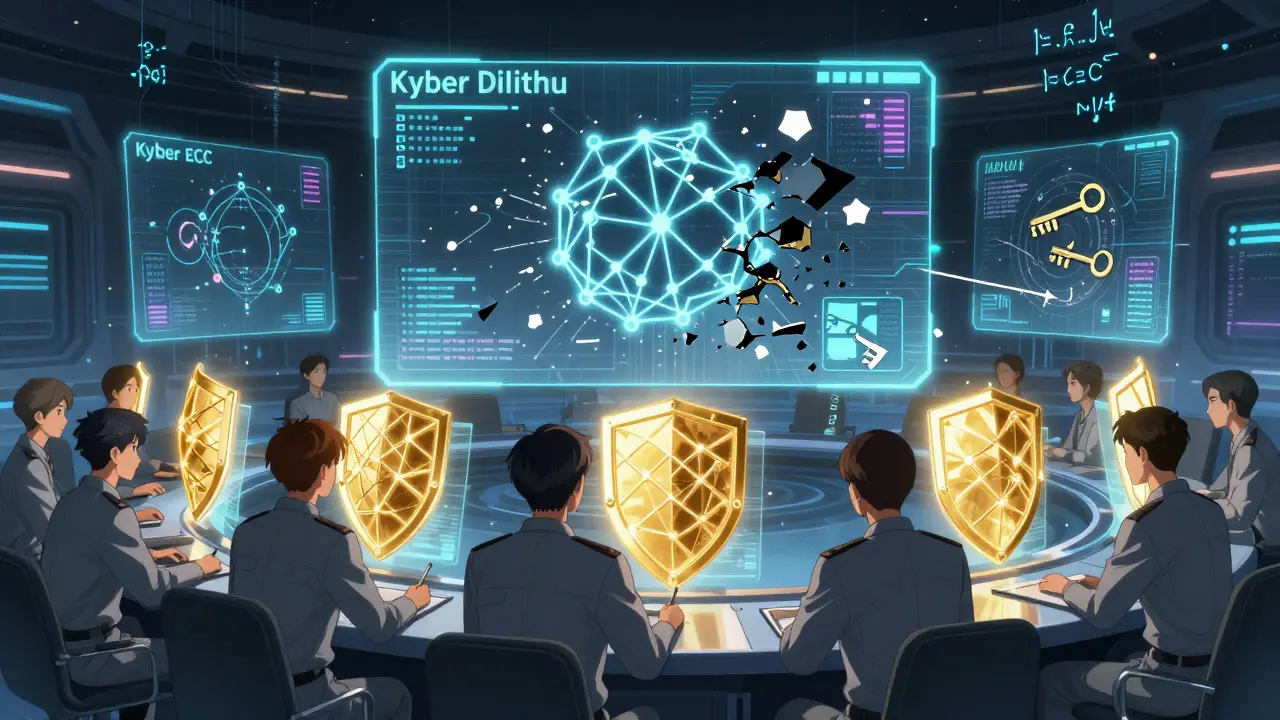
What This Means for Blockchain and Decentralized Systems
Blockchain networks are especially vulnerable. Most use ECC for digital signatures to prove ownership of wallets. If a quantum computer can crack those signatures, someone could steal any cryptocurrency by forging a signature that looks like it came from the wallet owner. Bitcoin, Ethereum, Solana-all rely on the same vulnerable math. Some blockchains are already preparing. Ethereum’s roadmap includes quantum-resistant signature schemes for its future upgrades. Other projects are exploring hybrid systems that combine classical and quantum-safe signatures during the transition. But the reality? Most blockchain wallets today are sitting ducks. If you hold crypto in a wallet that uses a standard ECDSA key, you’re exposed. The fix isn’t simple. You can’t just swap out a library. Blockchain consensus, transaction formats, and node software all need updates. That’s why migration will take years. But the clock is ticking. A single quantum breakthrough could erase billions in value overnight.Implementation Isn’t Just About Swapping Code
You can’t just install a new crypto library and call it done. Quantum-resistant algorithms have trade-offs.- Larger keys and signatures - Even the best ones are bigger than RSA. That means more bandwidth, more storage, more processing time.
- Higher CPU usage - Some algorithms require more computation, which can slow down servers or mobile devices.
- Legacy system incompatibility - Old hardware, embedded systems, and industrial control systems may not support new algorithms at all.
- Expertise gap - Very few security teams understand lattice math. Most still think in terms of RSA and AES.
Who’s Leading the Charge?
This isn’t just a government project. Big tech is moving fast.- IBM has integrated quantum-safe cryptography into its IBM Z mainframes, protecting enterprise data for banks and governments.
- Google tested Kyber in Chrome and Android, proving it works at scale.
- Cloudflare offers a free quantum-resistant TLS option for websites.
- Fortanix and Thales are building key management systems that support PQC out of the box.

Regulations Are Starting to Bite
Governments aren’t waiting. The U.S. has mandated that all federal agencies must start migrating to quantum-resistant systems by 2026. The EU, UK, Canada, and Australia have similar timelines. The NSA has already warned that “the time to prepare is now.” If you’re in healthcare, finance, defense, or critical infrastructure, you’re already under pressure. Regulations like HIPAA, GDPR, and NIST SP 800-175B now explicitly mention quantum threats. Non-compliance could mean fines, audits, or even loss of contracts.What Should You Do Right Now?
You don’t need to rebuild everything tomorrow. But you need a plan.- Inventory your crypto assets - Find every system using RSA, ECC, or DSA. That includes VPNs, TLS certificates, code signing, and blockchain wallets.
- Classify your data - What needs to stay secret for 10+ years? That’s your priority. Government secrets, patient records, intellectual property.
- Start testing - Try hybrid TLS with Cloudflare or IBM. Use NIST’s open-source libraries to test Kyber and Dilithium in your dev environment.
- Train your team - Get your security staff up to speed on lattice-based crypto. It’s not just another algorithm-it’s a new way of thinking.
- Plan for migration - Build a 3-5 year roadmap. Start with new systems. Then phase out old ones. Don’t wait for a breach.
The Future Is Already Here
Dr. Michele Mosca from the University of Waterloo says there’s a 50% chance major public-key crypto will be broken by 2031. That’s six years from now. If you think you have time, you’re wrong. Quantum computers are still in labs. But the math doesn’t care if they’re built yet. The threat is real. The solution exists. The question isn’t whether you’ll switch to quantum-resistant security-it’s whether you’ll switch before it’s too late. The next decade won’t be about faster computers. It’ll be about who prepared for them.Is quantum-resistant security the same as quantum cryptography?
No. Quantum-resistant security (post-quantum cryptography) uses mathematical algorithms that are hard for quantum computers to break. Quantum cryptography, like QKD (Quantum Key Distribution), uses the physical properties of photons to exchange keys. The first is software-based and can be added to existing systems. The second requires new hardware and fiber optic networks. Most organizations will use quantum-resistant crypto, not quantum cryptography.
Can I just use longer RSA keys to stay safe?
No. Shor’s algorithm breaks RSA no matter how long the key is. Even a 4096-bit RSA key is useless against a quantum computer. The problem isn’t key size-it’s the underlying math. You need a completely different algorithm, like Kyber or Dilithium.
Are my cryptocurrency wallets at risk?
Yes-if they use ECDSA or similar elliptic curve signatures, which nearly all do. A quantum computer could derive your private key from your public address. That means someone could steal your coins. The fix: use wallets that support quantum-resistant signatures once they become available. Until then, move funds to new addresses after each transaction to reduce exposure.
Do I need to replace all my hardware?
Not immediately. Most modern servers and network devices can handle new algorithms through software updates. But older embedded systems, IoT devices, and industrial controllers may not support PQC at all. Prioritize replacing or upgrading those that handle sensitive data or long-term secrets.
What’s the biggest mistake organizations make?
Waiting for a “quantum apocalypse” to happen before acting. The threat isn’t the day a quantum computer turns on-it’s the data being collected now. If you wait until 2030, you’ll be scrambling to patch systems that have been storing encrypted secrets for a decade. Start now, even if it’s just a hybrid TLS test.










Dustin Bright
December 24, 2025 AT 06:41 AMbro this is wild 😳 i just realized my crypto wallet is basically a time bomb waiting for some sci-fi villain to flip a switch. i’m moving my coins tomorrow. no cap.
chris yusunas
December 24, 2025 AT 09:05 AMquantum computers gonna crack our secrets like a bad lockpick but hey at least we got time to panic slowly 🌍✌️
Rishav Ranjan
December 25, 2025 AT 10:45 AMtoo late already.
Alison Fenske
December 26, 2025 AT 21:25 PMimagine your grandma’s medical records getting leaked because someone thought ‘it’ll be fine’... we’re not just talking tech here. we’re talking lives. and we’re sleeping on it.
Earlene Dollie
December 27, 2025 AT 01:51 AMso basically the world is one quantum hiccup away from total digital chaos and everyone’s still scrolling tiktok? i feel like we’re in the last episode of a dystopian show and no one brought the popcorn
Grace Simmons
December 27, 2025 AT 21:33 PMLet me be clear: this isn’t theoretical. The U.S. military, financial institutions, and intelligence agencies have been preparing for this since 2018. If you’re still using ECC or RSA without a hybrid fallback, you’re not just negligent-you’re endangering national infrastructure. NIST didn’t pick Kyber because it’s trendy. It picked it because the math holds. The time for debate is over. Action is mandatory.
Aaron Heaps
December 29, 2025 AT 12:18 PMlol so now we’re supposed to trust NIST? they helped push SHA-1 and then acted shocked when it broke. same people who said AES-256 was ‘unbreakable’ until quantum came along. this is just another corporate theater. wait for the next ‘revolution’ and then panic again.
Sophia Wade
December 29, 2025 AT 20:33 PMThere’s a deeper layer here that no one’s talking about: we’ve built an entire civilization on trust in mathematical abstractions. RSA, ECC-they’re not just tools. They’re the invisible architecture of modern society. When they fall, it’s not just data that’s exposed. It’s the illusion of order. We’ve outsourced our security to equations that assume the universe is deterministic. But what if it isn’t? What if the next breakthrough isn’t quantum computing, but a new understanding of reality itself? Then all of this-Kyber, Dilithium, even our notions of ‘resistance’-becomes a footnote in a much stranger story.
Tristan Bertles
December 31, 2025 AT 07:47 AMyou guys are overthinking it. start with hybrid TLS on your web servers. Cloudflare’s free. Test it. See if your app breaks. If it doesn’t, you’re 90% there. Then tackle your internal PKI. Don’t try to boil the ocean. Just fix the leak you can reach. Progress > perfection. And yes, your crypto wallet? Move funds to a new address after each use. It’s dumb, but it buys you time.
SHEFFIN ANTONY
January 2, 2026 AT 00:26 AMeveryone’s acting like this is new. i told my boss in 2019 that ECC was a house of cards. he laughed. now he’s asking me to ‘fix it’. i’m not your janitor. i’m not fixing your legacy mess because you ignored the warning signs. if you want quantum-safe, pay for consultants. don’t ask me to do it on a friday night.
Vyas Koduvayur
January 3, 2026 AT 02:53 AMlet’s be real-most of you don’t even know what a lattice is. you just heard ‘quantum’ and panicked. Kyber isn’t magic. it’s based on Learning With Errors, which is just polynomial rings with noise added. it’s elegant, sure, but it’s not unbreakable. there are side-channel attacks, timing leaks, even potential algebraic weaknesses under certain assumptions. NIST picked it because it was the least bad option after 5 years of testing-not because it’s perfect. and don’t get me started on the key sizes. your IoT thermostat won’t handle 1KB signatures. you’ll need hardware upgrades. which means you’ll be stuck with vulnerable systems for another decade. so yes, start testing. but don’t pretend you’ve solved anything. you’ve just bought yourself a few more years of denial.
Ellen Sales
January 3, 2026 AT 12:10 PMsooo… we’re all gonna die because some nerd in a lab got a big computer? 🤡 i mean, i still use windows 7 on my toaster. if quantum computers break crypto, maybe the universe is just trying to reboot us. pass the popcorn, i’m ready for the apocalypse.