

Imagine waking up to find your bank account frozen and police at your door because you bought a few fractions of a digital coin online. In Nepal, this isn't a nightmare scenario-it's a legal reality. Despite a total ban that's been in place since 2017, a massive shadow economy for digital assets thrives in the dark. People are risking years of imprisonment just to trade Bitcoin or stablecoins. But why is the demand so high when the risks are this extreme?
The core of the problem is a clash between a strict government and a tech-savvy population. While the Nepal Rastra Bank (NRB) views digital assets as a threat to the country's financial stability, many citizens see them as a lifeline for international remittances and a way to escape traditional investment limits. This has created a high-stakes game of cat and mouse where traders use every digital tool available to stay invisible.
How the Shadow Market Actually Works
Since you can't just open an account on a standard exchange without jumping through legal hoops, traders have turned to a decentralized approach. The most common method is P2P Trading (Peer-to-Peer). Instead of using a central broker, two people agree on a price. The buyer sends local currency through a mobile wallet like eSewa or a direct bank transfer, and the seller releases the crypto from their wallet.
To even see the platforms where these trades are listed, users have to bypass the Nepal Telecommunication Authority (NTA), which blocks most crypto sites. This is where VPNs (Virtual Private Networks) come in. By masking their IP addresses and appearing as if they are browsing from another country, Nepalese traders can access global exchanges like Binance. However, the NRB has recently flagged the use of VPNs for crypto access as a specific violation, making the simple act of connecting to a server in the US or Europe a legal risk.
The coordination happens in the shadows. You won't find these deals on Facebook or public forums. Instead, the action is on encrypted apps like Telegram and WhatsApp. Here, private groups vet new members and arrange the timing of transfers to avoid triggering bank alerts.
The Danger Zone: Legal and Financial Risks
Trading in the underground market isn't just "grey area" activity-it's a criminal offense. The government uses a combination of cybercrime laws and foreign exchange regulations to trap traders. The biggest threat isn't actually the blockchain, which is anonymous; it's the bank trail. When a trader sends thousands of rupees to a stranger with no clear business purpose, it triggers a red flag for anti-money laundering units.
| Factor | Official Stance (Legal) | Underground Reality |
|---|---|---|
| Legal Status | Strictly Prohibited | Illegal / Criminal |
| Access Method | Blocked by NTA | VPNs & Mirrors |
| Payment Route | Frozen/Monitored | P2P via eSewa/Bank |
| Consequence | N/A | Fines, Imprisonment, Asset Seizure |
The scale of these risks became clear in July 2025. The Central Investigation Bureau (CIB) of the Nepal Police busted a massive operation disguised as a grocery store called Rajatirtha Traders in Lalitpur. Two Indian nationals were arrested for moving over Rs 1.5 billion in illegal crypto transactions. This case proved that the government isn't just looking for small-time hobbyists; they are targeting the infrastructure of the shadow market, specifically focusing on Hundi (informal money transfer systems) tied to digital assets.

The Technical Hurdle: How Traders Try to Hide
For a regular person, getting started in this world requires a steep learning curve. It's not about knowing how to click "buy"; it's about operational security (OpSec). Experienced traders often use multiple bank accounts to split transactions, avoiding large, singular transfers that look suspicious to auditors. They also rely on "trusted circles" to avoid scams, as there is no legal recourse if a P2P partner steals your money.
Many users focus on stablecoins, which are pegged to the US Dollar. This allows them to hedge against the volatility of the Nepali Rupee and provides a more stable vehicle for sending money across borders. The goal for most isn't just speculation-it's survival and financial flexibility in a restricted economy.
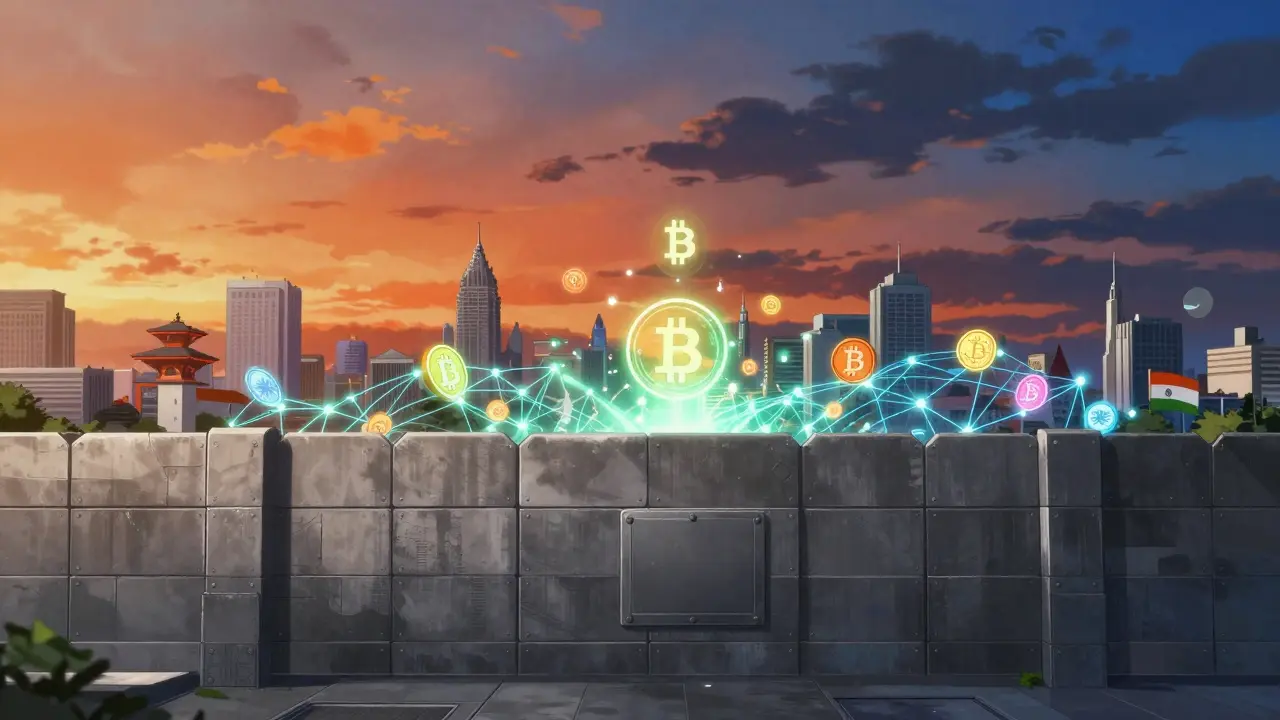
Nepal vs. The Neighbors: A Growing Divide
What makes the situation in Nepal so tense is the contrast with its neighbors. While India has introduced taxes and regulatory frameworks to control crypto, it hasn't completely banned the act of owning it. Bhutan has even explored government-backed mining. When Nepalese citizens see their neighbors adopting the technology, the total prohibition feels outdated and suffocating.
This divergence creates a pressure cooker environment. The more the world moves toward digital finance, the more the NRB tightens its grip. This has led to a cycle where every new restriction simply forces the underground market to become more sophisticated. When the government blocks a website, traders move to a new mirror site; when they monitor bank transfers, traders move to more obscure digital wallets.
Survival Checklist for the Risk-Averse
While we cannot encourage illegal activity, understanding the pitfalls can help anyone analyzing the market. Most people who get caught do so because of these three mistakes:
- Using the same account for everything: Mixing personal rent payments with P2P trading transfers is a fast track to a bank audit.
- Trusting strangers on Telegram: The shadow market is rife with "recovery scams" where people promise to get your lost funds back for a fee.
- Ignoring the VPN: Accessing an exchange on a local IP address is an immediate signal to the NTA and government surveillance tools.
Is it illegal to own Bitcoin in Nepal?
Yes. According to the Nepal Rastra Bank, the possession, trading, and mining of cryptocurrencies are strictly prohibited. Violators can face heavy fines and imprisonment under the country's cybercrime and foreign exchange laws.
How does the government track crypto trades?
The government doesn't usually track the blockchain itself, but rather the "on-ramps" and "off-ramps." They analyze bank transaction patterns for unusual transfers to unknown individuals and monitor IP addresses for access to blocked cryptocurrency exchanges.
Can I use a VPN to bypass the crypto ban?
While a VPN allows you to access blocked websites, the Nepal Rastra Bank has explicitly stated that using a VPN to engage in cryptocurrency activities is also a violation of their regulations.
What is the link between crypto and Hundi in Nepal?
Many underground traders use crypto as a modern version of Hundi. Instead of relying on a chain of brokers to move money across borders, they use digital assets to transfer value instantly, then liquidate it into local currency at the destination.
Will Nepal ever legalize cryptocurrency?
As of early 2026, there are no official plans for legalization. The government remains committed to protecting the monetary system. However, increasing international pressure and the ability of citizens to circumvent bans may eventually force a shift toward a regulated framework.










Siddharth Bhandari
April 4, 2026 AT 23:29 PMP2P is basically the only way for people in the region to maintain any level of financial autonomy. The risks with eSewa are real because the transaction logs are basically an open book for the authorities if they decide to audit a specific cluster of users. Using multiple accounts is a basic step, but the real protection comes from using non-custodial wallets and avoiding any connection to a real-world identity for as long as possible.
Erica Mahmood
April 6, 2026 AT 22:10 PMopsec is everything here. if you aren't using a hardware wallet and a hardened os your basically just begging for a seed phrase drain or a trace back via ip leak. most people underestimate the metadata trail left by mobile wallets
Matthew Wright
April 7, 2026 AT 13:19 PMThat's a very good point!!! I wonder if the use of Monero would be more effective for those wanting total anonymity, given that Bitcoin's ledger is completely public??? It seems like the bank trail is the only real bottleneck here!!!!
Manisha Sharma
April 7, 2026 AT 21:22 PMtypical nepal. they try to play with tech they dont even understand. india is way ahead in how we handle this, even with the taxes. it's just lack of vison from their govmnt. they think banning things makes them safe, which is just basicly a joke in the age of decentralization
Arwyn Keast
April 8, 2026 AT 19:17 PMThe sheer incompetence of these regulatory frameworks is staggering. We see the same pattern of futile prohibitionism across the globe, yet the idiots still think a simple IP block constitutes a sovereign financial barrier. It's purely a case of regulatory capture by legacy banking systems that are terrified of losing their grip on remittance fees. Honestly, the lack of a proper legal framework just ensures that only the most sophisticated criminals and the most desperate peasants are operating in the space, which is exactly what happens when you implement a blunt-force ban instead of a nuanced fiscal policy. It's a joke.
Emma Pease-Byron
April 10, 2026 AT 05:06 AMOh, how quaint that some people actually believe a VPN is a 'security' measure. It is a privacy tool at best, and in a regime this determined, it is merely a digital curtain that can be pulled back with the slightest bit of effort from a competent agency. I find it amusing that anyone considers this 'sophisticated' trading.
Adriana Gurau
April 11, 2026 AT 15:47 PMImagine thinking you're a 'trader' while hiding in a Telegram group like a teenager 🙄 The level of delusion here is just peak. Why would anyone risk jail for a coin that could crash 90% in a week? Just get a real job and stop pretending you're in a spy movie 💅
Sharhonda Walker
April 12, 2026 AT 12:22 PMI realy think people need to be carefull with the P2P stuff. There are so many scammrs pretending to be trusted sellers on those apps. Just becuase someone is in a private group doesnt mean they wont steal your money and block you immidiately. Always use a middleman if you can find one you actually trust!!
gladys christine
April 12, 2026 AT 14:27 PMMy heart just breaks for these people!!! Imagine the sheer terror of having your whole life upended just for wanting a better financial future for your family!!! It is absolutely criminal that the world is moving forward while some are left in the dark ages!!! We must support the courage of those fighting for their freedom!!!
Suzanne Robitaille
April 14, 2026 AT 01:49 AMThere is something deeply poetic and tragic about the struggle for financial autonomy in such a restrictive environment. It reflects the universal human desire to be free from the shackles of a system that no longer serves the people. I truly hope for a day where technology brings liberation rather than a reason for imprisonment. May peace and wisdom guide those navigating these dangerous waters.
June Coleman
April 15, 2026 AT 20:55 PMSure, let's just all use VPNs and hope the government doesn't notice we're all pretending to be in New Jersey. What could possibly go wrong with that plan? Truly a masterclass in risk management.
Evan Borisoff
April 16, 2026 AT 20:01 PMThe strategic failure of the NRB to implement a tiered regulatory sandbox is an absolute travesty of economic governance, especially when you consider the massive capital flight occurring through the Hundi systems that are essentially just analog versions of the blockchain they claim to despise. The American system, despite its flaws, understands that you cannot simply legislate away a mathematical reality, and the fact that Nepal is trying to maintain a 20th-century financial wall against a 21st-century digital tide is a recipe for total systemic collapse within their internal remittance markets.