

When you hear about a new blockchain project launching a token, it’s easy to assume all tokens are the same. But that’s not true. Utility tokens and security tokens are fundamentally different - not just in how they work, but in what they represent, how they’re regulated, and who can buy them.
What Is a Utility Token?
A utility token gives you access to a product or service on a blockchain platform. Think of it like a coupon or a prepaid card - you buy it to use something later. It doesn’t give you ownership, profits, or voting rights in a company. It just lets you interact with the system.Most utility tokens run on Ethereum using the ERC-20 standard. Examples include Filecoin’s FIL token, which lets you rent storage space on a decentralized network, or IX Swap’s IXS token, which reduces trading fees on their exchange. You don’t own part of Filecoin or IX Swap - you just pay with their token to use their tools.
These tokens exploded in popularity during the 2017-2018 ICO boom. Projects raised millions by selling tokens before even building their product. Many were pure speculation: buy now, hope the price goes up. That’s why utility tokens are often volatile. According to Messari’s Q3 2023 report, their median daily price swing is 12.7%, compared to just 3.9% for security tokens.
Launching a utility token is relatively simple. A team can build a basic smart contract in 4-6 weeks for $50,000-$150,000. No lawyers, no regulators, no investor checks. That’s why over 78% of all token offerings are utility tokens - they’re cheap and fast to launch.
What Is a Security Token?
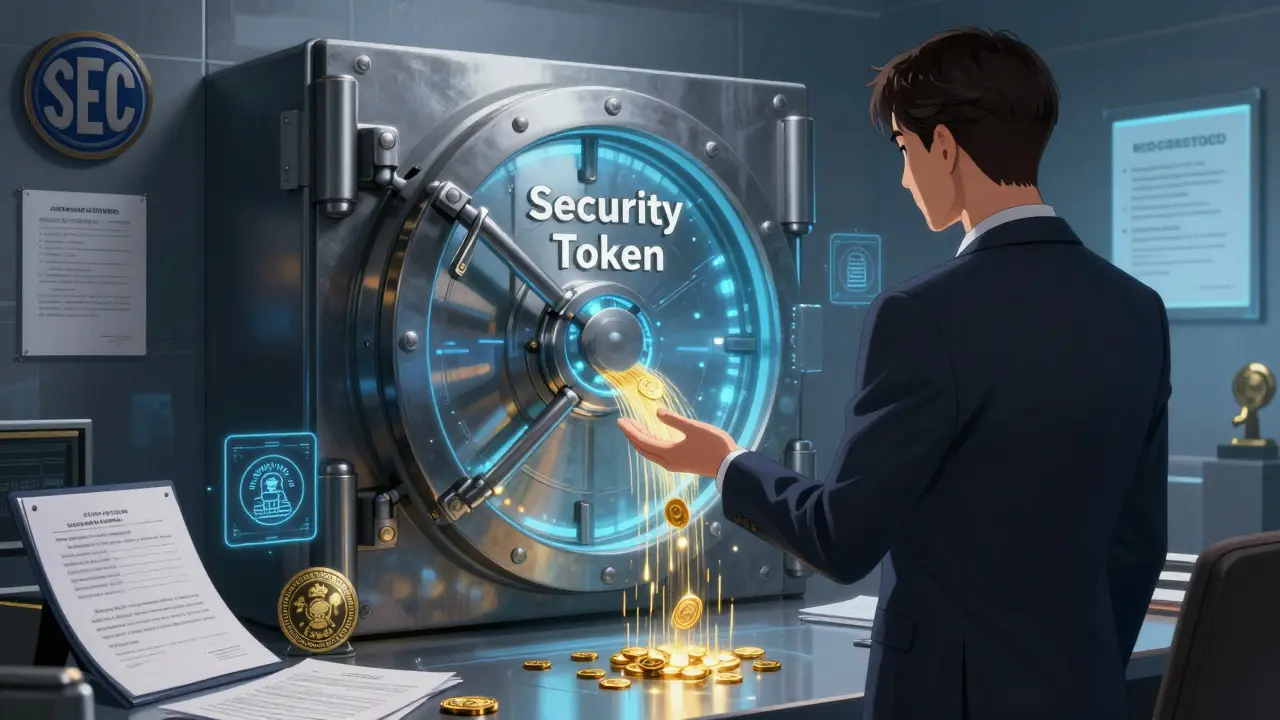
A security token represents ownership in a real-world asset. That could be shares in a company, a slice of a rental property, a bond, or even a fraction of a private equity fund. It’s not just a digital key - it’s a digital share certificate.Security tokens are legally treated like stocks or bonds. They must pass the Howey Test, a U.S. Supreme Court ruling from 1946 that says if you invest money in a common enterprise expecting profit from others’ efforts, it’s a security. The SEC applied this to crypto in 2017 and since then, 98.7% of tokens marketed as “utility” were later reclassified as securities - and fined.
Security tokens aren’t built on standard ERC-20. They use specialized standards like ERC-1400 or ST-20 that embed compliance rules directly into the code. These tokens can only be traded by accredited investors (those earning over $200,000/year or with $1 million net worth). They can’t be sent to just anyone - the smart contract blocks transfers if the recipient isn’t verified.
Platforms like InvestaX in Singapore or Securitize in the U.S. handle this complexity. They verify identities, block illegal transfers, automate tax reporting, and even distribute dividends. LABS Group’s token, for example, pays quarterly rental income from real estate holdings directly to token holders.
But this comes at a cost. Launching a security token takes 6-12 months and costs $500,000 to $2 million. You need lawyers, auditors, compliance officers, and regulators on your side. That’s why only 11.3% of all tokens are security tokens - but they’re growing 4.2x faster than utility tokens.
Regulation: The Biggest Divide
This is where things get serious. Utility tokens exist in a legal gray zone. In the U.S., the SEC says most are securities anyway. In 2022 alone, they filed 47 enforcement actions against projects mislabeling securities as utility tokens. The result? Over $1.2 billion in fines and forced refunds.Security tokens, by contrast, are tightly regulated. They must follow rules like SEC Regulation D (for private placements), Regulation A+ (for public offerings up to $75 million), or Regulation S (for non-U.S. investors). Each has strict disclosure rules, investor limits, and reporting requirements.
Other countries are catching up. Switzerland’s FINMA guidelines let tokens be classified as “payment,” “utility,” or “asset” tokens - offering more flexibility. The European Union’s MiCA regulation, effective December 2024, will force all crypto projects to clearly label their tokens as either utility or security, ending the confusion.
But here’s the catch: 68 of 135 countries now have their own rules. What’s legal in Singapore might be illegal in Brazil. That’s why institutional investors - like BlackRock and Franklin Templeton - are moving slowly. They need certainty before putting billions into tokenized assets.
Investor Experience: Who Benefits?
Retail investors love utility tokens. They’re easy to buy on exchanges like Binance or Coinbase. No paperwork. No income checks. You just click “buy.” But that freedom comes with risk. Reddit users report that 27.6% of utility token holders feel “no fundamental value” behind their holdings. The Steem token, for example, lost 92% of its value after a governance dispute - because there was no asset backing it.Security tokens are the opposite. They’re hard to access. You need to prove you’re an accredited investor. But once you’re in, the experience is different. Trustpilot reviews for security token platforms average 4.3/5 - higher than utility platforms at 3.1/5. Why? Because holders get real payouts. A token representing a share in a commercial building sends rent checks every quarter. A bond token pays interest on schedule.
But there’s a trade-off: liquidity. Utility tokens trade in millions daily. The average security token? Just $4.2 million per day. That’s because only a small pool of accredited investors can trade them. It’s like owning a rare painting - valuable, but hard to sell quickly.
Market Trends: Where Is the Money Going?
The global tokenized asset market was worth $2.3 billion in 2022. By 2030, it’s projected to hit $16.1 trillion. That growth isn’t coming from meme coins or NFTs. It’s coming from security tokens.Fortune 500 companies are jumping in. In 2021, only 17 used security tokens. By 2023, that number jumped to 89. Why? Because tokenizing real estate, private equity, and debt makes it easier to split ownership, reduce paperwork, and automate payments. DTCC’s Project Ion, which handles $1.2 trillion in daily trades, is already built to support security tokens.
BlackRock’s BUIDL fund and Franklin Templeton’s OnChain Fund are managing over $550 million in tokenized assets. These aren’t crypto startups - they’re Wall Street giants. They’re not buying utility tokens. They’re buying tokenized bonds, real estate, and private equity. That’s where the institutional money is going.
Meanwhile, utility tokens still dominate retail trading. But their long-term value is shaky. Without a real asset behind them, their price depends on hype, not fundamentals. And when the hype fades - as it did with many 2018 ICOs - the price crashes.

Hybrid Models and the Future
Some projects are trying to bridge the gap. TokenSoft’s Universal Token Framework, launched in June 2023, lets a single token act as a utility token for regular users and a security token for accredited investors. The smart contract changes behavior based on who’s holding it.This could be the future. Imagine a platform where anyone can use its services with a utility token, but only verified investors can own a stake in the company’s profits. That’s the kind of hybrid model regulators are starting to accept.
But until global rules align, the divide will stay wide. Utility tokens will keep serving consumers - access keys to apps, games, and services. Security tokens will serve institutions - digitized versions of stocks, bonds, and real estate.
The bottom line? If you’re buying a token to use a service, you’re holding a utility token. If you’re buying it to make money off someone else’s work, you’re holding a security - whether the project admits it or not.
How to Tell Them Apart
Here’s a quick checklist to spot the difference:- Does the token give you a share of profits, dividends, or ownership? → Security token
- Is it marketed as an “investment opportunity” or “potential return”? → Security token
- Can you trade it freely on any exchange? → Likely utility token
- Do you need to pass a KYC check to buy it? → Security token
- Does it only work within one platform’s ecosystem? → Utility token
- Is there a whitepaper explaining how the token powers a product? → Utility token
- Is there a legal disclaimer saying “this is not a security”? → Red flag - check the Howey Test
Don’t be fooled by labels. The SEC doesn’t care what you call it. They care what it does.
Are utility tokens legal?
Yes - if they truly only provide access to a product or service and aren’t sold as investments. But the SEC has reclassified over 98% of tokens marketed as utility as securities. If a project promises price appreciation or profit-sharing, it’s likely illegal. Always check the Howey Test.
Can anyone buy security tokens?
No. Security tokens are restricted to accredited investors under most regulations. In the U.S., that means you need at least $200,000 in annual income or $1 million in net worth (excluding your primary home). Some platforms allow non-accredited investors under Regulation A+, but that’s rare and requires heavy compliance.
Why do security tokens cost so much to launch?
Because you’re not just coding a token - you’re building a regulated financial product. You need legal counsel, investor verification systems, audit trails, compliance software, and filings with regulators like the SEC or MAS. A single security token offering can require 187+ pages of documentation and months of review.
Is XRP a security or utility token?
The SEC sued Ripple in 2020, claiming XRP was an unregistered security. In 2023, a judge ruled that XRP sold to institutions was a security, but XRP traded on public exchanges was not - because buyers weren’t promised profits. This created a gray zone: the same token can be both, depending on how and to whom it’s sold.
What’s the future of utility tokens?
Utility tokens will keep thriving in consumer-facing apps - gaming, social platforms, decentralized storage. But they’ll face more scrutiny. Projects that promise returns disguised as “rewards” or “voting rights” will get flagged. The future belongs to clear, functional tokens with no investment pitch.
Why are institutions investing in security tokens?
Because they offer the same benefits as traditional assets - dividends, interest, ownership - but with lower costs, faster settlement, and 24/7 trading. Tokenizing a $100 million real estate deal into 10,000 shares lets more investors participate. It’s easier to audit, harder to fraud, and integrates with existing financial systems. That’s why BlackRock and Goldman Sachs are building infrastructure for them.









Naman Modi
December 25, 2025 AT 12:07 PMThis is why I don't trust any token labeled 'utility' anymore. 😒
chris yusunas
December 26, 2025 AT 22:17 PMUtility tokens are the digital equivalent of a carnival ticket - fun while it lasts, but worthless once the ride ends. Meanwhile, security tokens? That’s the actual prize inside the box. 🎯
Most folks chasing utility tokens are just gambling with WiFi. The real money’s in the ones that pay rent, dividends, or equity - not hype.
Tyler Porter
December 27, 2025 AT 06:00 AMYes! Exactly! I’ve been saying this for years - if it smells like a security, acts like a security, and walks like a security… it’s a security! 🚨
Stop hiding behind buzzwords. The SEC isn’t fooled. And neither should you be.
Steve B
December 29, 2025 AT 02:34 AMOne must ask: is the token a tool, or a transaction? The metaphysical distinction eludes most retail participants, who confuse utility with opportunity. The market, in its infinite wisdom, rewards neither.
Sophia Wade
December 30, 2025 AT 23:49 PMThe beauty of this divide lies not in the code, but in the intention behind it. Utility tokens are the poetry of decentralized access - ephemeral, expressive, unbound. Security tokens are the ledger of capital - cold, calculated, and bound by centuries of legal tradition.
One dreams. The other owns. And in the end, ownership always outlasts the dream.
Brian Martitsch
December 31, 2025 AT 12:09 PMOf course utility tokens are trash. 😴 Only amateurs buy them. Real investors? They’re in tokenized private equity. If you don’t have a KYC and a lawyer, you’re not investing - you’re donating to someone’s crypto fantasy.
vaibhav pushilkar
January 2, 2026 AT 06:13 AMJust added this to my checklist for every new token I see. Super clear breakdown. Especially the Howey Test part - that’s the golden rule now.
Pro tip: if the whitepaper says ‘potential ROI’ anywhere, close the tab. Immediately.
SHEFFIN ANTONY
January 2, 2026 AT 22:55 PMEveryone’s acting like security tokens are the future. Newsflash: they’re still stuck in 2018 compliance hell. Meanwhile, utility tokens are powering actual apps - games, DeFi, AI agents. You’re clinging to old finance like it’s sacred. Wake up.
Tokenized real estate? Please. That’s just Wall Street with a blockchain tattoo.
Vyas Koduvayur
January 4, 2026 AT 22:25 PMLet’s be brutally honest - 98% of utility tokens are pump-and-dumps dressed in smart contract clothing. The fact that people still buy them shows how little they understand blockchain fundamentals.
Security tokens? They’re not perfect, but at least they’re not scams. You’re not just buying a token - you’re buying a legal claim. That’s not ‘crypto’ - that’s finance, with better tech.
And don’t get me started on XRP. The whole ‘it’s utility because it’s on an exchange’ loophole is laughable. The SEC didn’t sue Ripple because they were mad - they sued because they were right.
People think decentralization means no rules. It doesn’t. It means better rules. And those rules are written in law, not code.
Also, the fact that institutional money is flowing into security tokens while retail flees to meme coins? That’s not a trend - that’s a wake-up call. The market’s voting with its wallets.
And yes, liquidity is low. So what? Private equity wasn’t liquid either - until everyone realized the value was real. This is the same story. Just slower.
Utility tokens will survive, sure. But they’ll be the Instagram filters of finance - flashy, disposable, and ultimately meaningless to anyone who matters.
Meanwhile, security tokens? They’re the bank account you forgot you had - until the dividends hit your wallet every quarter.
Lloyd Yang
January 5, 2026 AT 05:42 AMI’ve been watching this space for 7 years. I remember when utility tokens were the hope - the promise that blockchain could empower users without gatekeepers.
But the truth? Most of them were never meant to be used. They were meant to be sold. And when the selling stopped, the utility vanished.
Security tokens feel different. They’re slower. They’re heavier. They come with paperwork, lawyers, and compliance. But they also come with real value - rent checks, interest payments, equity stakes.
It’s like comparing a flashy smartphone with a reliable old car. One looks cool in the showroom. The other gets you to work every day.
The fact that BlackRock and Franklin Templeton are moving in? That’s not a fad. That’s the endgame.
And honestly? I’m glad. I’m tired of gambling. I want to invest.
Let the hypesters have their meme coins. I’ll be here, collecting dividends from tokenized real estate.
And if you’re reading this and thinking ‘but I want to get rich quick’ - maybe take a step back. The real wealth isn’t in the next pump. It’s in the steady drip.
That’s not sexy. But it’s real.
Jake Mepham
January 5, 2026 AT 18:19 PMJust came back from a blockchain summit in Singapore - and guess what? Every single institutional panel was talking about security tokens. Zero mention of utility tokens.
Meanwhile, the retail floor? Pure chaos. People holding tokens they can’t even explain.
It’s like watching a high school dance where the cool kids are in the back room with the teachers. The rest are just dancing to beats they don’t understand.
Don’t get me wrong - utility tokens have a place. In apps. In games. In decentralized tools.
But if you’re buying a token because you think it’ll 10x? You’re not a user. You’re a speculator. And the market is catching on.
Craig Fraser
January 7, 2026 AT 00:20 AMHow many times must we be told that ‘it’s not a security’ before we realize that’s the first red flag? The fact that this needs explaining at all is a testament to the industry’s chronic dishonesty.
And yet - here we are. Still pretending the emperor has clothes.
At least MiCA is forcing clarity. Good riddance to the gray zone.
Tyler Porter
January 8, 2026 AT 00:02 AMExactly! And don’t forget - even if you’re ‘just using’ a utility token, if the project raised money by promising future utility AND price growth? That’s still a security under the Howey Test.
It’s not about what you do with it. It’s about how it was sold.