
Have you ever wondered why some decentralized exchanges seem to pay their users more than others? Or why locking up your crypto tokens for years sounds like a bad idea until you see the math behind it? If you are diving into the world of DeFi on the Fantom blockchain, you have likely come across Solidly, a decentralized exchange protocol designed for low slippage and high capital efficiency.
Solidly isn't just another trading platform. It is an automated market maker (AMM) that tries to fix the biggest headaches in decentralized finance: high fees when swapping stablecoins and diluted rewards for long-term holders. At the heart of this system is the SOLID token, which serves as both a governance tool and a revenue generator. Understanding how SOLID works is key to unlocking the potential of the Solidly ecosystem.
The Core Problem: Slippage and Inefficient Fees
Most people start using decentralized exchanges because they want freedom from centralized brokers. But there is a catch. Traditional AMMs like Uniswap v2 use a simple mathematical formula called x*y=k. This works fine for swapping Bitcoin for Ethereum, but it fails miserably when you try to swap two assets that should have the same value, like USDC and DAI. You end up paying huge "slippage" fees because the algorithm doesn't understand that these assets are pegged.
Then there is Curve Finance, which solved the stablecoin slippage problem with a complex curve formula. However, Curve's governance model has flaws. It distributes fees evenly among all voters, regardless of whether they voted for profitable pools or not. This creates a "free rider" problem where everyone gets paid even if they don't contribute to the pool's success.
Solidly was built to combine the best of both worlds. It uses Uniswap's reliable architecture but replaces the constant product formula with a new equation: x³y + y³x = k. This allows for near-zero slippage on correlated assets while keeping the codebase simple. More importantly, it changes how money flows through the system.
How the SOLID Token Works
The SOLID token is the fuel that powers the Solidly engine. Unlike many other DeFi tokens that are purely speculative, SOLID has a direct link to real protocol revenue. Here is how it functions in practice:
- Governance Power: Holding SOLID alone gives you no voting rights. You must lock your tokens to receive veSOLID (vote-escrowed SOLID). The longer you lock, the more veSOLID you get.
- Revenue Share: Trading fees generated by pools are distributed exclusively to veSOLID holders who voted for those specific pools. If you vote for a pool, you earn its fees. If you don't, you earn nothing from it.
- Emission Control: The total supply of SOLID is capped at 300 million. New tokens are emitted weekly, but only if there are unlocked tokens in circulation. As more people lock their tokens, emissions decrease. When 100% of tokens are locked, emissions hit zero.
This structure creates a powerful incentive. By locking your SOLID, you reduce inflation for everyone else. You also secure your share of future fee revenues. It is a classic example of aligning individual greed with collective health.
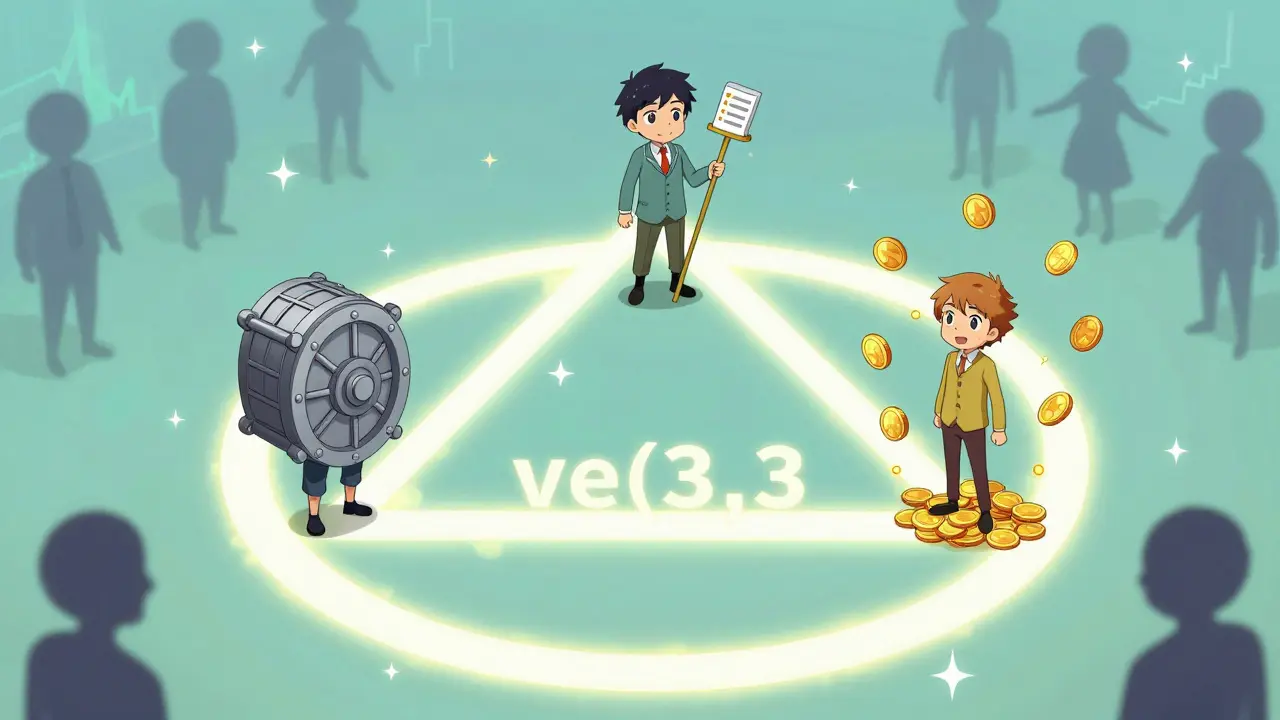
The ve(3,3) Economic Model Explained
You might hear the term "ve(3,3)" thrown around in Solidly discussions. This refers to the economic game theory model underpinning the protocol. It is an evolution of the (3,3) model popularized by Olympus DAO, adapted for vote-escrow systems.
In traditional economics, the Nash Equilibrium often leads to suboptimal outcomes for groups. The (3,3) model aims for a scenario where mutual cooperation yields the highest reward for all parties. In Solidly, this means:
- Lock Tokens: Users lock SOLID to get veSOLID.
- Vote for Pools: veSOLID holders vote on which liquidity pools receive incentives.
- Earn Fees: Voters earn trading fees from the pools they supported.
- Attract Liquidity: High incentives attract liquidity providers, which reduces slippage and attracts traders.
- Generate Revenue: More traders mean more fees, which goes back to the voters.
This cycle creates a positive feedback loop. The more people participate honestly, the richer the entire ecosystem becomes. It prevents the "race to the bottom" seen in other protocols where teams bribe voters with unsustainable token emissions.

Why Locking SOLID Makes Sense (The Math)
Let's look at the numbers. Why would anyone lock their crypto for four years? Here is the conversion rate for veSOLID based on lock duration:
| Lock Duration | veSOLID per 1 SOLID | Benefit Level |
|---|---|---|
| 6 Months | 0.125 | Low Voting Power |
| 2 Years | 0.5 | Moderate Voting Power |
| 4 Years | 1.0 | Maximum Voting Power |
If you lock 1,000 SOLID for four years, you get 1,000 veSOLID. If you lock it for six months, you only get 125 veSOLID. Since veSOLID determines your share of trading fees and governance influence, long-term locks are significantly more valuable. This mechanism protects long-term holders from dilution. As short-term speculators sell their unlocked tokens, the emission rate drops, preserving the value of the locked supply.
NFT-ized Locks: A Game Changer
One of the most innovative features of Solidly is the introduction of veNFTs (vote-escrowed Non-Fungible Tokens). In traditional ve-token models, once you lock your tokens, they are gone until the timer expires. You cannot sell them, move them, or use them elsewhere.
Solidly changes this. When you lock SOLID, you receive an NFT that represents your vested position. This NFT can be:
- Sold on Secondary Markets: Want to exit early? Sell the NFT instead of breaking the lock. The buyer takes over the remaining vesting period.
- Used as Collateral: Some lending protocols may accept veNFTs as collateral, allowing you to borrow against your locked position without selling it.
- Split into Batches: You can separate one large lock into multiple smaller NFTs, giving you flexibility in how you distribute your voting power or manage risk.
This liquidity layer makes locking far less risky. You aren't trapped; you just need to find a buyer for your NFT. This innovation bridges the gap between illiquid long-term commitments and the desire for financial flexibility.
Solidly vs. Other Decentralized Exchanges
How does Solidly stack up against the giants? Let's compare it to Uniswap and Curve Finance.
| Feature | Uniswap v2/v3 | Curve Finance | Solidly |
|---|---|---|---|
| Slippage on Stablecoins | High (v2) / Low (v3) | Very Low | Very Low |
| Fee Distribution | To LPs | To All Voters | To Pool-Specific Voters |
| Governance Mechanism | Token Holders | veCRV | veSOLID + veNFTs |
| Lock Liquidity | No | No | Yes (via NFTs) |
| Primary Chain | Ethereum/Multi-chain | Ethereum/Multi-chain | Fantom |
Uniswap is the gold standard for general-purpose trading, but its stablecoin swaps are expensive compared to specialized platforms. Curve dominates stablecoin trading but suffers from inefficient fee distribution. Solidly aims to capture the stability of Curve with the fairer economics of a ve(3,3) model, all while running on the fast, low-cost Fantom network.
Risks and Considerations for Investors
No investment is without risk. Before you buy or lock SOLID, consider these factors:
- Smart Contract Risk: Like all DeFi protocols, Solidly relies on smart contracts. Bugs or exploits could lead to loss of funds. Always check for recent audits.
- Market Volatility: The price of SOLID can fluctuate wildly. Even if you earn fees, a drop in token price could outweigh your gains.
- Liquidity Depth: While Solidly has grown, it still trails behind Uniswap and Curve in total volume. Lower volume means fewer fees to distribute.
- Complexity: The ve(3,3) model and NFT mechanics are complex. Misunderstanding the lock periods or voting mechanisms can lead to poor financial decisions.
Additionally, the broader crypto market sentiment heavily influences DeFi projects. During bear markets, trading volumes drop, which directly impacts fee revenues for veSOLID holders.
Getting Started with Solidly
If you decide to explore Solidly, here is a practical roadmap:
- Set Up a Wallet: Use a wallet compatible with Fantom, such as MetaMask or Trust Wallet. Ensure you have FTM for gas fees.
- Acquire SOLID: Buy SOLID on a centralized exchange like Binance or trade for it on a DEX like SpookySwap or Solidly itself.
- Visit the Solidly Interface: Go to the official Solidly website. Connect your wallet.
- Lock Your Tokens: Navigate to the "Lock" section. Choose your desired lock duration (up to 4 years). Confirm the transaction.
- Vote for Pools: Once you have veSOLID, go to the governance section. Vote for pools that offer good returns and sustainable incentives.
- Claim Rewards: Periodically claim your earned SOLID emissions and trading fees.
Remember, this is not financial advice. Do your own research and never invest more than you can afford to lose.
The Future of Solidly on Fantom
Solidly continues to evolve. Recent developments include derivative protocols like Solidex, which allow users to accumulate SOLID and provide liquid versions of locked positions. These innovations extend the utility of the SOLID token beyond simple governance.
The Fantom ecosystem remains a strong home for Solidly. With low transaction costs and high speed, Fantom supports the frequent interactions required by ve(3,3) models. As more projects integrate with Solidly and the user base grows, the potential for fee generation increases.
The protocol's focus on sustainability over hype sets it apart in a crowded market. By prioritizing fee accrual and anti-dilution mechanisms, Solidly offers a glimpse into what decentralized exchanges could look like in the next generation of DeFi.
What is the maximum supply of SOLID tokens?
The maximum supply of SOLID tokens is capped at 300 million. This hard cap ensures that inflation is controlled and eventually eliminated as more tokens are locked by users.
Can I unlock my SOLID tokens before the lock period ends?
You cannot directly unlock SOLID tokens before the period ends. However, you can sell your veNFT on secondary markets. The buyer will then hold the vested position until maturity.
How do I earn fees from Solidly?
To earn fees, you must lock SOLID to receive veSOLID, then vote for specific liquidity pools. You will receive a pro-rata share of the trading fees generated by the pools you voted for.
Is Solidly safe to use?
Like any DeFi protocol, Solidly carries smart contract risks. While it has undergone audits and has a strong track record since its 2022 launch, users should always exercise caution and diversify their investments.
What is the difference between SOLID and veSOLID?
SOLID is the native ERC-20 token that can be traded freely. veSOLID is a non-transferable representation of voting power obtained by locking SOLID for a set period. Only veSOLID holders can vote and earn trading fees.
Why does Solidly use the Fantom blockchain?
Fantom offers low transaction fees and high throughput, which is essential for a DEX that encourages frequent voting and fee claiming. This cost efficiency benefits both traders and liquidity providers.
What happens if I don't vote for any pools?
If you hold veSOLID but do not vote for any pools, you will not earn any trading fees. Your voting power is only monetized when actively allocated to specific liquidity pools.
How does the anti-dilution mechanism work?
As more SOLID tokens are locked, the weekly emission of new tokens decreases. When all tokens are locked, emissions stop entirely. This protects long-term holders from inflation and preserves their percentage of ownership.