

Have you ever wondered what happens when a crypto project tries to "invade" other metaverses? That’s the bold pitch behind VEMP, also known as VEMP Horizon, the native token of the vEmpire DDAO ecosystem, a decentralized organization focused on metaverse investment and anti-centralization strategies. If you’ve stumbled upon this micro-cap coin in your research, you’re likely looking for more than just a price chart. You want to know if it’s a legitimate play in the Web3 space or just another speculative asset with thin liquidity.
In this guide, we’ll break down exactly what VEMP is, how its unique multi-token structure works, and whether it fits into your portfolio strategy. We’ll look at the hard numbers-supply, price history, and trading venues-and separate the marketing hype from the on-chain reality.
Quick Summary / Key Takeaways
- Identity: VEMP (now rebranded as VEMP Horizon) is the utility and reward token of vEmpire DDAO, operating primarily on the Arbitrum network.
- Purpose: It enables users to stake metaverse tokens (like MANA or SAND) to earn dual yields: interest on the staked asset plus rewards in VEMP.
- Governance: Staking VEMP converts it to xVEMP, which grants voting rights and a share of platform profits (up to 20% of pool revenues).
- Market Status: As of mid-2026, VEMP is a micro-cap asset with a circulating supply around 500 million and significant price volatility.
- Risk Profile: High risk due to low liquidity, small market cap (~$30k-$100k range), and niche adoption compared to major DeFi protocols.
What Exactly Is vEmpire DDAO?
To understand the coin, you first need to understand the machine that runs it. vEmpire DDAO is a decentralized autonomous organization that positions itself as a metaverse investment fund and governance body. Unlike traditional funds managed by a team of analysts, vEmpire relies on community staking and automated smart contracts to acquire virtual assets.
The project’s narrative is aggressive: it claims to fight against centralization in Web3. The idea is simple but ambitious. Users stake popular metaverse tokens into vEmpire’s pools. The protocol then uses these pooled assets to buy virtual land, NFTs, and other digital properties in various metaverses. The goal? To capture value from these ecosystems and return profits to the stakers.
Dom Ryder, the CEO and public face of vEmpire, has described the project as the "Metaverse’s first Layer Two Protocol." This doesn’t mean it’s a blockchain itself, but rather a layer of financial infrastructure built on top of existing networks (specifically Arbitrum) that interacts with multiple metaverses simultaneously. Instead of betting on one world like Decentraland or The Sandbox, vEmpire aims to be agnostic, moving capital wherever the best opportunities arise.
How VEMP Tokenomics Work: The Three-Token System
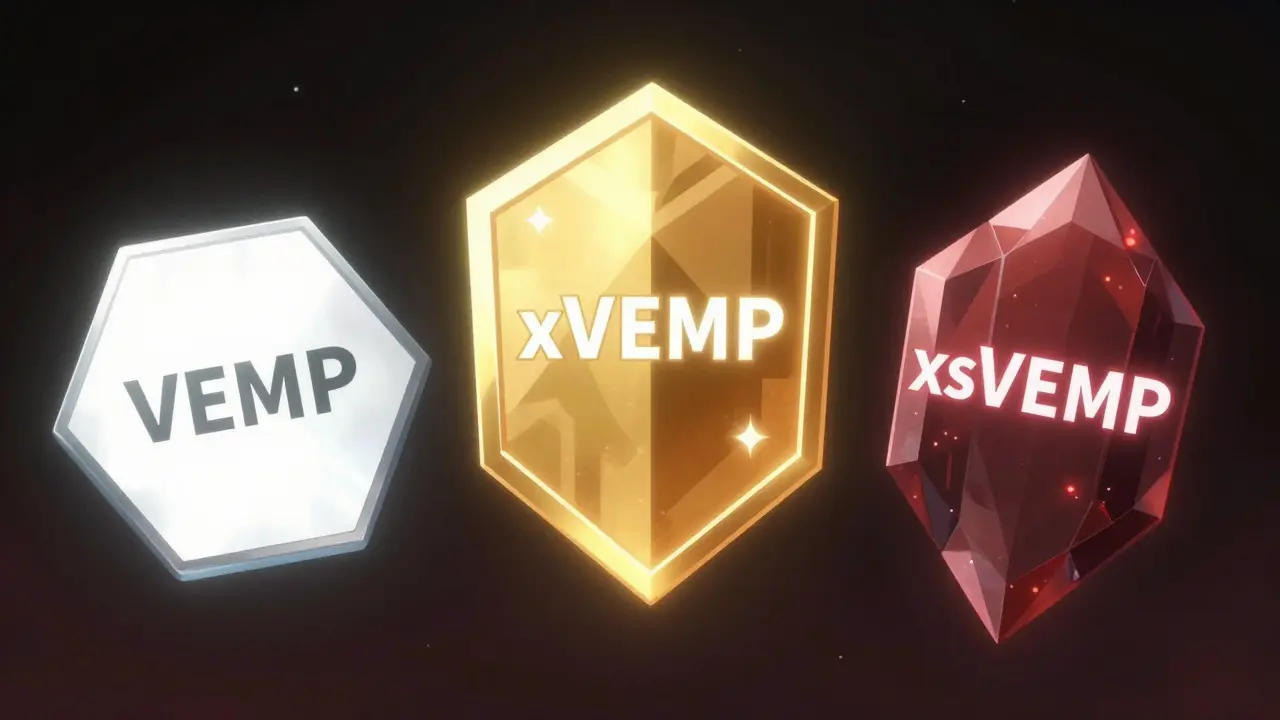
Most crypto projects have one token. vEmpire uses three, each with a distinct job. Understanding this separation is crucial because mixing them up can lead to confusion about your actual holdings.
- VEMP (The Utility Token): This is the token you buy on exchanges. It serves as the workhorse of the ecosystem. You use it to pay for services, participate in gaming features, and most importantly, to stake. When you stake VEMP, you are locking it up to support the network.
- xVEMP (The Governance Token): When you stake VEMP, you receive xVEMP. This isn’t just a receipt; it’s a governance share. Holding xVEMP gives you voting rights in the DDAO. More importantly, it entitles you to a portion of the profits generated by the staking pools. According to project documentation, up to 20% of profits from all metaverse strategies are distributed to xVEMP holders.
- xsVEMP (The Deep Stake Token): While less frequently discussed in public materials, xsVEMP is mentioned in whitepapers as part of deeper staking mechanics. It likely represents longer-term or more locked commitments within the treasury, though specific details on its utility remain sparse compared to VEMP and xVEMP.
This structure creates a flywheel effect. You buy VEMP, stake it to get xVEMP, and earn rewards in both the underlying metaverse tokens you helped fund and new VEMP emissions. It’s designed to incentivize long-term holding over short-term trading.
Supply, Emissions, and the "Max Cap" Confusion
If you look at different crypto trackers, you might see conflicting numbers for VEMP’s supply. This is a common issue with older projects that undergo contract migrations or rebranding. Let’s clear up the fog.
Originally, the whitepaper outlined a strict emission schedule. The initial supply was set at 90 million VEMP. Over a 21-year period, the protocol was supposed to mint new tokens at decreasing rates: starting at 20 per block for the first three years, dropping to 15, then 10, and finally 5 per block. This mathematical model resulted in a theoretical maximum supply of 810,720,000 VEMP.
However, current data tells a different story. As of mid-2026, major aggregators like CryptoSlate and Bybit report a circulating and total supply capped at 500,000,000 VEMP. CoinCarp lists a max supply closer to 807 million. Why the discrepancy?
The project rebranded to "VEMP Horizon" and migrated its primary contracts to the Arbitrum network. During such migrations, tokens are often burned, consolidated, or moved to new addresses. The 500 million figure appears to be the effective circulating supply currently active in the market. For investors, this means the inflation rate is effectively paused or significantly altered from the original 21-year plan. Always check the live contract address on Arbitrum to verify the real-time supply, as historical data may not reflect the current state of the ledger.
Where Can You Trade VEMP?
Because VEMP is a micro-cap asset, you won’t find it on every major exchange. Liquidity is fragmented, which impacts your ability to buy or sell large amounts without affecting the price.
| Exchange Type | Platform | Trading Pair | Liquidity Note |
|---|---|---|---|
| Centralized (CEX) | KuCoin | VEMP/USDT | Higher volume relative to others; occasional spikes. |
| Centralized (CEX) | BingX | VEMP/USDT | Available but lower daily volume. |
| Centralized (CEX) | Gate.io | VEMP/USDT | Very low daily volume (often under $20). |
| Decentralized (DEX) | Uniswap V4 (Arbitrum) | VEMP/ETH | Primary on-chain venue; requires Arbitrum wallet setup. |
The shift to Arbitrum is significant. Ethereum mainnet fees were too high for a token with such low individual value. By moving to Arbitrum, transaction costs drop to pennies, making micro-transactions and frequent staking viable. However, this also means you need an Ethereum-compatible wallet (like MetaMask) configured for the Arbitrum network to interact directly with the vEmpire dApp.
Price Performance and Market Reality Check
Let’s talk numbers, because they paint a stark picture. VEMP is not a blue-chip asset. It is a highly speculative, micro-cap coin.
In early 2025, VEMP traded around $0.0008. By February 2026, it had dropped to roughly $0.0002. As of June and July 2026, prices hovered between $0.00005 and $0.0001 depending on the exchange. With a circulating supply of 500 million, the market capitalization fluctuates between approximately $29,000 and $108,000.
For context, top metaverse tokens like MANA or SAND have market caps in the hundreds of millions or billions. VEMP ranks outside the top 6,000 coins on CoinGecko. What does this mean for you?
- High Volatility: A single trade of $1,000 could move the price significantly because the daily trading volume is often very low (sometimes under $200 on CEXs).
- Liquidity Risk: You might see a price on an exchange, but if there aren’t enough buyers, you may struggle to exit your position at that price.
- Data Inconsistency: Some platforms list the circulating supply as zero or incorrect, leading to misleading market cap calculations. Always cross-reference with on-chain data via Etherscan (for Arbitrum).
This performance suggests that while the technology and concept exist, mass adoption has not yet materialized. The price action reflects a niche community rather than broad market interest.
Is VEMP Worth Your Attention?
So, should you buy VEMP? That depends entirely on your goals and risk tolerance.
If you are a die-hard believer in the concept of "decentralized metaverse invasion" and want to support a project that explicitly fights centralization through DAO governance, VEMP offers a unique entry point. The mechanism of earning yield on idle metaverse tokens is genuinely useful if the pools are profitable. The 20% profit share to xVEMP holders is a strong incentive if the underlying investments succeed.
However, if you are looking for stable growth or easy liquidity, VEMP is likely not for you. The micro-cap status means it carries substantial risk of further depreciation or stagnation. The complexity of managing three different tokens (VEMP, xVEMP, xsVEMP) across the Arbitrum network adds a layer of technical friction that casual investors may find frustrating.
Before diving in, ask yourself: Do I trust the vEmpire team’s ability to generate profits from virtual land acquisitions? Am I comfortable with a token that trades with minimal volume? If the answer is yes, proceed with caution and start small. If no, stick to larger, more liquid metaverse projects.
Frequently Asked Questions
What is the difference between VEMP and xVEMP?
VEMP is the tradable utility token you buy on exchanges. xVEMP is the governance token you receive when you stake VEMP. While VEMP is used for transactions and rewards, xVEMP grants you voting rights in the vEmpire DDAO and entitles you to a share of the platform's profits (up to 20% of pool revenues). You cannot trade xVEMP directly; you must unstake it to convert it back to VEMP.
Which blockchain does VEMP operate on?
As of 2026, VEMP (rebranded as VEMP Horizon) primarily operates on the Arbitrum Layer 2 network. This migration was done to reduce transaction fees and increase speed. Older contracts on Ethereum mainnet are largely deprecated. Ensure your wallet is connected to Arbitrum when interacting with the vEmpire dApp or Uniswap V4.
What is the maximum supply of VEMP?
The original whitepaper specified a maximum supply of 810,720,000 VEMP tokens over a 21-year emission schedule. However, current market data from 2026 shows a circulating and total supply capped at approximately 500,000,000 VEMP due to contract migrations and potential burns. Always verify the live supply on-chain, as aggregator data can vary.
How do I earn yield with VEMP?
You can earn yield in two ways. First, by staking metaverse tokens (like MANA or SAND) in vEmpire’s pools, you earn interest on those tokens plus rewards in VEMP. Second, by staking your own VEMP tokens, you receive xVEMP, which earns a share of the profits generated by the entire platform’s investment strategies.
Is VEMP a safe investment?
VEMP is considered a high-risk, micro-cap asset. As of mid-2026, it has a very low market capitalization (under $100k) and limited trading volume. This makes it susceptible to high volatility and liquidity issues. It is suitable only for experienced crypto investors who understand the risks associated with small-cap DeFi and metaverse projects.
Who is behind vEmpire DDAO?
Dom Ryder is the CEO and public representative of vEmpire. He has been involved since the project’s early days (circa 2021) and outlines the vision of vEmpire as a decentralized protocol that invests across multiple metaverses to combat centralization. The team emphasizes community governance through the DDAO structure.