

It’s May 2026. The dust has settled on the massive price swings of 2024 and 2025, and your eyes are already on the horizon. You’re wondering: when is the next Bitcoin halving?
The short answer is that it will happen around January 2028. But if you’ve been in crypto long enough, you know that "around" doesn’t help much when you’re planning investments or tracking network changes. The exact date isn’t set in stone because Bitcoin runs on a decentralized network where timing fluctuates slightly.
Understanding this event isn’t just about picking a date on the calendar. It’s about grasping why Bitcoin’s supply shrinks, how that affects miners, and what history tells us about price movements. Let’s break down exactly what happens, when it happens, and why the 2028 cycle might look different from the ones before it.
What Exactly Is the Bitcoin Halving?
To understand the "when," you first need to nail down the "what." A Bitcoin halving is a pre-programmed event in Bitcoin's protocol that cuts the reward miners receive for validating transactions by 50%.
This isn’t a decision made by a board of directors or a central bank. It’s code. Satoshi Nakamoto wrote this rule into the original whitepaper in 2009 to ensure Bitcoin remains scarce. There will only ever be 21 million bitcoins. The halving controls the speed at which new coins enter circulation.
Here is how it works in practice:
- Block Reward: Miners solve complex mathematical puzzles to secure the network. When they do, they get paid in newly created Bitcoin plus transaction fees.
- The Cut: Every 210,000 blocks, that new coin payment is cut in half.
- The Goal: This reduces inflation over time, making Bitcoin deflationary compared to fiat currencies like the US Dollar or Euro.
Think of it like a gold mine. At first, gold pours out easily. As the easy veins run dry, it takes more effort to find less gold. Bitcoin mimics this scarcity digitally, but with perfect precision.
Pinpointing the Next Halving Date
You might be looking for a specific day and time. Here is the reality: we can estimate it very closely, but not perfectly years in advance.
Bitcoin aims to produce one block every 10 minutes. However, mining is probabilistic. Sometimes blocks come every 8 minutes; sometimes it takes 12. Over 210,000 blocks, these small variances add up.
| Metric | Value / Estimate |
|---|---|
| Target Block Height | 1,050,000 |
| Current Block (May 2026) | ~990,000+ (Approximate) |
| Blocks Remaining | ~60,000 |
| Projected Month | January 2028 |
| Specific Estimate (NiceHash) | January 23, 2028 |
| New Block Reward | 1.5625 BTC |
As of mid-2026, major trackers like NiceHash and CoinCodex point to late January 2028. If the average block time stays close to 10 minutes, the event will trigger right then. If miners get lucky and blocks come faster, it could shift earlier by a few weeks. If they struggle, it pushes later.
The key takeaway? Don’t bet on the exact hour. Bet on the month. By December 2027, the date will be clear within days.
Historical Context: How Past Halvings Played Out
History doesn’t repeat itself, but it often rhymes. Looking at previous halvings gives us a framework for what *might* happen, though past performance never guarantees future results.
- November 2012 (Halving #1): Price was ~$12. Six months later, it hit $130. A massive 1,000%+ gain.
- July 2016 (Halving #2): Price was ~$650. Six months later, it reached $2,520. A solid 3x increase.
- May 2020 (Halving #3): Price was ~$8,600. Six months later, it climbed to $17,900. Roughly a 2x gain.
- April 2024 (Halving #4): Price was ~$64,000. By November 2024, it had risen to ~$90,000. A more modest 41% increase initially, though prices continued to climb toward $110,000 by early 2025.
Notice the pattern? The percentage gains have diminished with each cycle. Why? Because Bitcoin is bigger. Moving the needle requires exponentially more capital now than it did in 2012. In 2012, a few million dollars could sway the price. In 2028, it will take billions.
Also, notice the lag. Prices rarely spike *on* the halving day. The real moves usually happen 6 to 12 months after the event as the reduced supply starts to bite against steady demand.
Why the 2028 Cycle Might Be Different
If you assume 2028 will just mirror 2020, you’re missing the biggest change in Bitcoin’s history: institutional adoption.
In 2020, most Bitcoin holders were individuals. Today, BlackRock, Fidelity, and other giants hold hundreds of thousands of BTC through Spot ETFs. These funds don’t panic sell during dips; they buy based on long-term mandates. This structural change absorbs volatility differently than retail-driven markets.
Consider these factors shaping the 2028 landscape:
- ETF Demand: With over 950,000 BTC held by ETF issuers alone, the liquid supply available for trading is smaller than many realize. This creates a tighter market.
- Miner Economics: Mining companies like Marathon Digital and Riot Platforms are publicly traded. They operate with efficiency pressures that solo miners didn’t face in 2016. Lower rewards mean higher pressure to optimize energy costs.
- Regulatory Clarity: Unlike 2017 or 2021, the regulatory environment in the US and EU is more defined. This reduces the risk of sudden bans that once caused flash crashes.
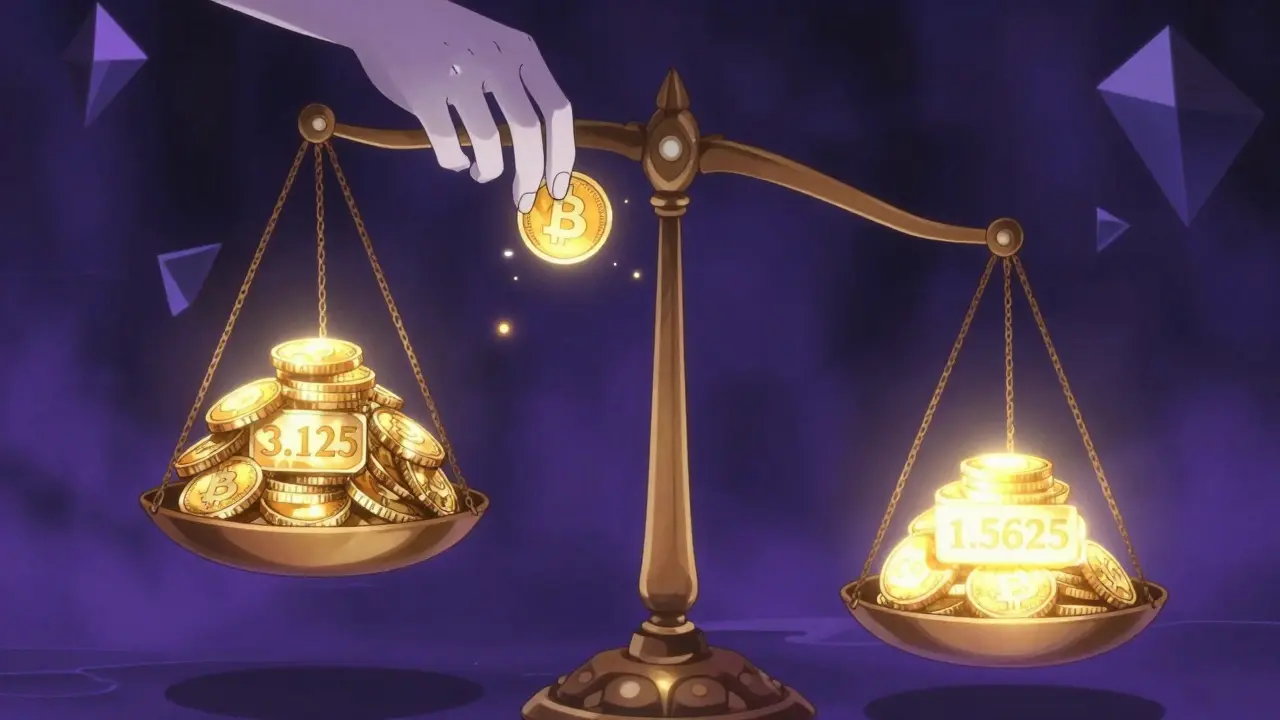
Some analysts argue that because ETFs provide constant buying pressure, the traditional "halving pump" might be smoother but less explosive. Others believe the scarcity effect will still dominate, pushing prices higher as issuance drops to 1.5625 BTC per block.
Impact on Miners and Network Security
The halving isn’t just good news for hodlers. It’s a stress test for miners.
When the reward halves, revenue drops by roughly 50% overnight (assuming transaction fees stay flat). Less efficient miners-those with older hardware or high electricity costs-will go bankrupt. They shut down their rigs. This causes a temporary drop in the network’s hash rate (computational power).
But here is the safety valve: Bitcoin’s difficulty adjustment. Every 2,016 blocks (about two weeks), the network automatically adjusts how hard the puzzles are to solve. If hash rate drops, difficulty drops. This ensures blocks still appear every 10 minutes, keeping the network stable.
By 2028, miners will rely even more heavily on transaction fees. As Bitcoin usage grows, so does fee revenue. The Taproot upgrade and potential future soft forks aim to make transactions cheaper and more flexible, encouraging more use cases beyond simple transfers. This fee income becomes crucial as block rewards approach zero around the year 2140.

How to Track the Countdown Yourself
You don’t need to trust my word or a single website. You can verify the progress yourself using blockchain explorers.
Head to sites like Blockchain.com or Mempool.space. Look for the current block height. As of May 2026, we are well past block 900,000. The target is 1,050,000.
Simple math helps here:
- Blocks remaining: 1,050,000 - Current Block
- Average time per block: ~600 seconds (10 minutes)
- Time remaining: Blocks remaining x 600 seconds
For example, if there are 60,000 blocks left: 60,000 x 600 = 36,000,000 seconds. Divide by 60 for minutes, by 60 for hours, by 24 for days. That gives you roughly 416 days, landing squarely in early 2028.
Tools like CoinWarz and NiceHash automate this calculation, updating in real-time as block times fluctuate. Bookmark one of these pages to watch the countdown tick down.
Common Mistakes to Avoid
With hype comes bad advice. Here is what seasoned investors avoid:
- Buying the Rumor, Selling the News: Many people buy months before the halving expecting an instant spike. Often, the price consolidates or dips right before the event. Patience is key.
- Ignoring Macro Factors: Bitcoin doesn’t exist in a vacuum. Interest rates, inflation data, and global liquidity impact crypto just as much as tech stocks. A strong halving narrative can be overridden by a recession.
- Overleveraging: Using high leverage to trade the halving volatility is dangerous. Flash wicks can liquidate positions even if the long-term trend is up.
Treat the halving as a macroeconomic event, not a casino slot machine pull. It shifts supply dynamics slowly, over months and years.
Will Bitcoin price double after the 2028 halving?
There is no guarantee. While historical cycles show significant price increases 6-12 months post-halving, the magnitude varies. The 2024 halving saw a more modest initial gain compared to 2016 or 2020 due to larger market cap and institutional involvement. Factors like global regulation, ETF flows, and macroeconomic conditions play huge roles.
What is the new block reward after the 2028 halving?
The block reward will drop from 3.125 BTC to 1.5625 BTC. This means miners will receive half as many new bitcoins for each block they validate, reducing the daily issuance of new Bitcoin significantly.
Can the Bitcoin halving date change?
Yes, slightly. The halving occurs at a specific block number (1,050,000), not a specific date. Since block times vary around the 10-minute average, the actual calendar date can shift by a few weeks earlier or later depending on miner luck and network activity.
Does the halving affect Bitcoin transaction fees?
Indirectly, yes. As block rewards shrink, miners may prioritize transactions with higher fees to maintain profitability. If network congestion is high during the post-halving period, users might see increased fees. However, Layer 2 solutions like the Lightning Network help mitigate this for everyday payments.
When will Bitcoin reach its 21 million supply limit?
The last bitcoin is expected to be mined around the year 2140. After that, miners will earn income solely from transaction fees rather than new coin issuance. The halving continues until the block reward becomes negligible.









John Gonzalez Bentham
May 23, 2026 AT 12:08 PMu guys really think this halving shit matters anymore its all rigged by the big banks and etfs anyway. price goes where they want it to go not because of some magic block number. stop listening to these tech bro narratives.
Ellie Riddell
May 23, 2026 AT 22:46 PMIt is fascinating how we project human desire for scarcity onto lines of code. The math doesn't care about your portfolio, yet here we are, obsessing over a date that might shift by a few weeks based on probabilistic luck. Perhaps the real lesson isn't about Bitcoin at all, but about our collective anxiety regarding value in a digital age. We build cathedrals out of algorithms and pray they hold their shape against the wind of market sentiment.
Destiny Kilby
May 24, 2026 AT 08:55 AMi find the historical data quite compelling when viewed through the lens of diminishing returns. each cycle brings less volatility relative to the total market cap which suggests maturation rather than decay. it is important to remember that institutional adoption changes the texture of the market entirely. retail panic selling is replaced by algorithmic rebalancing which creates a different kind of stability. one must approach this with patience and an understanding that the narrative has shifted from speculation to asset allocation.
Tobias Gjerlufsen
May 25, 2026 AT 23:22 PMyou people are so naive thinking the halving causes the pump. correlation is not causation you idiots. the money supply expansion by the fed is what drives the price up not some arbitrary reduction in miner rewards. if you cant see the macroeconomic forces at play then you deserve to get rekt. the halving is just a convenient excuse for bag holders to justify their losses. wake up sheeple.
Sheldon Friesen
May 26, 2026 AT 10:19 AMI have to say! That is a rather harsh take! But I suppose there is truth in the idea that macro factors dominate! However! One cannot ignore the supply shock! It is a tangible event! And markets love tangible events! Even if they are programmed! So! Let us not throw the baby out with the bathwater! The halving is a catalyst! Not the sole cause!
Tobias Gjerlufsen
May 26, 2026 AT 21:45 PMstop being so gullible. the supply shock is negligible compared to the liquidity injections from central banks. you are focusing on the micro while ignoring the macro tsunami. typical retail behavior. always looking for the silver bullet instead of understanding the system.
Ruben Michel
May 26, 2026 AT 21:58 PMThe notion that one can simply 'bet on the month' is a vulgar simplification of complex cryptographic processes. The precision of the blockchain protocol demands respect, not casual gambling attitudes. Furthermore, the assertion that ETFs absorb volatility ignores the fact that these institutions are merely large speculators themselves, albeit with more capital. Their presence does not eliminate risk; it merely redistributes it among those who believe they understand the game better than the average participant. One must cultivate a deeper appreciation for the technical nuances before offering such simplistic advice.
Gavin Wonnacott
May 27, 2026 AT 08:57 AMOh look another american trying to explain crypto like he invented it. pathetic. you probably lost money in 2022 and now you're clinging to this elitist bullshit to save face. i don't give a damn about your 'technical nuances'. the only thing that matters is who holds the most bags and who gets squeezed first. and spoiler alert: it's you. keep pretending you're smarter than the market while it eats your lunch.
Ruben Michel
May 27, 2026 AT 13:19 PMYour rudimentary understanding of discourse is as disappointing as your lack of decorum. I am not here to engage in juvenile posturing with individuals who lack the intellectual capacity to grasp the implications of institutional custody. My comments were intended for those who seek genuine insight, not for trolls seeking attention through aggression. Please refrain from further interaction unless you can elevate your contribution to a level worthy of serious consideration.
Samara McCallum
May 28, 2026 AT 16:49 PMits funny how everyone acts like the halving is this big dramatic moment but really its just code doing what it was told to do. no drama no emotion just math. maybe we should all just chill and let the blocks mine themselves without all this hype. the market will do what it wants regardless of our feelings about it. why do we need to make everything a spectacle?
Caique Muniz
May 29, 2026 AT 01:54 AMlol yeah right like any of this matters. price is going to crash hard in 2027 because the economy is gonna suck. all this talk about halvings and etfs is just distraction. nobody knows what will happen except that it will be bad for retail. dont buy anything just wait for the bloodbath.
robert Whitehead
May 29, 2026 AT 13:45 PMYou are all missing the point completely. The halving is a test of conviction. Those who sell before the event are weak. Those who hold are strong. It is a moral imperative to support the network security during times of reduced reward. If miners fail due to inefficiency, they deserved to fail. It is natural selection in action. Do not pity them. Celebrate the efficiency of the market.
Bradley Geldenhuys
May 31, 2026 AT 01:19 AMbro listen up the key here is to stay calm and focused. dont let the fear mongers get to you. the trend is your friend until the bend ends. just hodl tight and trust the process. the long term vision is clear even if the short term noise is loud. keep your head down and your stack growing. you got this.
Tricia Alach
May 31, 2026 AT 11:24 AMi think the article misses the emotional toll of waiting. two years is a long time to sit on your hands. the uncertainty is exhausting. we keep checking the charts hoping for a sign but nothing happens. its like watching paint dry but with more anxiety. i hope by 2028 we have learned to appreciate the journey not just the destination. or maybe im just tired of looking at screens all day.
Shelby Cantu
June 2, 2026 AT 00:26 AMStay strong. Focus on the fundamentals. Ignore the noise.