
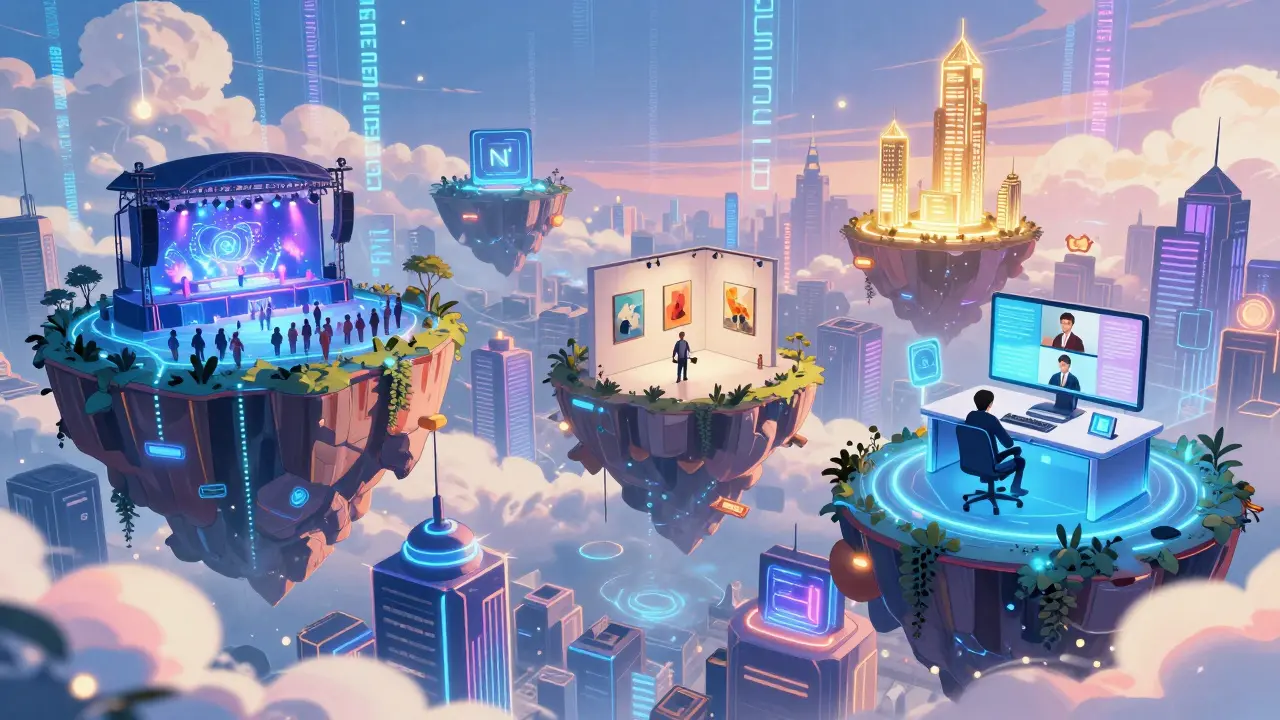
Imagine buying a plot of land-not in New Zealand, not in Tokyo, but in a digital world where you can build a concert venue, open a gallery, or rent out a virtual office. This isn’t science fiction. It’s happening right now in blockchain-based metaverses like Decentraland and The Sandbox. Virtual land ownership is no longer just a novelty. It’s a real asset class, backed by blockchain technology and Non-Fungible Tokens (NFTs). But what does it actually mean to own something that doesn’t physically exist? And is it worth your time-or your cryptocurrency?
What Is Virtual Land, Really?
Virtual land in a blockchain metaverse is a digital parcel of space within a 3D online world. Think of it like a lot in a video game, but with real economic value. Each parcel is represented as an NFT, meaning it’s a unique, tamper-proof digital certificate stored in your cryptocurrency wallet. Unlike regular in-game items that can be deleted or reset by a game company, these NFTs live on public blockchains like Ethereum or Polygon. Once you own one, no one else can take it away-unless you lose your private key. These plots aren’t just empty squares. They’re assigned coordinates-like X: 123, Y: -456-so every piece of land has a precise location. Just like in real life, location matters. Land near popular landmarks, event hubs, or big-brand storefronts sells for way more than land in the middle of nowhere. In Decentraland, a plot next to the Fashion District or a major art gallery has sold for over $100,000 in MANA cryptocurrency. Meanwhile, land on the outskirts might cost under $1,000.How Do You Buy It?
Buying virtual land isn’t as simple as clicking ‘Add to Cart’. You need to understand three things: cryptocurrency, wallets, and platforms. First, you need crypto. Most metaverses use their own tokens: MANA for Decentraland, SAND for The Sandbox. You can buy these on exchanges like Coinbase, Binance, or Kraken. Once you have them, you transfer them to a non-custodial wallet like MetaMask or Coinbase Wallet. This is critical. If you leave your crypto on an exchange, you don’t own the NFT-you’re just renting it. Next, you visit the metaverse’s official land marketplace. Decentraland has its own store. The Sandbox lets you buy through its website or OpenSea. You browse available plots, check their coordinates, and make an offer. When you complete the purchase, the NFT is sent to your wallet. That’s it. You now own that piece of digital land. But here’s the catch: owning the NFT doesn’t mean you control the whole world around it. The metaverse platform still runs the servers. If The Sandbox shuts down tomorrow, your land still exists as an NFT-but you can’t access it. It’s like owning a deed to a house that’s been bulldozed. The paper still exists. The building doesn’t.What Can You Do With It?
Ownership gives you freedom to build. You can create anything: a nightclub, a museum, a casino, a virtual office, or even a mini-game. Some owners rent out their land for events. Others host NFT art shows or sell digital fashion. Brands like Samsung, Adidas, and Walmart have bought land to connect with customers in immersive ways. One owner in Decentraland turned a plot into a working casino that hosted live poker tournaments, earning thousands in tips. Development tools are getting better. Platforms now offer drag-and-drop builders, 3D modeling integrations, and even VR editing. You don’t need to be a coder to design a simple shop. But to stand out, you need creativity-and a plan. Empty land doesn’t generate income. A well-designed space with foot traffic does.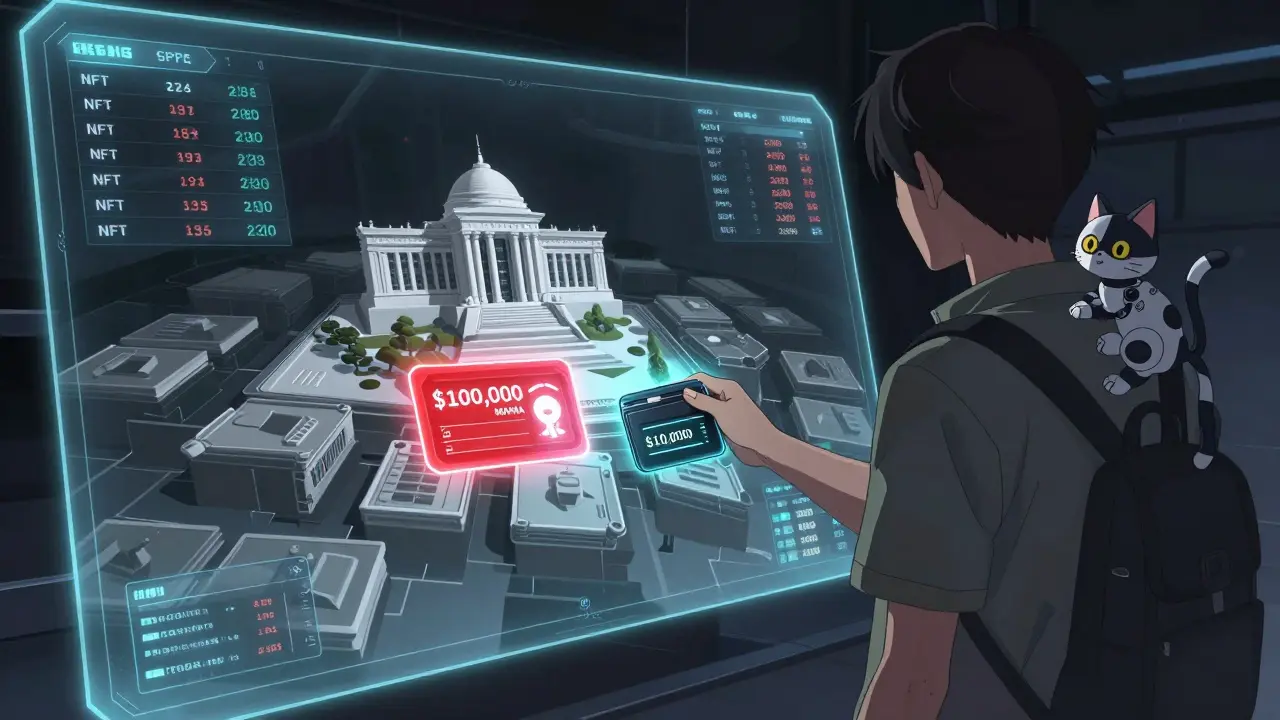
Why It’s Not Like Real Estate
This is where people get fooled. Virtual land looks like real estate. It has location, price, and scarcity. But legally, it’s nothing like it. In the real world, if you own land, you have rights. You can sue if someone trespasses. You can get a mortgage. You can pass it down to your kids. None of that exists in the metaverse. There’s no government agency to enforce rules. No zoning laws. No property taxes (yet). And if the platform changes its Terms of Service, they can ban you, remove your buildings, or even freeze your NFT. Legal experts at firms like Linklaters say virtual land exists in a gray zone. You own the token-but not the experience. The platform controls the code. That means your land’s value depends on how long the company stays in business. If The Sandbox goes bankrupt, your NFT becomes a digital ghost. No one can visit it. No one can use it. It’s still in your wallet. But it’s useless.Who’s Making Money-and Who’s Losing?
Some people are making serious money. Early buyers in Decentraland and The Sandbox saw land prices spike 10x between 2021 and 2022. A plot bought for $500 sold for $6,000. Others turned their land into rental properties, charging users to host events. One developer rented out a virtual theater for $200 per night during a music festival. But the market has cooled. Prices dropped over 80% from their peak. Many buyers bought hoping to flip quickly. When hype faded, so did demand. Now, the smart owners are the ones building real utility: games, communities, ads, or services. They’re not gambling. They’re running businesses. The biggest risk? Platform dependency. If you invest in a new, unknown metaverse, you’re betting on its survival. Decentraland and The Sandbox have years of user data, funding, and developer support. Newer platforms? They could vanish overnight.
Is It Worth Getting Into?
If you’re curious, start small. Buy one plot for under $500. Learn how the tools work. Build something simple-a logo, a sign, a mini-game. See how people interact with it. Don’t go all-in. Think of it like early internet domain names. In the 1990s, people bought .com domains for $10. Some sold them for millions. Others lost money because no one visited. The same pattern is repeating. The key isn’t speculation. It’s creation. If you’re a designer, artist, or developer, virtual land gives you a global stage. No gatekeepers. No rent to a landlord. Just you, your ideas, and a blockchain that won’t let anyone erase your work. If you’re just looking to make a quick buck? Be careful. The market is volatile. Regulation is coming. And platforms can change the rules anytime.What’s Next?
The next big step is interoperability. Right now, you can’t take your Decentraland house and move it to The Sandbox. That’s changing. New standards are being tested to let NFTs work across platforms. If that happens, virtual land could become more like a global digital property network. Also, mobile access is improving. Right now, most experiences need VR headsets or powerful PCs. But soon, you’ll be able to walk through your land on your phone. That will open the market to billions of people who don’t own VR gear. And regulation? It’s inevitable. Tax authorities are watching. Governments are asking: Who owns digital assets? How do you inherit them? Will they be taxed like real estate? These questions won’t stay unanswered forever. For now, virtual land ownership is a mix of opportunity, risk, and experimentation. It’s not a get-rich-quick scheme. It’s a new kind of digital entrepreneurship. And like any new frontier, the early movers are the ones who shape what comes next.Can you really make money from virtual land?
Yes-but not by just buying and holding. People earn money by building useful spaces: hosting events, renting out venues, selling digital goods, or running ads. Some owners charge entry fees for concerts or charge brands to place billboards. The key is creating value, not waiting for prices to rise. Most people who bought land hoping to flip it lost money when the hype cooled.
What happens if the metaverse platform shuts down?
Your NFT stays in your wallet. But you lose access to the world where your land exists. The land isn’t deleted-it’s just unviewable. No one can visit your building. No one can interact with it. It becomes like a photo of a house that no longer stands. That’s why investing in established platforms like Decentraland or The Sandbox is safer than betting on new, unproven ones.
Do you need a VR headset to use virtual land?
No. Most metaverses work on desktop browsers and mobile phones. VR headsets give a more immersive experience, but they’re not required. You can explore, build, and interact using a mouse, keyboard, or touchscreen. Many users never use VR at all.
Are virtual land purchases taxed?
In many countries, yes. If you sell virtual land for a profit, it’s treated like capital gains-similar to selling crypto or stocks. Some tax agencies, like the IRS in the U.S. and IRD in New Zealand, classify NFTs as property. If you buy with crypto and later sell for more, you may owe taxes on the gain. Always consult a tax professional familiar with digital assets.
Can you inherit virtual land?
Technically, yes-but it’s complicated. Since the land is stored in a crypto wallet, you need to leave your private key or recovery phrase to your heirs. If they don’t know how to access it, the asset is lost. Some people use legal wills that include digital asset instructions, or use services that securely store keys for inheritance. Without proper planning, virtual land can disappear forever.

Olivette Petersen
February 7, 2026 AT 20:35 PMThis is actually kind of beautiful. Imagine being able to build something that anyone in the world can visit, no matter where they are. No zoning laws, no landlords, just pure creation. I bought a tiny plot last year and turned it into a little poetry garden. People leave notes in virtual flowers. It’s not about the money. It’s about making something that matters.
And yeah, I know it’s risky. But isn’t that true of every new frontier?
Kieren Hagan
February 9, 2026 AT 03:40 AMThe legal gray area here is the real issue. You own an NFT, not a right. That’s not property-that’s a license to a service that can be revoked at any time. If I buy a house, I have recourse if someone breaks in. If someone hacks my virtual plot or the platform decides to delete it? I’m out of luck. This isn’t investment. It’s digital gambling with a fancy label.
Michelle Anderson
February 11, 2026 AT 01:53 AMLet’s be real. Most of these ‘landowners’ are just crypto bros who bought a plot because they saw a meme. You think your 10x return on a plot next to a virtual Walmart is genius? Nah. You’re just the sucker who bought high before the rug pull. And don’t even get me started on ‘virtual galleries’-half of them are just JPEGs with a fancy frame.
Kyle Pearce-O'Brien
February 12, 2026 AT 08:38 AMAh, the metaphysics of digital ownership. We’ve moved beyond the material, yes-but have we transcended the human condition? The NFT is a sacrament of capitalism’s last gasp. A tokenized echo of land, divorced from soil, from gravity, from time. We worship the deed, not the dwelling. And in that worship, we become ghosts haunting our own signatures.
🌌
Joshua Herder
February 13, 2026 AT 11:04 AMYou think this is new? It’s just the same pyramid scheme dressed in blockchain. Remember Second Life? People bought virtual land there too. Then it crashed. Now you’re telling me this time it’s different because the tokens are on Ethereum? Please. The servers are still owned by a company. The code is still centralized. You’re not owning anything-you’re renting on a blockchain. The only difference is the rent is paid in crypto and the landlord is a VC firm.
Brittany Novak
February 13, 2026 AT 12:54 PMWait. So you’re telling me I can’t sue someone if they build a giant penis on my virtual plot? Or if the company decides to turn the whole world into a TikTok ad? This is literally a dystopia with better graphics. Who’s regulating this? Who’s holding them accountable? There’s no law. No oversight. Just code. And code can be changed. Always.
Jacque Istok
February 15, 2026 AT 00:21 AMOh wow, so now we’re treating NFTs like real estate? Congrats, you’ve turned a meme into a tax form. Let me guess-you’re also filing a 1099 for your virtual nightclub profits? How cute. Meanwhile, real people are struggling to pay rent in the actual world while you’re ‘investing’ in a 3D cartoon. I’m not mad. I’m just… disappointed.
Brittany Coleman
February 15, 2026 AT 10:36 AMI think it’s fascinating how we project our real-world fears and desires onto digital spaces. We want ownership, control, permanence. But maybe the point isn’t to replicate real estate. Maybe it’s to imagine something entirely new. What if land isn’t about exclusivity-but accessibility? What if the value isn’t in selling it, but in sharing it?
Molly Andrejko
February 15, 2026 AT 19:57 PMI love how this is opening doors for artists who never had a gallery. I know a woman in Detroit who turned her virtual plot into a free interactive storytelling space for kids. No ads. No paywalls. Just magic. That’s the real win here-not flipping land, but building community. And it’s possible because the barrier to entry is low. Anyone with a laptop can start.
Don’t let the hype drown out the hope.
sachin bunny
February 17, 2026 AT 04:41 AMBRO. THIS IS ALL A CRYPTO ZIONIST PLAN TO CONTROL THE DIGITAL REALM 😱 THEY’RE USING NFT LAND TO MAP OUR SOULS INTO THE MATRIX. THE BLOCKCHAIN ISN’T DECENTRALIZED-IT’S A BACKDOOR FOR THE ILLUMINATI TO TRACK EVERY CLICK. YOU THINK YOU OWN LAND? YOU OWN A QR CODE THAT’S BEING SCANNED BY AI DREAMS. 🤖🔮
Robin Ødis
February 18, 2026 AT 22:07 PMI’ve been following this since 2020 and I’ve seen it all. People think they’re buying land but they’re actually buying a ticket to a party that might not even happen. The platforms are all funded by venture capital and they’re not here to build a world-they’re here to extract value before the next bubble pops. And guess what? The ones who get hurt? The average joe who didn’t know that ‘Decentraland’ isn’t decentralized at all. The CEO still controls the servers. The devs still change the rules. The blockchain just makes it look fancy. I’ve lost three wallets to this. Don’t be me.
laura mundy
February 20, 2026 AT 01:55 AMYou call this entrepreneurship? I call it delusion. You’re not building a business-you’re building a digital shrine to your own ego. And for what? So you can brag on Twitter that you own a plot next to a virtual Adidas store? Meanwhile, real people are losing homes in real cities because rent’s too high. This isn’t innovation. It’s a distraction. A shiny object to keep us from asking why the real world is falling apart.
Matthew Ryan
February 22, 2026 AT 00:13 AMI bought one plot. Used it to host a friend’s art show. Got 200 visitors from 17 countries. No one paid. No one bought. But we talked. We laughed. We shared stories. That’s worth more than any NFT price chart. Maybe the value isn’t in the land. Maybe it’s in the connections.
sabeer ibrahim
February 22, 2026 AT 22:14 PMWhy are Americans so obsessed with owning digital land? In India, we build temples, not NFT galleries. This whole thing feels like a capitalist cult. You think you’re free? You’re just another node in a blockchain hive. And don’t even get me started on how this is just another way for rich guys to buy influence. Meanwhile, real infrastructure in real countries is crumbling. This isn’t progress. It’s a digital drug.
Mendy H
February 22, 2026 AT 23:23 PMI read the whole thing. Didn’t learn anything new. Just a bunch of buzzwords wrapped in a PowerPoint. If you need a 2000-word essay to explain why buying a pixel is ‘real estate,’ you’re not an investor. You’re a marketer.