
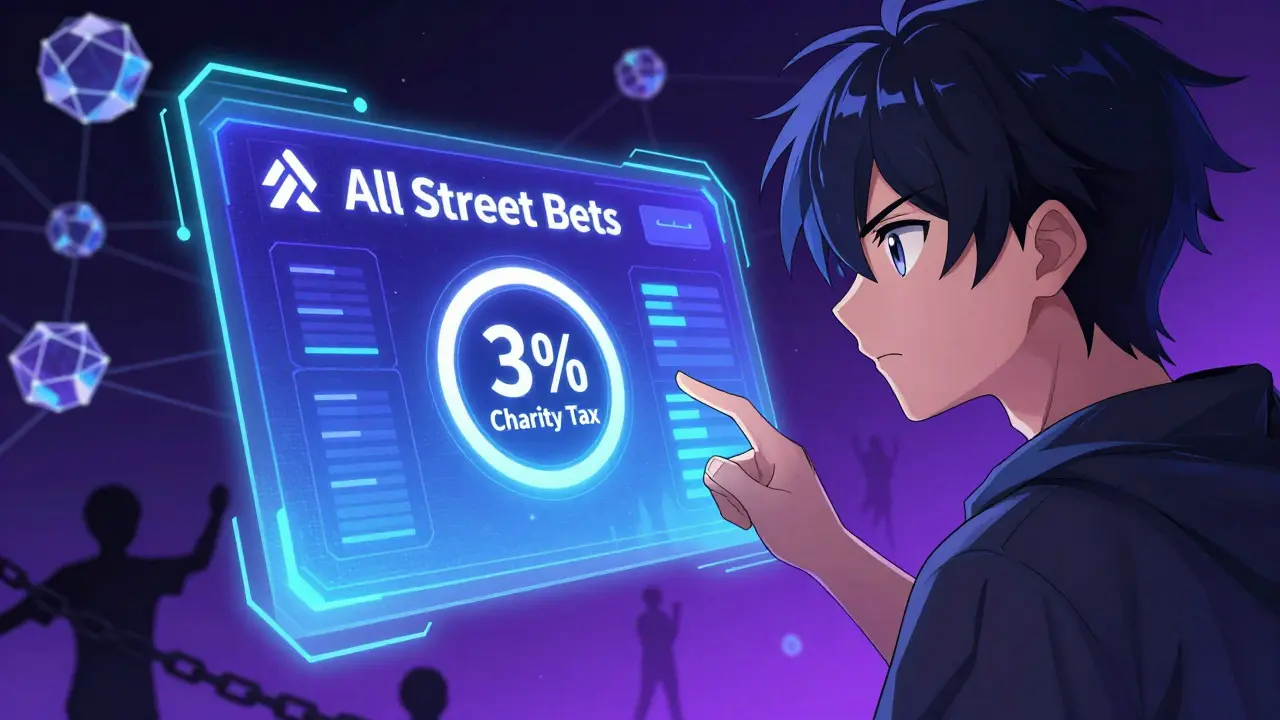
You’ve probably seen the name All Street Bets pop up in crypto feeds. It sounds like a nod to the famous Reddit community that sparked the GameStop saga, but this isn’t just another copycat meme coin. The All Street Bets (BETS) token is a freedom-themed cryptocurrency built on the Base network, and it has a twist: every time you buy, sell, or transfer it, a small portion of your money goes directly to fighting human trafficking.
If you are wondering whether this is a legitimate investment vehicle or just hype with a heart, you aren’t alone. The crypto space is flooded with projects promising social good while delivering volatility. To figure out where BETS fits, we need to look past the marketing slogans and examine the mechanics, the numbers, and the risks involved in holding a token that taxes itself.
The Core Concept: Freedom Meets Philanthropy
At its heart, All Street Bets positions itself as more than a speculative asset. The project’s branding leans heavily into themes of financial freedom and individual liberty, which resonates with a specific segment of the crypto audience. However, the defining feature that separates BETS from thousands of other tokens is its integrated charitable mechanism.
Here is how it works: there is a fixed 3% transaction tax applied to every trade. This isn’t a fee you pay to an exchange; it is baked into the smart contract code. When you execute a transaction, 3% of the value is automatically diverted to designated charities focused on anti-human trafficking initiatives. For proponents, this makes every trade feel like a dual action: participating in the market while contributing to a cause. For skeptics, it raises questions about efficiency and transparency.
This model is known as a "charity tax" or "social impact token." Unlike traditional donations where you manually send funds to an organization, this approach automates philanthropy at the protocol level. The idea is that high trading volume generates significant funding for these causes without requiring active effort from the holders. But automation doesn’t always mean optimization, and that brings us to the technical side of things.
Technical Infrastructure: Why Base Blockchain?
To understand the potential of BETS, you have to look at where it lives. The token is deployed on the Base blockchain. Base is a layer-2 scaling solution developed by Coinbase, designed to sit on top of Ethereum. This choice is strategic for several reasons.
- Low Transaction Costs: Ethereum mainnet fees can be prohibitively expensive for small trades. On Base, gas fees are fractions of a cent. This makes frequent trading-and thus generating that 3% charity tax-economically viable for average users.
- Speed: Transactions confirm much faster on Base than on Layer 1 networks, improving the user experience for buying and selling.
- Ecosystem Access: Being on Base gives BETS access to Coinbase’s massive user base and the growing ecosystem of decentralized applications (dApps) built specifically for this network.
However, being on Base also means BETS is subject to the security and stability of the Base network. While Base inherits Ethereum’s security guarantees, it relies on sequencers to process transactions. If you are used to Bitcoin’s simplicity, the complexity of Layer-2 architecture might seem daunting, but for a retail-focused token, it offers the best balance of cost and accessibility currently available.

Market Data and Volatility: What the Numbers Say
Let’s talk money. Cryptocurrency prices are notoriously volatile, and BETS is no exception. As of early 2026, data from major aggregators shows significant fluctuations. According to CoinGecko, the token traded around $0.000029, seeing sharp swings of nearly 20% in single days. Coinbase reported slightly different figures, hovering near $0.000021. These discrepancies highlight a common issue in crypto: price data varies depending on the liquidity pool and exchange you check.
| Metric | Value / Detail |
|---|---|
| Total Supply | 10,000,000,000 (Fixed) |
| Transaction Tax | 3% (Directed to Anti-Human Trafficking Charities) |
| Blockchain Network | Base (Layer-2 on Ethereum) |
| Recent Price Range (Feb 2026) | $0.000021 - $0.000031 USD |
| All-Time High (ATH) | ~$0.0027 USD (Significant decline since peak) |
| 24h Trading Volume | Approx. $135,000 - $144,000 USD |
The most striking number here is the distance from its all-time high. At one point, BETS traded closer to $0.0027. Today, it sits at less than 1% of that value. This represents a drop of over 99%. In crypto terms, this is not unusual for meme-inspired tokens, but it is a critical warning sign for new investors. It suggests that the initial hype cycle has passed, and the current price reflects either a mature market finding equilibrium or a lack of sustained interest.
The total supply is capped at 10 billion tokens. This fixed supply mimics traditional equity models, meaning no new tokens can be printed to inflate the market. Scarcity usually supports price appreciation, but only if demand exists. With a daily trading volume of around $140,000, the liquidity is present but modest compared to major cryptocurrencies like Bitcoin or Ethereum. This means large buys or sells can still move the price significantly.
The Risks You Can't Ignore
No discussion of a niche crypto token is complete without addressing the dangers. BETS carries several layers of risk that go beyond standard market volatility.
1. The "Meme" Factor: Despite the charitable mission, the name "All Street Bets" ties it to internet culture and meme stock history. Tokens driven by community sentiment rather than utility often suffer from rapid inflows and outflows of capital. Once the novelty wears off, prices can collapse.
2. Transparency Gaps: While the 3% tax is coded into the smart contract, verifying exactly where those funds end up requires trust in the developers’ reporting. Are the funds going to verified NGOs? Is there an audit trail? Currently, public information lacks detailed reports on specific partnerships or quarterly donation receipts. Without third-party verification, you are trusting the team’s word.
3. Regulatory Uncertainty: Governments worldwide are tightening rules around cryptocurrencies, especially those that resemble securities or involve complex tax structures. A token with an automatic built-in tax could face scrutiny from regulators who view it as a mechanism to evade standard financial controls or as an unregistered security offering.
4. Smart Contract Risk: Like any DeFi project, BETS relies on code. If there is a bug in the smart contract handling the 3% distribution, funds could be lost or misdirected. There is limited public information regarding independent security audits of the BETS contract, which is a red flag for cautious investors.

How It Compares to Other Social Impact Tokens
BETS isn’t the first token to try mixing finance with philanthropy. Projects like CharityCoin or various NFT drops for disaster relief have tried similar models. So, what makes BETS different?
Most charitable crypto initiatives are episodic. An NFT collection launches, sells out, and the proceeds are donated. BETS attempts to make this continuous through the transaction tax. The advantage is sustainability: as long as people trade, the charity receives funds. The disadvantage is friction. That 3% tax eats into your profits. If you buy at $0.000025 and sell at $0.000030, a 20% gain, the 3% tax reduces your net return. Over multiple trades, these fees compound, making it harder to achieve arbitrage or short-term gains compared to standard ERC-20 tokens.
Furthermore, unlike established stablecoins or major altcoins, BETS lacks deep institutional backing. Its value is derived almost entirely from community belief in the brand and the cause. This makes it highly susceptible to social media trends. If the narrative shifts away from "freedom-themed charity coins," the demand could dry up quickly.
Is All Street Bets Right for You?
Deciding whether to engage with BETS depends on your goals. If you are looking for a passive income stream or a stable store of value, this is likely not the right fit. The volatility is too high, and the regulatory landscape is unclear.
However, if you are a believer in the anti-human trafficking mission and want to support it through everyday trading activity, BETS offers a unique mechanism. You are essentially paying a premium (the tax) to align your financial activities with your values. Just remember that in crypto, alignment doesn’t guarantee profit. Many people have supported great causes financially while losing their principal investment.
Before buying, do your own due diligence. Check the latest contract address on official channels to avoid scams. Understand that the 3% tax applies to *all* transfers, including moving your own tokens between wallets, so factor that into your strategy. And never invest more than you can afford to lose, especially in assets that have already dropped 99% from their highs.
What is the minimum amount I can invest in All Street Bets (BETS)?
There is no strict minimum set by the token itself. However, because the price is extremely low (fractions of a cent), exchanges may have minimum order sizes in USD terms, typically around $10-$20. Given the 3% transaction tax, investing very small amounts might result in negligible impact on both your portfolio and the charitable cause.
Does the 3% tax apply when I send BETS to my own wallet?
Yes. The tax is embedded in the smart contract and triggers on every transfer event, regardless of whether it is a sale on an exchange or a peer-to-peer transfer. Always account for this 3% reduction when calculating the final amount received in the destination wallet.
Which charities receive the funds from the BETS tax?
The project states that funds go to anti-human trafficking initiatives. However, specific partner organizations and regular financial reports are not prominently published in widely accessible sources. Investors should seek out the project’s official documentation or community channels for updated lists of beneficiary NGOs to ensure transparency.
Can I hold BETS in a standard hardware wallet like Ledger or Trezor?
Since BETS is on the Base network (which is EVM-compatible), you can store it in wallets that support Ethereum and Layer-2 assets. Apps like MetaMask, Trust Wallet, and hardware wallets like Ledger (via Ledger Live) generally support Base tokens. You will need to add the custom token contract address manually in some cases.
Why is the price of BETS so low compared to its all-time high?
The price drop reflects broader market corrections and the typical lifecycle of meme-inspired tokens. After an initial surge driven by hype and novelty, many such tokens experience a "cooling off" period where speculative buyers exit. The current price represents a market equilibrium based on reduced trading volume and lower investor enthusiasm compared to its launch phase.