

APOon isn't a typical cryptocurrency. It doesn't mine, isn't decentralized, and doesn't operate on its own blockchain. Instead, it's a digital token that mirrors the value of Apollo Global Management stock (APO), traded on the NYSE. Created by Ondo Finance, APOon lets investors around the world buy and trade exposure to a U.S. hedge fund giant - 24 hours a day, five days a week - without needing a U.S. brokerage account.
How APOon Works: A Digital Twin of Real Stock
Think of APOon like a digital copy of a physical stock certificate. When you buy APOon, you're not owning shares directly on the NYSE. You're holding a blockchain-based token that represents the same economic rights: price movement, dividend reinvestment, and ownership stake in Apollo Global Management. Ondo Finance holds the actual APO shares in a custodial account, then issues APOon tokens on Ethereum and BNB Chain in a 1:1 ratio. Every time someone buys APOon, Ondo buys more APO stock. When someone sells, Ondo sells the underlying shares.
This system is built on Regulation S, a U.S. securities rule that allows companies to sell securities to non-U.S. investors without registering with the SEC. That’s why APOon is available globally - except to U.S. citizens or residents. You don’t need to be an accredited investor. You just need a crypto wallet and access to one of the few exchanges that list it.
Technical Details: Where APOon Lives
APOon is an ERC-20 token, meaning it runs on the Ethereum network. Its contract address is 0x4d21affd27183b07335935f81a5c26b6a5a15355. A smaller amount also exists on BNB Chain, with the address 0x563...8f7f3a. As of late 2025, there were only 6,125.42 APOon tokens in total - a tiny supply compared to most cryptocurrencies.
This low supply isn’t a mistake. It’s intentional. Ondo only mints new tokens when someone buys them, and only if they can buy the real APO stock to back it. The market cap hovers around $900,000, making APOon one of the smallest tokenized equities in existence. For comparison, BlackRock’s BUIDL token has over $200 million in assets under management. APOon is niche, not massive.
Price and Trading: Volatility in a Small Pool
APOon’s price usually stays close to the real APO stock price - but not always. On December 23, 2025, it hit an all-time high of $151.23, a 11.67% premium over the underlying stock. That happened because demand surged among international investors during a market rally. But liquidity is thin. The daily trading volume across all platforms averages just $171. On CoinMarketCap, it’s listed at $133.57, while Crypto.com shows $125.35. These differences aren’t errors - they’re reflections of how little trading actually happens.
With only 64 wallets holding APOon total, and just 3 of them owning over two-thirds of the supply, the market is highly concentrated. One large holder selling could crash the price. That’s why the 24-hour trading range is narrow: $132.07 to $135.27. There’s not enough volume to swing it wildly.
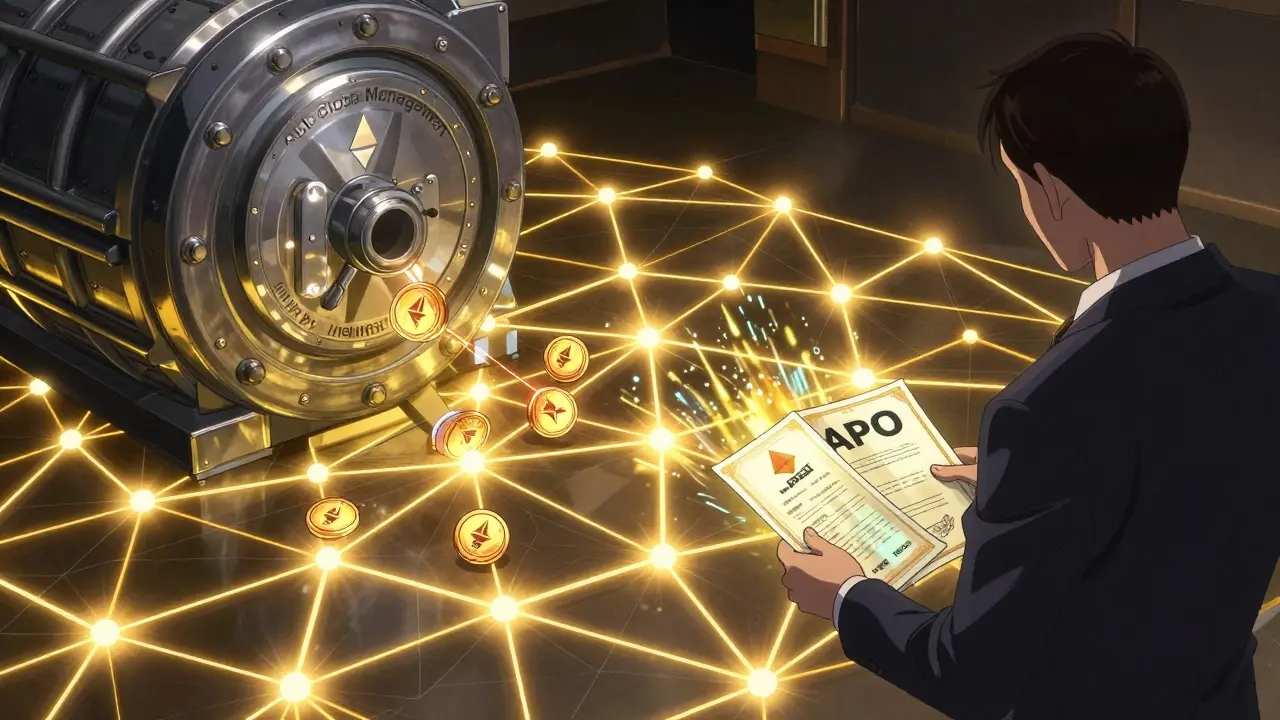
Why Use APOon? The Real Advantages
For most people, APOon makes sense only if they’re outside the U.S. and can’t easily access U.S. stocks. Here’s why:
- 24/5 Trading: The NYSE opens at 9:30 a.m. and closes at 4 p.m. Eastern time. APOon trades nonstop, including weekends and holidays. If you’re in Asia or Africa and want to react to U.S. earnings reports at 3 a.m., you can.
- Zero Minimums: On the NYSE, you buy whole shares. APO stock trades around $130 per share. With APOon, you can buy $1 worth. Fractional ownership becomes possible.
- No Brokerage Account: No need for Interactive Brokers, Charles Schwab, or Fidelity. Just a crypto wallet and an exchange that supports APOon.
- Dividend Reinvestment: Ondo automatically reinvests dividends from APO stock into more APOon, so your holdings grow without manual action.
The Downsides: What You Lose
But there are big trade-offs:
- Liquidity Risk: If you need to sell quickly, you might not find a buyer. The daily volume is too low. You could be stuck for days.
- Redemption Delays: If you want to turn APOon back into real APO shares, Ondo requires a minimum of 50 tokens and takes 48 hours to process. That’s not instant. And there’s a $15 fee per redemption.
- Regulatory Uncertainty: The SEC hasn’t formally approved tokenized equities. While APOon follows Regulation S, regulators could change the rules overnight. In February 2026, the SEC signaled it might expand eligibility under Regulation D - but that could mean tighter controls.
- Wallet Complexity: You need to understand Ethereum gas fees, wallet security, and private keys. If you lose your wallet, you lose your APOon. There’s no customer service for that.
- Concentration Risk: A handful of wallets hold most of the supply. That’s a single point of failure.
Real User Experiences
Users on Reddit and Trustpilot report mixed results. One investor in India successfully redeemed 50 APOon for real APO shares in 48 hours - but said the $15 fee made small trades pointless. Another user in Brazil complained of a 72-hour delay during market volatility. Support response times are fast - 8.2 minutes on average - but the system still feels fragile.
On social media, 62% of mentions are positive. People love the 24/5 access. But 85% of complaints are about limited exchange availability. APOon isn’t on Binance, Coinbase, or Kraken. It’s only listed on a few smaller platforms like Crypto.com and Ondo’s own portal.
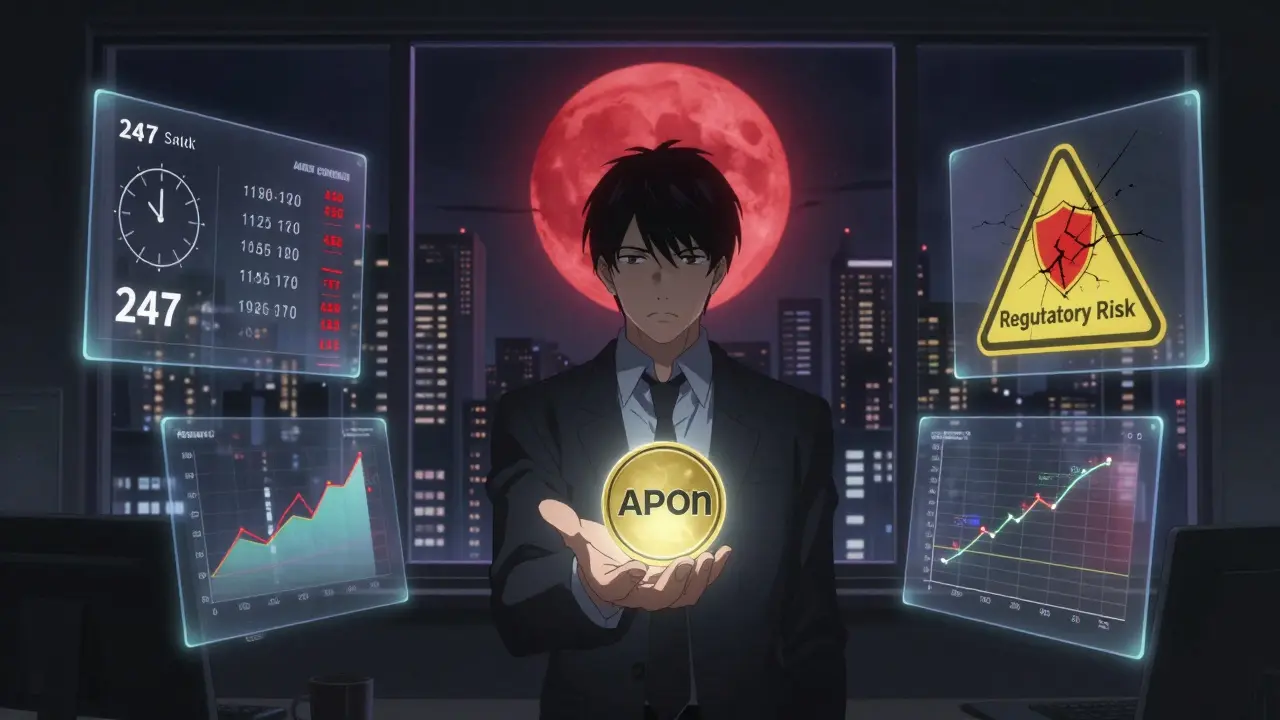
Where APOon Fits in the Bigger Picture
APOon is part of a growing trend: tokenizing real-world assets. By Q1 2026, the entire market was worth $14.2 billion. But APOon makes up less than 0.01% of that. It’s a tiny slice of a niche slice.
Compare it to BlackRock’s BUIDL token - which tokenizes a U.S. Treasury fund and trades with hundreds of millions in volume. Or to SIX Digital Exchange’s tokenized equities - which are only available to accredited investors. APOon sits in between: accessible to retail investors, but with very little liquidity.
Analysts predict APOon could hit $165 by the end of 2026 if Ondo expands to Solana and Polygon, cutting transaction costs by 63%. But that’s a big "if." The company has only 53 unique holders with 8.16% monthly growth - far below the 22.3% average for tokenized assets.
Should You Buy APOon?
If you’re outside the U.S., can’t access U.S. stocks, and want to invest in Apollo Global Management - APOon is one of the few ways to do it. The 24/5 trading and fractional ownership are real advantages.
But if you’re looking for a high-volume crypto investment, or want to trade frequently, APOon isn’t for you. The liquidity is too thin. The redemption process is slow. The supply is tiny. And regulatory risks remain.
It’s not a get-rich-quick play. It’s a specialized tool for a very specific group: international investors who want exposure to U.S. equities but can’t use traditional brokers.
How to Get Started
Here’s what you need to do:
- Set up a crypto wallet that supports ERC-20 tokens (MetaMask, Phantom, or Trust Wallet).
- Buy Ethereum or BNB to cover gas fees.
- Go to an exchange that lists APOon - currently Crypto.com or Ondo’s official portal.
- Buy APOon using your crypto balance.
- Store it in your wallet. Never send it to an exchange unless you plan to trade.
Remember: Always verify the contract address before sending funds. A single typo could lose your investment.







Ajay Singh
February 4, 2026 AT 16:27 PMAPOon is literally the only way us non-US folks can get exposure to decent hedge funds
Matt Smith
February 5, 2026 AT 21:44 PMOh wow another crypto scam dressed up like finance 🤡
Alex Garnett
February 7, 2026 AT 00:38 AMLet me guess-this is another ‘regulation S’ loophole designed to let Americans bypass SEC oversight while pretending they’re not. Pathetic.
Mrs. Miller
February 7, 2026 AT 21:54 PMSo you’re telling me I can buy a slice of a hedge fund… but only if I’m not American? That’s like being invited to a party… but only if you’re not the host. 😏
Katie Haywood
February 8, 2026 AT 15:35 PM64 wallets holding the whole thing? That’s not a market, that’s a group chat with one guy who bought too much.
Kieren Hagan
February 9, 2026 AT 15:13 PMWhile APOon offers unique access for international investors, the operational risks-including redemption delays, gas fee volatility, and custodial dependency-demand serious due diligence. This is not a passive investment vehicle.
Michelle Anderson
February 10, 2026 AT 06:06 AMThey’re calling this ‘tokenized stock’? More like ‘tokenized gamble’ with a $15 fee to cry about it later.
Brittany Novak
February 11, 2026 AT 11:33 AMDid you know Ondo Finance’s CEO used to work for a crypto Ponzi scheme? This isn’t finance-it’s a laundering front disguised as a hedge fund proxy. The SEC is watching. Mark my words.
Paul Jardetzky
February 13, 2026 AT 11:08 AMBro I bought $20 of APOon last week and it’s already up 8%! 24/7 trading is insane 🚀
perry jody
February 14, 2026 AT 09:03 AMThat’s the spirit! Just don’t forget to check the contract address before you send anything. I saw someone send ETH to the wrong address and lost $5k 😭
Jim Laurie
February 16, 2026 AT 07:41 AMGuys, I’ve been holding APOon since launch. The dividend reinvestment is slick-automatically compounds without me lifting a finger. And the fact that it’s on BNB Chain means lower fees than Ethereum. This isn’t hype, it’s utility. The liquidity is thin, sure, but that’s why it’s a long-term play, not a day-trade.
Also, the 24/5 access lets me react to Fed announcements at 3 a.m. while my friends in the US are asleep. That’s not a gimmick-that’s power.
Yeah, the redemption takes 48 hours, but I’m not trying to cash out tomorrow. I’m building a diversified international portfolio. And if you’re worried about concentration risk, diversify into other tokenized assets. APOon’s just one piece.
And no, I’m not a shill. I’m just tired of people calling this ‘crypto’ when it’s literally backed by real NYSE shares. It’s a bridge, not a bubble.
Also, the supply cap? Genius. Scarcity + real asset = value. Not like Dogecoin where the devs just print more.
Bottom line: if you’re outside the US and want exposure to quality US equities without a brokerage nightmare? This is it. Just know your risks. And maybe don’t put your life savings in it.
Oliver James Scarth
February 17, 2026 AT 01:36 AMOne cannot help but observe that the structural architecture of APOon represents a fascinating, albeit fragile, convergence of traditional finance and distributed ledger technology. The regulatory arbitrage under Regulation S is, in many respects, a masterstroke of legal engineering-yet the profound illiquidity and concentration risk render it a precarious vessel for retail capital. One might liken it to owning a diamond in a sandcastle: exquisite in form, perilous in substance.
Olivette Petersen
February 17, 2026 AT 20:33 PMI love that this exists. I’m in rural Nebraska and I can’t open a foreign brokerage account, but I can buy a fraction of APO with my MetaMask. It’s not perfect, but it’s progress. I wish more asset managers would do this.
Danica Cheney
February 18, 2026 AT 07:25 AMwhy do people care about this so much like its a big deal its just a token of a stock lol
Ryan Chandler
February 18, 2026 AT 09:35 AMLet me paint you a picture: A man in Jakarta, at 2 a.m., sips chai, watches APOon tick up as Wall Street sleeps. He didn’t need a broker. He didn’t need a visa. He just needed a wallet. This isn’t finance. This is revolution. 🌍✨