

Price swings in the crypto world can feel like a rollercoaster with no brakes. One day you’re up 10%, the next you’re down 20%. But what if you could measure that chaos? That’s exactly what historical volatility does. It takes the guesswork out of market fear by turning past price movements into hard data. For anyone serious about trading or investing in digital assets, understanding this metric isn’t just nice to have-it’s essential for survival.
We aren't talking about vague feelings of 'market sentiment' here. We are talking about math. Historical volatility (HV) quantifies how much an asset's price has changed over a specific period. By looking at the standard deviation of returns, traders get a clear picture of risk. This guide breaks down how HV works, why it matters more than ever in 2026, and how you can use it to protect your portfolio.
What Is Historical Volatility?
At its core, historical volatility is a statistical measurement. It calculates the annualized standard deviation of daily logarithmic returns for a given asset. Think of it as a speedometer for price changes. If Bitcoin moves from $50,000 to $55,000 and back to $50,000 in a week, the average price didn't change, but the volatility was high. HV captures that movement.
The methodology originated in traditional finance but became critical for crypto after Bitcoin’s market adoption surged post-2017. Formal academic application really took off around 2019 when options markets matured. Today, it is the baseline for risk assessment. According to Fidelity Digital Assets, 87% of institutional cryptocurrency traders rely on HV analysis for risk management. Why? Because it provides objective proof of how risky an asset actually is, rather than relying on hype or fear.
To calculate HV, analysts typically use 30-day, 60-day, or 90-day windows. The 30-day window is the industry standard because it balances recent trends with enough data to smooth out daily noise. For example, during the high-activity periods of 2021-2023, Bitcoin’s 30-day historical volatility averaged 75%. In contrast, Ethereum often showed 15-20 percentage points higher volatility than Bitcoin during the same timeframe. Stablecoins, like USDT and USDC, sit at the other extreme, with 30-day HV ranging from just 3% to 8%.
How Historical Volatility Differs From Implied Volatility
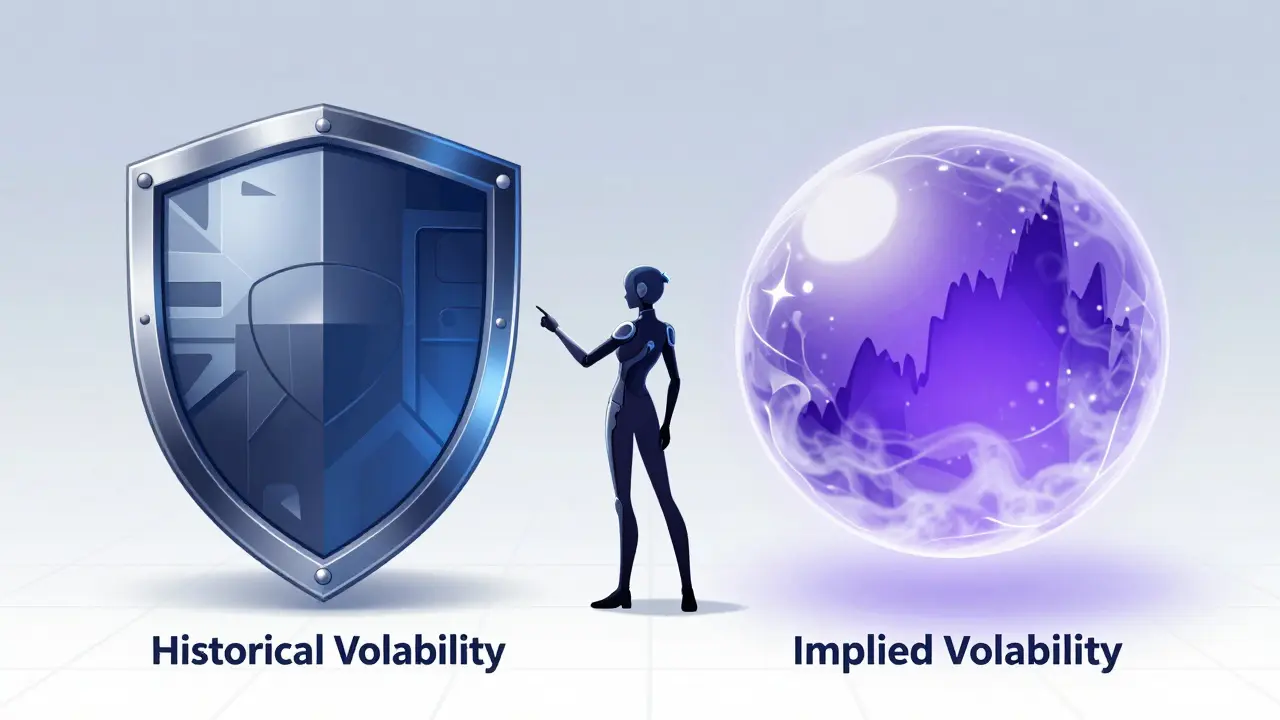
A common mistake new traders make is confusing historical volatility with implied volatility (IV). They sound similar, but they serve completely different purposes. Historical volatility looks backward. It measures what *has* happened based on actual price data. Implied volatility looks forward. It represents what the market *expects* to happen, derived from options pricing.
| Feature | Historical Volatility (HV) | Implied Volatility (IV) |
|---|---|---|
| Direction | Backward-looking | Forward-looking |
| Data Source | Past price action | Options pricing models |
| Availability | All cryptocurrencies | Only liquid markets (BTC, ETH) |
| Primary Use | Risk assessment, position sizing | Options trading, sentiment gauge |
This distinction is crucial. Only Bitcoin and Ethereum have liquid enough options markets for reliable IV calculation. Deribit’s BTC options market reached $1.2 billion in open interest by late 2023, making IV a useful tool for those assets. However, for most altcoins, there are no options markets. This means historical volatility is the *only* quantifiable metric available. You cannot gauge future expectations via options if no one is trading them. For 90% of the crypto market, HV is your only compass.
Calculating Volatility: Methods That Matter
Not all volatility calculations are created equal. The method you choose affects how accurately you see market risks. Three primary approaches dominate the field today:
- Simple Standard Deviation: The most basic approach. It treats all past data points equally. While easy to understand, it can lag behind sudden market shifts.
- Exponential Weighted Moving Average (EWMA): This model assigns greater weight to recent price action. It reacts faster to new information, making it useful for short-term traders.
- GARCH Models: Specifically, the GARCH (1,1) model is the gold standard for advanced analysis. It captures 'volatility clustering,' where large changes tend to be followed by large changes, and small changes by small ones.
Research from UKM Malaysia in 2025 highlighted that applying Indicator Saturation techniques to GARCH (1,1) outputs creates the most robust framework for identifying structural breaks in Bitcoin’s volatility series. The study found that using a student’s t distribution within the GARCH model yielded the most accurate results because it accounts for 'fat tails'-the rare but extreme events common in crypto.
For retail traders, simple moving averages might suffice, but they suffer from a 12-18 day lag in detecting regime shifts. If you want to catch a crash early, you need more sophisticated tools. Realized volatility, calculated from minute-level intraday data, offers superior accuracy. A 2024 Arxiv study showed that realized volatility reduces estimation error by 37.2% compared to traditional daily closing price calculations. However, accessing this high-frequency data costs money, with providers like Kaiko charging $300-$800 monthly.
Real-World Benchmarks: How Volatile Are Your Coins?
Understanding abstract percentages helps, but seeing real numbers makes it stick. Here is how major assets compare based on recent data:
- Bitcoin (BTC): Averaged 75% 30-day HV during 2021-2023. Professor John Smith of MIT noted that while this is high, it has decreased from 150% in 2017, indicating maturing market efficiency.
- Ethereum (ETH): Consistently demonstrates 15-20 percentage points higher volatility than Bitcoin due to its role in DeFi and smart contracts.
- Solana (SOL): Often shows even higher spikes, though data quality can vary between exchanges due to thinner order books.
- USDT/USDC: These stablecoins hover around 4.7% and 5.2% respectively. Their low HV makes them ideal for parking funds during turbulent times.
These benchmarks help set realistic expectations. If you hold an altcoin with 100%+ historical volatility, a 20% drop in a single day is statistically normal, not an anomaly. Knowing this prevents panic selling and helps you size positions appropriately.
Using Historical Volatility in Trading Strategies
So, how do you actually use this data? Traders incorporate HV into their strategies primarily for two things: position sizing and stop-loss placement. UEEx Technology found that traders who integrate HV analysis improve performance by up to 20% through better-informed entry and exit timing.
Position Sizing: High volatility means higher risk. If an asset has a 30-day HV of 80%, you should allocate less capital to it than an asset with 40% HV. A common rule of thumb is to reduce position size inversely proportional to volatility. This ensures that a sharp drop doesn’t wipe out your entire account.
Stop-Loss Placement: Setting stops too tight in a volatile market leads to getting 'stopped out' by normal noise. By analyzing HV, you can place stops outside the typical range of daily fluctuations. For example, if Bitcoin’s daily move is usually 5%, a 3% stop-loss will trigger constantly. A 10% stop might be more appropriate.
Institutional traders also link HV with on-chain metrics. Fidelity Digital Assets proposed a model linking Bitcoin’s HV extremes with MVRV Z-Score and SOPR, achieving 68.3% accuracy in predicting volatility regime changes 72 hours in advance. While complex, this shows the direction professional desks are heading: combining price history with network activity.

Tools and Platforms for Tracking Volatility
You don’t need a PhD in quantitative finance to access these metrics anymore. The ecosystem has matured significantly since 2022.
For Retail Traders: Free platforms like TradingView offer built-in 30/60/90-day HV indicators. CoinMarketCap also provides volatility trackers. These are sufficient for basic monitoring. TradingView’s community has developed over 15,000 public scripts for custom volatility indicators, allowing you to visualize HV directly on charts.
For Institutional Users: Premium services like Kaiko Volatility Analytics ($1,200/month) or Bloomberg’s Crypto Volatility Index provide deeper insights. Exchanges like Binance now implement real-time HV metrics directly into their interfaces. Binance launched its Volatility Index (BVOL) in August 2023, offering 5-minute updates across 17 major cryptocurrencies.
Data quality remains a challenge, especially for altcoins. CoinGecko identified a 23.7% measurement discrepancy between exchanges for Solana’s 30-day HV during low-liquidity periods in Q4 2023. To mitigate this, use volume-weighted calculations or rely on aggregated data sources like CryptoCompare’s Professional API, which incorporates exchange reliability scores.
Future Trends: AI and Regulatory Standards
The field is evolving rapidly. Machine learning is beginning to enhance traditional models. A 2024 Arxiv research team developed an ML model combining HV with on-chain and macroeconomic indicators, improving prediction accuracy to 82.4% compared to 67.1% for traditional GARCH models. Expect more AI-driven regime detection in the coming years.
Regulation is also shaping the landscape. MiCA regulations require EU-based exchanges to publish daily volatility metrics starting June 2024. IOSCO is proposing global standards for cryptocurrency volatility measurement. This standardization will likely reduce discrepancies between platforms and increase transparency.
Despite these changes, historical volatility remains indispensable. As J.P. Morgan’s Nikolaos Panigirtzoglou stated, "As cryptocurrency markets mature, historical volatility will converge toward traditional asset levels but retain 2-3x higher baseline measurements through 2028." Until then, HV is your best friend in navigating the storm.
Is historical volatility the same as implied volatility?
No. Historical volatility measures past price movements based on actual data, while implied volatility reflects market expectations of future volatility derived from options pricing. HV is backward-looking; IV is forward-looking.
Which time window is best for calculating historical volatility?
The 30-day window is the industry standard. It provides a balance between capturing recent trends and smoothing out daily noise. 60-day and 90-day windows are used for longer-term trend analysis.
Can I use historical volatility for altcoins?
Yes, and it is often the only option. Most altcoins lack liquid options markets, meaning implied volatility is unavailable. However, be cautious of data quality issues on thin order books; use volume-weighted calculations for accuracy.
How does historical volatility help with position sizing?
Higher historical volatility indicates greater risk. Traders typically reduce position sizes for high-HV assets to ensure that normal price swings do not exceed their risk tolerance. It allows for consistent risk exposure across different assets.
What is the average historical volatility of Bitcoin?
During the 2021-2023 period, Bitcoin’s 30-day historical volatility averaged around 75%. This is significantly higher than traditional assets but lower than its peak of 150% in 2017, showing market maturation.










Tobias Gjerlufsen
May 6, 2026 AT 13:30 PMyou people really think a standard deviation calculation is going to save you from the inevitable collapse of this entire digital charade. it is just math dressed up as wisdom but it changes nothing about the fundamental lack of intrinsic value in these assets. i have seen every cycle since 2013 and the only thing that remains constant is the delusion of retail traders who think they can outsmart the market with a spreadsheet. hv is a lagging indicator by definition so it tells you what already happened which is useless for predicting the next black swan event that will wipe out your portfolio before you even hit refresh on your terminal.
Ruben Michel
May 7, 2026 AT 16:59 PMThe distinction between historical and implied volatility is not merely academic; it is the dividing line between amateur speculation and institutional-grade risk management. To conflate the two is to display a profound ignorance of financial derivatives markets. One must appreciate that while historical volatility provides a retrospective audit of price action, implied volatility offers a forward-looking consensus on future uncertainty, derived from the sophisticated pricing mechanisms of options markets. It is essential for the serious practitioner to understand that relying solely on historical data is akin to driving a vehicle while looking exclusively through the rearview mirror.
Samara McCallum
May 8, 2026 AT 15:07 PMbut doesnt the act of measuring it change the outcome because we are all looking at the same numbers and reacting to them simultaneously creating a self fulfilling prophecy where the volatility becomes what we expect it to be rather than what it naturally would be without observation
Sheldon Friesen
May 9, 2026 AT 21:32 PMLook! I mean, look at the data! The GARCH (1,1) model isn't just some dusty academic exercise; it's a tool! A very specific, highly technical tool! And if you're using simple moving averages, you're essentially flying blind! Blind! Do you want to fly blind?! No! You don't! So maybe consider upgrading your methodology! Because the lag time is real! And the pain is real! And the missed opportunities are incredibly frustrating!
Tricia Alach
May 10, 2026 AT 14:22 PMi totally get what ur saying about the garch models being better but honestly its just so overwhelming trying to keep up with all the different metrics and tools when im just trying to make sense of my own portfolio and sometimes i feel like the more i learn the less i actually understand about whats happening in the market
Jan Gilmore
May 10, 2026 AT 15:19 PMYou are absolutely right to feel overwhelmed because the barrier to entry for true quantitative analysis has never been higher! But here is the secret that everyone ignores: you do not need to build the model yourself! You just need to know how to interpret the output! TradingView scripts are free! They are abundant! And they provide a visual representation of HV that is sufficient for 90% of retail strategies! Stop worrying about the code and start worrying about the context! Context is king!
Gavin Wonnacott
May 11, 2026 AT 21:02 PMI find it deeply unsettling that you are suggesting retail traders rely on public scripts for risk assessment. It is a breach of professional boundaries to assume that such diluted, community-sourced indicators offer any semblance of reliability compared to institutional-grade analytics. Your casual dismissal of the necessity for high-frequency data access reveals a dangerous complacency. I expect those engaging in this discourse to maintain a certain standard of rigor, and your suggestion falls woefully short of that expectation. It is intrusive to watch people gamble with their livelihoods based on such superficial advice.
Caique Muniz
May 12, 2026 AT 08:42 AMlol yeah sure jan tell me again how tradingview is enough when half the time the data feeds are delayed or wrong especially for altcoins. its not even worth arguing about because most of you dont even trade enough volume to matter anyway so why pretend like your stop loss placement is some science instead of just gambling with extra steps
Bradley Geldenhuys
May 12, 2026 AT 10:19 AMListen up folks! We need to stop fighting about the tools and start focusing on the mindset! Yes the data matters! Yes the models matter! But none of it helps if you cant handle the emotional rollercoaster! Volatility is just fear and greed quantified! If you cant accept that then no amount of garch modeling will save you! You gotta embrace the chaos! You gotta lean into the uncertainty! Because thats where the opportunity lives! Not in the safety of a stablecoin but in the wild swings of the market!
beti macedo
May 12, 2026 AT 20:52 PMit is truly inspiring to see such a detailed breakdown of these complex concepts because it shows that even in the midst of such chaotic market conditions there is always a way to find structure and meaning through careful analysis and dedication to learning which gives me hope that we can all navigate these challenges together with patience and understanding despite the typos in my message i believe in our collective ability to grow
Shelby Cantu
May 13, 2026 AT 08:50 AMFocus on the process.