

Blockchain Architecture Comparison Tool
Your Project Requirements
Recommendation
When you send a crypto transaction, what’s really happening under the hood? Most people don’t think about it-but the answer changes everything depending on whether the blockchain is monolithic or modular. These two designs aren’t just technical preferences; they shape performance, security, cost, and even who can use the network. If you’ve ever been stuck waiting for a transaction to confirm, paid $5 in gas fees, or lost funds crossing a bridge between chains, you’ve felt the real-world impact of this divide.
What Is a Monolithic Blockchain?
A monolithic blockchain handles every single task in one unified layer. Think of it like a single factory that manufactures, packages, ships, and tracks every product-all in the same building. Every node on the network must verify every transaction, store the full history, and agree on the order of events using one consensus mechanism. This design started with Bitcoin in 2009 and was later refined by chains like Solana, Avalanche, and Cardano.Monolithic chains are simple by design. There’s no need to coordinate between layers. Everything happens on-chain, which means strong security. If a node is honest, the whole system stays honest. But that simplicity comes at a cost: scalability. As more users join, every node has to work harder. Hardware requirements skyrocket. Solana, one of the fastest monolithic chains, needs validators to run machines with 128GB of RAM, 1.2TB of NVMe storage, and a 1Gbps internet connection. Most home users can’t run a full node. That’s why Solana’s network is controlled by just 1,952 validators as of October 2023-far fewer than Ethereum’s 811,784.
On the upside, monolithic chains deliver speed. Solana processes up to 65,000 transactions per second (TPS) with finality in 2-5 seconds. During the 2021 Degenerate Ape Academy NFT drop, it handled 4,400 mints in minutes without breaking a sweat. Transaction fees are dirt cheap-around $0.00025 on average. That’s why gaming, NFTs, and high-frequency trading thrive here. But speed isn’t everything. In 2022, Solana had 19 outages totaling 41 hours of downtime. One network glitch can shut down every dApp running on it. That’s the downside of putting all your eggs in one basket.
What Is a Modular Blockchain?
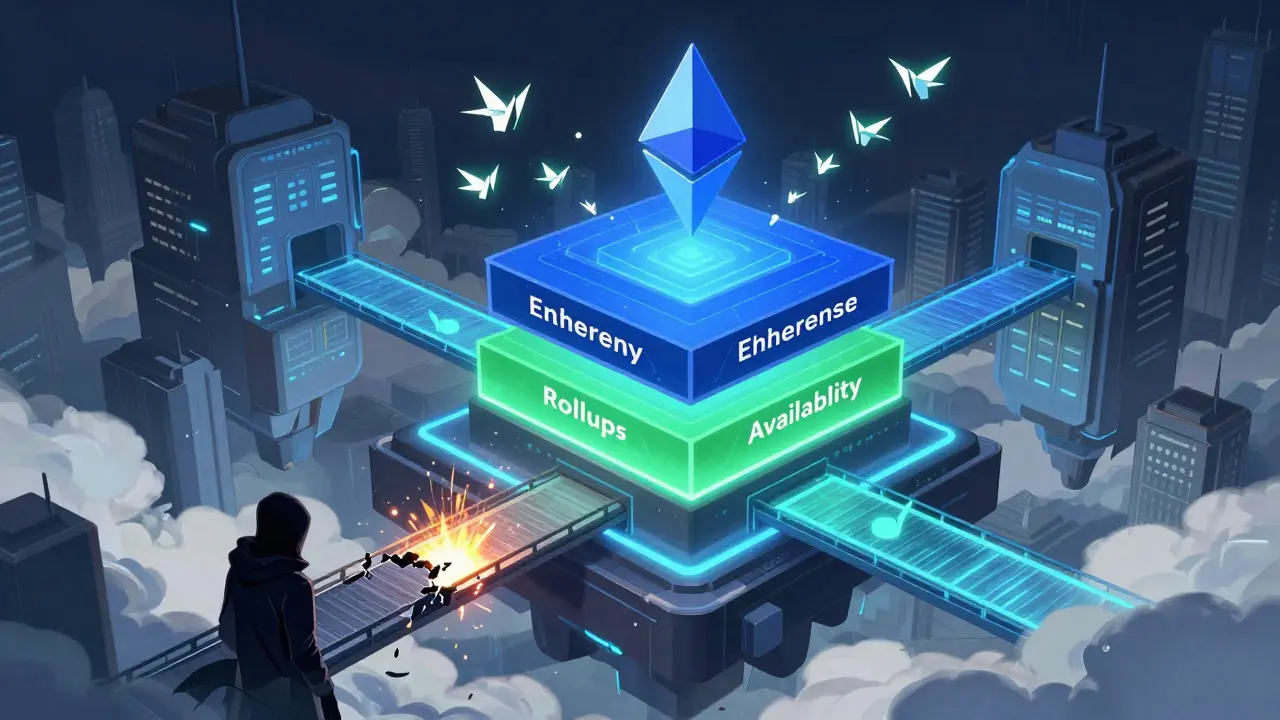
Modular blockchains break the job into pieces. Instead of one chain doing everything, they split execution, consensus, data availability, and settlement into separate layers. Each layer can be optimized independently. Ethereum is the poster child for this approach. Its main chain (Layer 1) now focuses mostly on security and data availability. All the heavy lifting-processing transactions, running smart contracts-is done by Layer 2 rollups like Arbitrum and Optimism.This separation solves the blockchain trilemma better than monolithic designs. You don’t have to sacrifice security for speed. Ethereum’s base layer remains ultra-secure, backed by thousands of validators and billions in locked value. Meanwhile, rollups handle thousands of transactions per second. Arbitrum One hits 4,500 TPS. Optimism hits 2,000 TPS. And fees? They’re 10-100x cheaper than Ethereum mainnet. The Dencun upgrade in January 2024 introduced proto-danksharding, which will cut Layer 2 costs by up to 90% by making data storage more efficient.
But modular systems are complex. Users now have to bridge assets between layers. Developers have to code for multiple environments-Solidity for Ethereum, Cairo for StarkNet, custom tooling for Optimistic rollups. And bridges are risky. The Ronin Bridge hack in March 2022 stole $625 million because attackers exploited trust assumptions between layers. A 2023 ConsenSys survey found 68% of Ethereum users felt confused by bridging. That’s not just a usability issue-it’s a security vulnerability.
Performance and Throughput: Speed vs Stability
Let’s compare real numbers. Solana (monolithic) can hit 65,000 TPS. That’s faster than Visa’s peak capacity. But when congestion hits, the network slows down or crashes. In contrast, Ethereum (modular) only does 15-30 TPS on Layer 1-but its rollups handle most of the load. Combined, Ethereum’s ecosystem processes over 10,000 TPS daily. The difference isn’t just peak speed-it’s reliability.Finality time matters too. Solana confirms transactions in 2-5 seconds. Ethereum’s optimistic rollups take 7 days to finalize (because they rely on fraud proofs). But ZK-rollups like zkSync and StarkNet solve this-they use cryptographic proofs to confirm in under a minute. That’s faster than most monolithic chains.
Uptime is another big factor. Ethereum maintained 99.989% uptime in 2022. Solana’s 41 hours of downtime that year meant millions in lost revenue for developers. For enterprise use cases-like banking or supply chain tracking-downtime isn’t just inconvenient. It’s unacceptable. That’s why 82% of financial institutions prefer modular architectures, according to IBM’s 2023 survey.
Security: Simplicity vs Specialization
Monolithic chains are secure because they’re simple. One rule, one consensus, one state. If you control 51% of the validators, you can break it. That’s why Solana’s validator count is so low-it’s easier to centralize. Ethereum’s modular design is more complex, but that complexity adds layers of defense. Even if a rollup is compromised, the base chain can reject bad data. The security of the whole system doesn’t depend on one component.That’s why Ethereum holds $28 billion in total value locked (TVL) across DeFi as of October 2023. No other chain comes close. Developers trust it because the base layer is battle-tested. Monolithic chains can’t match that. Even if they’re faster, they’re more vulnerable to single points of failure. The 2023 SEC enforcement actions targeted monolithic chains in 67% of cases-not because they’re illegal, but because regulators see them as more centralized.
Modular systems aren’t perfect. Bridges are weak points. But the industry is fixing them. Projects like Celestia and Avail are building dedicated data availability layers that can be shared across multiple rollups. That’s not just modular-it’s a new kind of infrastructure.
Developer Experience and Costs
If you’re building on Solana, you learn one language (Rust), one toolset, one network. The learning curve is 6-8 weeks. That’s why Solana has 85,000 active developers on Discord. But when the network goes down, your app goes down with it. No fallback.Ethereum developers face a steeper climb. You need to know Solidity, plus rollup-specific tools. Some rollups use Cairo, others use custom fraud proof systems. The learning curve is 12-16 weeks. Documentation is fragmented. But the payoff? You can build on a network that’s never been hacked at the base layer. And you can deploy to multiple rollups without rewriting your app.
Hardware costs differ too. Running a Solana validator costs $15,000-$20,000 in equipment. Ethereum execution clients? $3,000-$5,000. But if you want to run a rollup node, add another $5,000-$10,000. So while entry-level nodes are cheaper, full-stack modular setups get expensive fast.

Market Trends and Future Direction
The market is split. Monolithic chains dominate gaming and NFTs-78% market share, according to DappRadar. Why? Speed and low fees. Gamers don’t care about 7-day finality. They want instant results.Modular chains lead in DeFi, holding 89% of total value locked. Financial apps need security, auditability, and compliance. Ethereum’s modular structure fits perfectly. The Forrester Research forecast predicts modular infrastructure will grow to $28.7 billion by 2028, nearly seven times its 2023 size.
But here’s the twist: the lines are blurring. Solana’s Firedancer client, launching in Q2 2024, adds modular components to its architecture. It’s still monolithic at its core, but now it uses specialized processing units to boost throughput to 1 million TPS. Meanwhile, Ethereum is becoming more modular by design-proto-danksharding, danksharding, and future upgrades are turning it into a true modular stack.
Industry experts now predict convergence. A CoinDesk survey found 78% believe all blockchains will become hybrid within 3-5 years. You won’t see pure monolithic or pure modular chains anymore. You’ll see chains that borrow the best of both: the speed of monoliths, the security of modular systems.
Which One Should You Use?
If you’re building a game, NFT platform, or social app where speed and low fees matter most-go monolithic. Solana, Aptos, or Sui are solid choices. Just accept the risk of outages.If you’re building a DeFi protocol, a tokenized asset, or anything that handles real money-go modular. Ethereum + zkSync or StarkNet is the safest bet. You’ll pay more in development time, but you’ll sleep better at night.
For enterprise users-banks, insurers, logistics firms-modular is the only real option. Compliance, audit trails, and uptime are non-negotiable. For consumers who just want to buy an NFT or swap tokens quickly? Monolithic chains deliver a smoother experience today.
The future isn’t about choosing one over the other. It’s about understanding the trade-offs and matching the architecture to the job. There’s no universal winner. Only the right tool for the task.
Is Solana better than Ethereum?
It depends on what you need. Solana is faster and cheaper for simple transactions, making it ideal for gaming and NFTs. Ethereum is slower on its base layer but far more secure and scalable through rollups, making it better for DeFi and enterprise apps. Solana has higher performance but lower reliability. Ethereum has lower peak speed but much stronger long-term security.
Why do modular blockchains have lower transaction fees?
Modular blockchains move most transaction processing off the main chain (Layer 1) and onto Layer 2 rollups. These rollups batch thousands of transactions and post only a tiny cryptographic proof back to Ethereum. That reduces the data load on the main chain, which is what drives up fees. Ethereum’s Dencun upgrade further cuts costs by making data storage cheaper for rollups.
Are modular blockchains more secure than monolithic ones?
Yes, generally. Monolithic chains rely on one consensus mechanism and one set of validators. If that layer fails, the whole chain fails. Modular chains isolate risks: even if a rollup is compromised, the base chain can reject invalid data. Ethereum’s base layer has never been hacked. Most major breaches (like Ronin Bridge) happened at bridges or rollups-not at the core security layer.
Can I build on both modular and monolithic blockchains?
Yes, but it’s not easy. Each has different tools, languages, and ecosystems. Solana uses Rust and Anchor. Ethereum uses Solidity and a range of Layer 2 toolkits. Developers who work on both need to switch contexts constantly. Some projects are starting to support multi-chain deployments, but cross-chain development still requires significant extra work.
What’s the future of blockchain architecture?
The future is hybrid. Chains like Solana are adding modular components to improve scalability. Ethereum is becoming more modular with danksharding and rollups. New projects like Celestia and Avail are building data availability layers that serve multiple chains. The distinction between monolithic and modular will fade as developers pick the best parts from each model. Expect all major blockchains to become modular in structure by 2028.
Blockchain architecture is no longer a theoretical debate. It’s a practical decision that affects your wallet, your app, and your security. Whether you’re a developer, investor, or user, understanding this split helps you make smarter choices. Don’t just follow the hype. Ask: What does this chain actually do-and is it built for the job?










Abhishek Bansal
December 13, 2025 AT 18:53 PMMonolithic is dead. Modular is the future. Anyone who still runs a Solana node is just clinging to 2021 vibes.
Ike McMahon
December 14, 2025 AT 08:51 AMActually, you're both right. Solana's great for gaming. Ethereum's better for money. Pick your poison.
Vidhi Kotak
December 15, 2025 AT 20:58 PMI've built on both. Solana feels like a sports car - fast until it breaks down. Ethereum is like a Toyota Camry. You don't notice it working until you need it to.
Jessica Petry
December 16, 2025 AT 17:48 PMI'm sorry, but if you're using anything other than Ethereum mainnet for DeFi, you're basically gambling with your life savings. The fact that people still trust rollups after Ronin... I just don't understand.
Toni Marucco
December 17, 2025 AT 19:52 PMThe dichotomy is a false construct. Architecture is not binary - it's a spectrum. Solana's Firedancer is already integrating modular components. Ethereum is layering abstraction upon abstraction. The convergence isn't coming - it's already here.
JoAnne Geigner
December 18, 2025 AT 16:13 PMI just want to say... thank you for writing this. So many people treat this like a religion - 'Ethereum good, Solana bad' - but the truth is, it's about matching the tool to the task. I'm building a social app and honestly, Solana’s speed saved us. But for my NFT royalty contract? Definitely zkSync. It's not either/or - it's both/and.
Anselmo Buffet
December 20, 2025 AT 05:31 AMI run a Solana node on a $2k Raspberry Pi cluster. It works fine. People overcomplicate this.
Patricia Whitaker
December 21, 2025 AT 02:20 AMWow. So you're saying the same people who got rich off Solana NFTs in 2021 are now pretending they didn't know it was a house of cards? Classic.
Kathleen Sudborough
December 23, 2025 AT 01:39 AMI used to think modular was overkill... until my DeFi protocol got hacked because of a bridge. Now I sleep better knowing my funds are anchored to Ethereum. Even if it takes 7 days to withdraw - it’s worth it.
Caroline Fletcher
December 25, 2025 AT 00:57 AMThey're all controlled by the same 5 guys in Silicon Valley anyway. Modular? Monolithic? Same thing. Just different packaging.
Heath OBrien
December 25, 2025 AT 05:12 AMI'm done with this. Every time I try to move my ETH to Arbitrum, it costs me $40 in gas and takes 3 days. I'm going back to BSC. At least there I know I'm getting scammed quickly.
Candace Murangi
December 25, 2025 AT 17:29 PMI'm from Kenya and I use Solana to send remittances home. Fees are 10 cents. If it goes down? I call my cousin. It's not perfect, but it works for us. Not everything has to be enterprise-grade to be valuable.
Rakesh Bhamu
December 26, 2025 AT 15:24 PMI think the real question is - who gets to run the validators? Solana's 2k validators vs Ethereum's 800k. That’s not scalability - that’s centralization with better marketing.
Kim Throne
December 28, 2025 AT 11:53 AMThe term 'modular blockchain' is semantically imprecise. A blockchain, by definition, is a monolithic data structure. What you're describing are layered architectures or hybrid consensus networks. Please update your terminology.
Hari Sarasan
December 29, 2025 AT 16:17 PMThe architectural paradigm shift is not merely technical - it is epistemological. The monolithic model presupposes a singular ontological truth state, whereas modular architectures enable distributed epistemic authority through compositional layering. This fundamentally alters the sociotechnical contract between user and protocol.
Stanley Machuki
December 29, 2025 AT 22:06 PMJust use Ethereum. You'll thank me later.
Bridget Suhr
December 30, 2025 AT 15:10 PMI just want to say... I love how this post doesn't just say 'Ethereum good' or 'Solana bad'. It actually explains why both exist. I'm not a dev but I finally get it. Thanks!
Taylor Farano
December 31, 2025 AT 13:35 PMModular? More like 'modularly overengineered'. You're paying 10x more in dev time for a system that still relies on bridges that get hacked every other month. This isn't progress - it's complexity theater.
Kathy Wood
January 2, 2026 AT 07:01 AMI can't believe people still think Solana is 'fast'. Last week it went down for 12 hours because someone forgot to update a DNS record. This isn't finance - it's a rollercoaster with no seatbelts.