
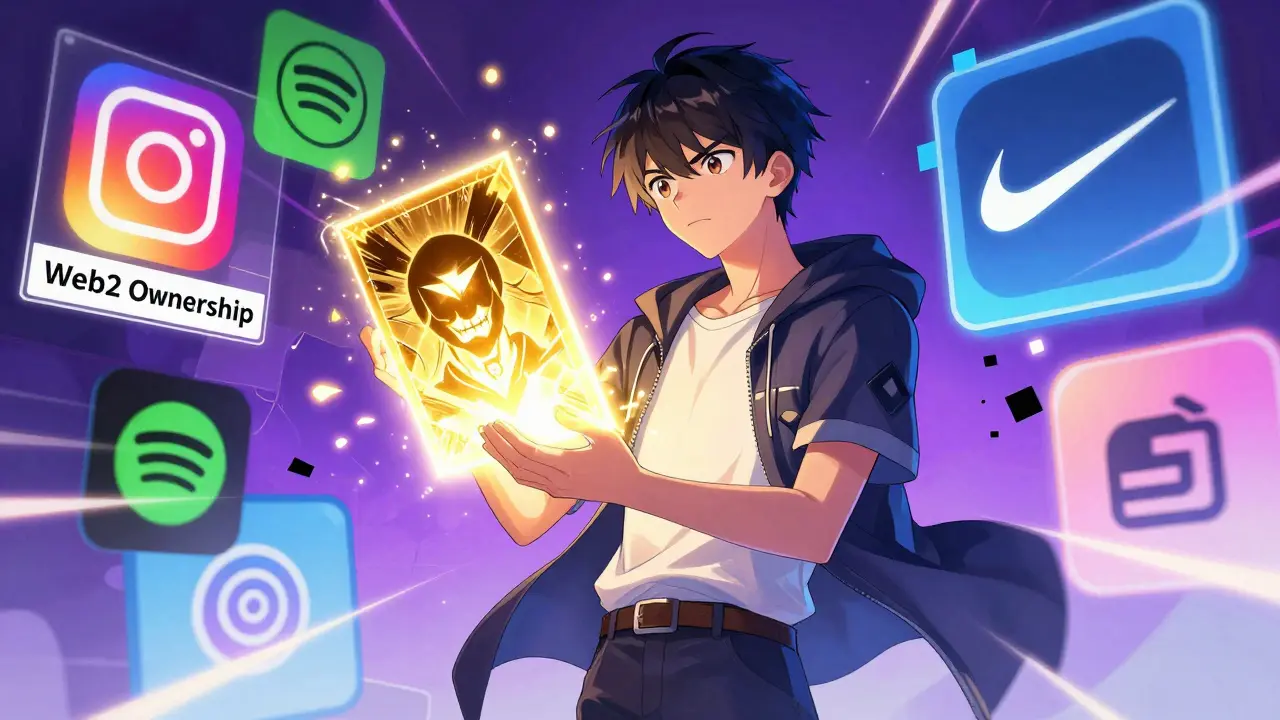
Think about your favorite song, your profile picture, or that digital sneaker you bought last year. Who really owns it? If you bought it on a platform like Instagram, Spotify, or Nike’s app, the answer is: they do. You can use it, but you can’t sell it freely, move it elsewhere, or even be sure it’ll still be there next year. That’s Web2. Web3 flips this completely. It’s not just another tech buzzword-it’s the first time in history you can truly own something digital, the same way you own a painting or a car. And it’s changing everything.
What Is Web3, Really?
Web3 isn’t a website or an app. It’s a new foundation for the internet. While Web1 was about reading static pages and Web2 let you post, like, and comment, Web3 adds one critical piece: own. You don’t just interact with content-you hold it. And you hold it directly, without a company standing between you and your stuff.
This shift is built on blockchain technology, mostly Ethereum. Unlike banks or Facebook, blockchains don’t rely on one company to keep records. Instead, thousands of computers around the world verify every transaction. If you buy a digital artwork as an NFT, that purchase is recorded permanently on the blockchain. No one can delete it. No platform can take it away. Even if the website you bought it from shuts down, your ownership stays intact.
That’s why Web3 is called the “read-write-own” web. You read content. You write it. And you own it-no middleman needed.
Digital Ownership Isn’t a Theory-It’s Already Happening
Look at NFTs. They’re not just JPEGs. They’re digital certificates of ownership, secured by code. When artist Beeple sold his artwork for $69 million in 2021, he didn’t just sell a file. He sold proof that someone owns the original version. That proof lives on the blockchain. Even today, if you buy an NFT on OpenSea, you’re not paying for a download-you’re paying for a verified, transferable asset.
It’s not just art. Musicians are selling album rights as NFTs. Gamers own in-game items they can sell outside the game. Collectors trade rare digital sneakers that hold value even when the game updates. And creators get paid every time their work is resold-through smart contracts that automatically send them a cut, no agent required.
Compare that to YouTube. If you upload a video, you don’t own it. YouTube can demonetize it, delete it, or change the algorithm and kill your views overnight. In Web3, if you create something, you control it. Period.
How Do You Actually Own Something in Web3?
You need a wallet. Not a bank account. Not a username. A crypto wallet-like MetaMask or Phantom. This wallet holds your private keys. These are long strings of letters and numbers that prove you’re the owner. If you lose them, you lose everything. There’s no “forgot password” button. No customer service to call.
Here’s how it works:
- Create a wallet (MetaMask is the most common).
- Write down your 12- or 24-word recovery phrase. Keep it offline. On paper. In a safe.
- Buy some cryptocurrency (like ETH or SOL) to pay for transactions.
- Connect your wallet to a dApp (decentralized app) like OpenSea, Blur, or a game.
- Buy, sell, or create something. Every action is recorded on the blockchain.
That’s it. No forms. No approval. No waiting. But here’s the catch: you’re now responsible for everything. If you send funds to the wrong address? Gone forever. If you click a fake link? Your wallet could be drained. In 2022, over $3.8 billion was stolen from Web3 users because of scams. Digital ownership sounds powerful-and it is-but it demands caution.

Why Web3 Still Feels Broken
Let’s be honest: Web3 is clunky. You might spend 20 minutes just to buy a $5 NFT because of high gas fees. Ethereum transactions can cost anywhere from $0.50 to $50 depending on how busy the network is. Solana is faster and cheaper, but it’s had outages. Many platforms still look like they were built in 2017.
And the learning curve? Brutal. A 2023 study found it takes new users an average of 8.3 hours to complete their first Web3 transaction. That’s not because it’s hard to understand-it’s because the tools aren’t designed for real people. You have to know what a “gas fee” is. You have to pick between Ethereum, Polygon, or Arbitrum. You have to understand the difference between a wallet and an exchange.
Then there’s regulation. The EU’s MiCA law, which took effect in June 2024, is the first real attempt to bring order. But in the U.S., it’s still a mess. The SEC sues one company, then says another token isn’t a security. That uncertainty scares off big players. And without them, Web3 can’t scale.
Even the tech has limits. Ethereum can only handle about 15-30 transactions per second. Visa does 65,000. That’s why layer-2 solutions like Starknet and Arbitrum are being built-they’re like express lanes on the blockchain highway. But they’re still new. Not everyone trusts them.
Who’s Actually Using Web3?
It’s not just crypto bros. The real users are in Southeast Asia, where 37% of internet users have interacted with Web3 apps. In the U.S., it’s 24%. Many are artists, musicians, and small creators who are tired of platforms taking 30-50% of their earnings. Others are collectors who see digital items as long-term assets.
Enterprises are watching. Gartner says 35% of big companies have tested Web3 projects. But only 8% have gone live. Why? Integration is hard. Most corporate systems weren’t built for blockchain. And legal teams are nervous.
But change is coming. Ethereum’s Shanghai upgrade in April 2023 let people withdraw staked ETH for the first time. That unlocked billions in liquidity. Zero-knowledge proofs are making transactions faster and cheaper. And cross-chain bridges now let you move assets between blockchains without going through exchanges.
Web3 vs. Web2: The Real Difference
| Feature | Web2 (Facebook, Spotify, Nike) | Web3 (NFTs, DAOs, dApps) |
|---|---|---|
| Who owns your data? | The company | You |
| Can you sell your content? | No-terms forbid it | Yes-directly to anyone |
| What if the platform shuts down? | You lose everything | You still own it |
| How are royalties paid? | Manual, delayed, often unpaid | Automatically via smart contracts |
| Transaction speed | Instant | Seconds to minutes |
| Cost to transact | Free | $0.50-$50+ (gas fees) |
Web2 gives you convenience. Web3 gives you control. You can’t have both-at least not yet.
What’s Next for Digital Ownership?
Web3 isn’t about replacing your Instagram feed. It’s about rebuilding trust. Imagine owning your health records and sharing them with doctors without giving them your entire medical history. Or owning your online reputation-your reviews, posts, and ratings-as a portable digital asset you can take anywhere.
Companies like Fetch.ai are already testing AI agents that own and trade services on your behalf. Your AI assistant could rent out your unused computing power, earn crypto, and pay you back-all without you lifting a finger. That’s not sci-fi. It’s happening now.
The big question isn’t whether Web3 will grow. It’s whether we’ll fix the user experience fast enough. If wallets become as simple as Apple Pay. If gas fees vanish. If scams drop by 90%. Then Web3 won’t be a niche for techies. It’ll be the default way we own things online.
For now, it’s a wild, messy, exciting experiment. You don’t need to jump in. But if you care about control, fairness, and real ownership in the digital world-you should be watching.
Can I really own a digital item if anyone can screenshot it?
Yes. Owning a digital item in Web3 isn’t about who can copy the file-it’s about who holds the verified proof of ownership on the blockchain. Anyone can screenshot a JPEG, but only the person with the private key can prove they bought it first and can legally sell it. It’s like owning the original Mona Lisa versus a poster of it. The poster looks the same, but only one is the real thing.
What happens if I lose my wallet password?
If you lose your private key or recovery phrase, you lose access forever. There is no reset button. No customer support. No “recover account.” That’s why writing down your 12- or 24-word phrase and storing it securely (like in a fireproof safe) is the most important step in Web3. If you only remember your email password, you can reset it. With Web3, you’re the bank.
Are NFTs just a bubble?
Some NFT projects were speculative hype, and many lost value. But the underlying technology-provable digital ownership-isn’t a bubble. It’s a tool. Just like the internet didn’t die after the dot-com crash, Web3 won’t die because some NFTs crashed. Real use cases are growing: ticketing, real estate deeds, music rights, and identity verification are all being built on NFT standards. The hype is fading. The utility is staying.
Do I need to buy cryptocurrency to use Web3?
Yes, for now. Most Web3 actions-buying NFTs, joining a DAO, playing a blockchain game-require paying gas fees in crypto like ETH or SOL. Some platforms offer “gasless” transactions using sponsorships, but those are still limited. If you want to truly interact with Web3, you need to hold at least a small amount of crypto. It’s the fuel for the system.
Is Web3 better than traditional ownership?
It’s not better-it’s different. Traditional ownership works for physical things: cars, houses, books. Web3 ownership works for digital things: art, music, game items, data. It’s faster, global, and programmable. But it’s not yet as simple or safe. Think of it like email vs. postal mail. Email is instant and cheap, but you still need to know how to avoid spam. Web3 is the email of digital ownership. It’s powerful, but you have to learn how to use it safely.
Where to Go From Here
Start small. Get a MetaMask wallet. Buy $10 worth of ETH. Try buying a $5 NFT from a reputable artist on OpenSea. See how the process works. Watch the transaction confirm on Etherscan. Feel what it’s like to truly own something online.
Don’t chase gains. Don’t follow influencers. Learn how private keys work. Learn how to spot phishing links. Learn how to use Revoke.cash to cut off app permissions.
Web3 isn’t about getting rich. It’s about getting back control. And that’s worth learning.



Rob Duber
January 29, 2026 AT 13:36 PMBro, Web3 is just crypto with extra steps. I bought a JPEG of a monkey for $20k last year and now it’s worth $80. Meanwhile, my actual dog just pooped on my rug and I can’t sell him. 😅
Gary Gately
January 31, 2026 AT 06:38 AMi rlly think web3 is the future but like… why do i gotta pay 40 bucks just to buy a digital sneaker?? its wild. also i lost my recovery phrase once and just kinda shrugged. live and learn i guess 🤷♂️
Joshua Clark
February 1, 2026 AT 08:39 AMLet me just say this: the paradigm shift here isn’t just technical-it’s philosophical. We’ve spent decades ceding control of our digital identities, our creative outputs, our very data to centralized entities that monetize our attention while offering us nothing but fleeting validation. Web3, despite its clunkiness, offers a return to agency. It’s not about speculation; it’s about sovereignty. And yes, the UX is terrible, the fees are insane, and the scams are everywhere-but so was the early web in ’95. We didn’t abandon it because it was messy. We fixed it. We can do the same here.
Brandon Vaidyanathan
February 1, 2026 AT 23:44 PMWow. Just… wow. Another one of these ‘Web3 is the future’ sermons. You know what’s real ownership? Owning a house. Not some JPEG that some guy in a Discord server says is rare. You’re not an owner-you’re a speculator with a wallet. And don’t even get me started on how many people think ‘I own this NFT’ when they can’t even find their private key. 🙄
Gareth Fitzjohn
February 2, 2026 AT 19:41 PMInteresting perspective. The concept of digital ownership is compelling, though the practical implementation remains a challenge for most. The idea of verifiable provenance is sound, but the current friction is significant. Perhaps the real innovation will come not from blockchain, but from better interfaces that hide its complexity.
Katie Teresi
February 2, 2026 AT 23:49 PMWeb3? More like Web-Scam. America’s got real problems-housing, healthcare, wages-and you’re buying monkey pics? Get a grip.
Moray Wallace
February 4, 2026 AT 00:52 AMI appreciate the optimism here, but I think we need to be honest: Web3 is still a solution looking for a problem most people actually have. I don’t need to own my Spotify playlist-I need it to work without ads. Simplicity still matters.
Dahlia Nurcahya
February 4, 2026 AT 20:27 PMHey, I started with just $5 in ETH last year and bought a digital art piece from a local artist. It felt amazing to know she got paid instantly and gets royalties every time it resells. Yeah, the interface is rough, yeah, I almost sent my funds to a scam site-but I learned. And honestly? That sense of direct connection to creators? Priceless. You don’t have to go all in. Just dip your toe. You might be surprised.
William Hanson
February 6, 2026 AT 06:02 AMSo you’re telling me I’m supposed to trust a bunch of anonymous devs who can’t even keep their network from crashing every other week? And you think that’s better than Spotify? Bro, I just want to listen to music without learning how to be a blockchain engineer. This isn’t innovation. It’s a tax on stupidity.
Lori Quarles
February 8, 2026 AT 01:47 AMWeb3 is the future and if you don’t get it, you’re stuck in 2005. 🌍✨ I’m from the Philippines and my cousin sells digital art to people in Germany-no middlemen, no delays, no BS. This isn’t hype. This is liberation. Stop being scared and start learning. The world is changing and you can either be part of it or get left behind.
Jeremy Dayde
February 9, 2026 AT 14:18 PMI’ve been reading about Web3 for months now and I think the real issue isn’t the tech or even the scams-it’s that nobody explains it in a way that makes sense to regular people. Like, I get that you own your NFT but what does that actually mean when I can’t even show it to my grandma without her thinking I’m some kind of wizard? And why do I need to buy crypto just to prove I like a song? I don’t need a wallet. I need a reason to care.
Steven Dilla
February 11, 2026 AT 02:49 AMOMG YES!!! 😍 I bought my first NFT last week and it felt like I was in a sci-fi movie!! 🚀 I’ve never felt so in control of something digital!! Also I cried when the transaction went through lol 💔💸
josh gander
February 12, 2026 AT 00:00 AMHey, I totally get where you’re coming from. I used to think Web3 was just for crypto bros too-until I saw a friend in Detroit use it to sell her handmade quilts directly to buyers in Japan. No platform took 30%. No middleman delayed her payment. She got paid in real time. That’s not magic. That’s justice. Yeah, the tech’s messy. Yeah, you gotta learn. But imagine if every creator-every painter, musician, coder, writer-could keep what they earn. That’s not a fantasy. That’s what Web3 is trying to build. And if we fix the UX? We won’t just change how we own things. We’ll change how we value each other.
Wayne mutunga
February 13, 2026 AT 18:22 PMJust wanted to say thanks for writing this. I’ve been skeptical, but your breakdown of the difference between Web2 and Web3 ownership made me pause. I’m not jumping in yet, but I’m watching. And maybe next year I’ll buy that $5 NFT.