
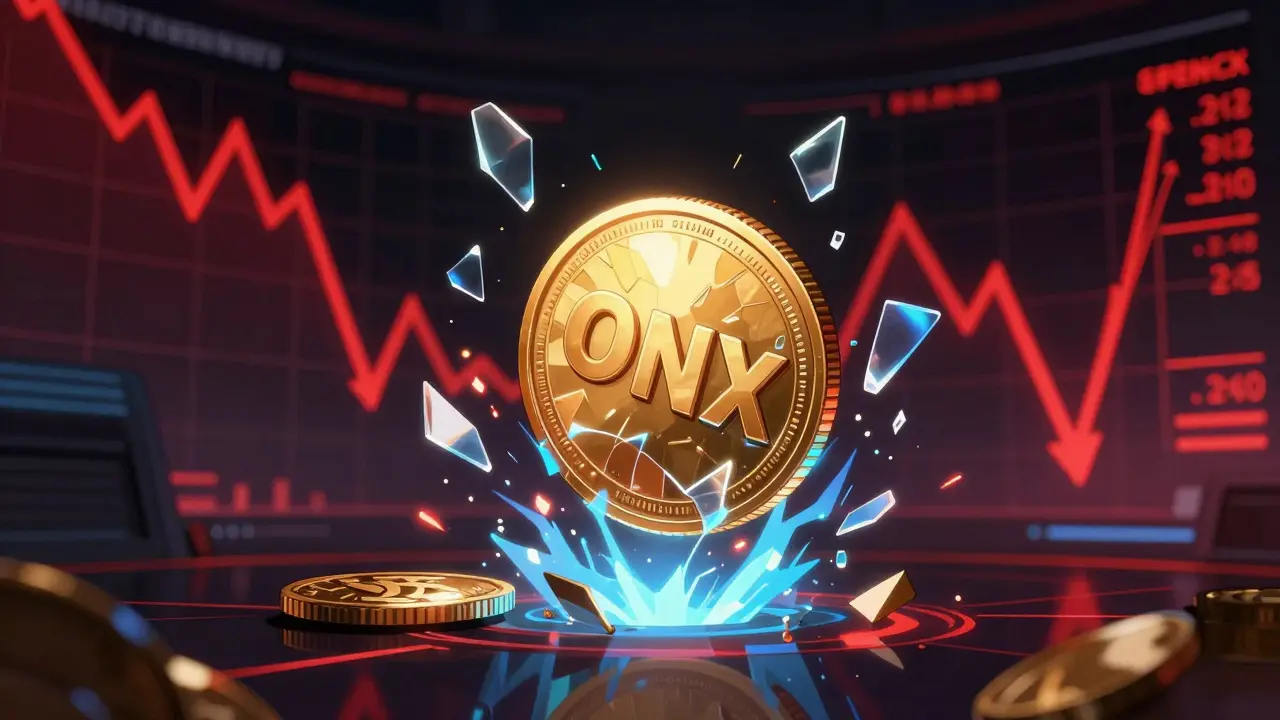
Imagine buying a digital asset that hits a peak price of $0.55, only to watch it plummet by nearly 100% over the following years. That is the reality for Onix (ONX) is a proof-of-work cryptocurrency designed for mining using the X11 hashing algorithm. Often referred to as ONX coin, it represents a slice of the early crypto era that has since struggled to maintain relevance in a fast-moving market. If you are looking at this coin today, you aren't just looking at a ticker symbol; you're looking at a case study in extreme market volatility and the risks of dormant projects.
The Technical Engine: How Onix Actually Works
To understand Onix, we have to look at its backbone. It relies on a Proof-of-Work (PoW) consensus mechanism. In simple terms, this means miners use hardware to solve complex math problems to secure the network and earn new coins. Unlike Bitcoin, which uses SHA-256, Onix utilizes the X11 hashing algorithm. This specific algorithm is designed to be more resistant to specialized mining hardware (ASICs) compared to simpler hashes, theoretically making it more accessible for people mining with GPUs.
When a miner successfully confirms a block of transactions, they receive a block reward of 60 ONX. However, the economics of this process have shifted dramatically. The total supply is capped at approximately 112.1 million tokens, with the vast majority already in circulation. While the tech sounds solid on paper, the actual value of those rewards has vanished as the market price collapsed.
Market Reality: Price, Liquidity, and Red Flags
If you check a price tracker for Onix crypto coin, you will see numbers that vary wildly. Some sources list it around $0.00098, while others show it closer to $0.00028. This discrepancy is a huge red flag. When different tracking sites can't agree on a price, it usually means there is almost no trading happening. In fact, many reports show a 24-hour trading volume of $0 USD.
Let's look at the historical trajectory to see the scale of the decline. On November 29, 2017, Onix reached an all-time high of $0.55. Comparing that to today's fractions of a cent shows a near-total loss of value. For an investor, this isn't just a "dip"; it's a permanent collapse in market confidence. The 52-week range, swinging between $0.000248 and $0.000546, shows that the coin is essentially flatlining.
| Attribute | Value/Detail |
|---|---|
| Consensus Mechanism | Proof-of-Work (PoW) |
| Hashing Algorithm | X11 |
| Max Supply | 112,119,456.99 ONX |
| Block Reward | 60 ONX |
| All-Time High | $0.55 (Nov 2017) |
| Current Status | Low Liquidity / Dormant |
Can You Still Mine Onix?
Technically, yes, you can still run a miner. But should you? Let's do the math. If you're paying $0.10 per kilowatt-hour for electricity, your net profit from mining ONX is effectively zero. When the cost of the power needed to run your computer exceeds the market value of the coins you earn, you are essentially paying the network to let you mine.
Mining becomes a hobby rather than a business when the Mining Profitability is negative. For most people, attempting to mine Onix today is a waste of electricity and hardware wear-and-tear. Unless you have free electricity and a nostalgic desire to support an old blockchain, there is no financial incentive to start a mining rig for this specific coin.
Buying and Trading: Where is the Liquidity?
Finding a place to buy or sell ONX is like trying to find a specific needle in a digital haystack. Most major centralized exchanges, such as Crypto.com, do not support it. While some platforms like Binance might mention it in the context of their Web3 Wallet, this doesn't mean they have a direct trading pair for it. Instead, they are pointing you toward Decentralized Exchanges (DEXs).
Trading on a DEX is possible, but you run into the "liquidity trap." Liquidity refers to how easily you can turn your coins into cash or another cryptocurrency without moving the price. With $0 daily volume on many trackers, you might hold ONX but find no one willing to buy it from you. This turns your investment into a "ghost asset"-it exists in your wallet, but it has no exit path.
The Verdict: Active Project or Digital Ghost?
When evaluating a crypto project, we look for three things: development activity, community engagement, and utility. Onix fails on all three fronts. There is no public, updated roadmap. There is no evidence of a functioning development team releasing new features. The official site exists, but it doesn't provide the transparency needed to trust the project's future.
A project that drops 99.8% from its peak and loses all its exchange listings is usually considered a "dead coin." While some projects experience "miracle recoveries," those usually happen because the project pivots to a new use case, like moving to a new blockchain or launching a revolutionary app. Onix hasn't done any of that. It remains a relic of the 2017 boom, serving as a reminder that not every coin with a working algorithm survives the test of time.
Is Onix (ONX) a safe investment?
Based on current market data, Onix is extremely high-risk. The lack of trading volume, the massive price drop from its all-time high, and the absence of active development suggest it is a dormant project. Investing in assets with zero liquidity often means you cannot sell your holdings.
What is the X11 algorithm used by Onix?
X11 is a hashing algorithm that runs 11 different hashing functions in a sequence. It was designed to make it harder for ASIC miners to dominate the network, allowing users with standard GPUs to remain competitive in mining.
Where can I buy ONX coins?
Onix is not available on most major centralized exchanges. Your best bet is using a Web3 wallet to connect to a Decentralized Exchange (DEX) that supports the token, though you should be cautious of the extremely low liquidity.
Is mining Onix profitable in 2026?
No. With the current market price of the coin and standard electricity costs (around $0.10/kWh), the cost of power far outweighs the value of the ONX mined, resulting in a net loss.
What happened to the Onix development team?
There is very little public information available regarding the current status of the development team. The lack of a documented roadmap or recent technical updates suggests the project is no longer being actively maintained.
Next Steps and Troubleshooting
If you currently hold ONX, your first priority should be checking the liquidity of the DEXs where it is listed. Try to see if there are any active "buy orders" to determine if you can actually exit your position. If you are a developer looking at the X11 algorithm for a new project, you might find it interesting, but avoid using the Onix ecosystem as a blueprint for a sustainable token economy.
For those new to crypto, the story of Onix is a perfect lesson in the importance of "liquidity." A coin can have a price on a screen, but if there is no volume, that price is essentially a fiction. Always check the 24-hour trading volume and the number of active exchanges before putting money into any low-cap altcoin.






Joshua Salwen
April 16, 2026 AT 08:37 AMOmg this is literally the most tragic thing i've read today!! Imagine actually holding this through the crash... just absolute madness. Everyone always forgets that the X11 thing was suposed to be a game changer but it just flopped hard lol. Totaly a disaster!
Saurav Bhattarai
April 16, 2026 AT 12:17 PMHow quaint that people still believe in these primitive Western-led 'innovations' that fail miserably. The X11 algorithm is a joke compared to the actual engineering we see in modern high-frequency systems. It's almost adorable that anyone thought this was a viable financial instrument in the first place. Absolute garbage.
Jeff Barlett
April 18, 2026 AT 09:43 AMI don't know, maybe the lack of liquidity is exactly why it's a buy right now. Everyone says it's dead, and that's exactly when the real money is made. If you wait for a roadmap and 'development activity,' you're just buying the top. I'll take the risk of a ghost asset over a hyped-up meme coin any day.
Robert Preston
April 18, 2026 AT 10:51 AMIf you're currently holding a significant amount of this, I strongly suggest you prioritize security over profit right now. Many 'dead' projects are targets for phishing scams promising 'migration' or 'recovery' tokens. Please be careful and only use verified DEX interfaces if you're attempting to swap your remaining holdings.
Keri Pommerenk
April 19, 2026 AT 13:07 PMtotally agree with the liquidity warning. it's a great lesson for anyone just starting out in crypto to check volume first
Ian Chait
April 20, 2026 AT 09:45 AMTypical. The 'market' crashed because the big players wanted to shake out the small fish. This isn't a dead coin, it's a controlled demolition by the globalists to force us into CBDCs. They hate PoW because it's too independant. X11 was a threat to their central surveillance grid and they suppressed the volum on purpose. Wake up people, the fake volume is a psyop!
Karen Mogollon Gutierrez
April 21, 2026 AT 06:41 AMIt is truly an appalling tragedy to witness the systemic failure of such an ambitious technological endeavor. One must wonder how the architects of this project could allow the liquidity to evaporate to such a degree without a single coherent communication to the stakeholders. The sheer negligence exhibited by the development team is beyond comprehension. It is a cautionary tale of the highest order, illustrating the precarious nature of speculative investments. We are left to sift through the ruins of a once-promising asset, mourning the loss of capital and confidence. Such a precipitous decline is not merely a financial loss but a failure of leadership. The disparity in price reporting across trackers is the final nail in the coffin of its credibility. I find the lack of transparency utterly reprehensible. It is an affront to the very principles of decentralization that crypto claims to uphold. To think that investors were lured in by the promise of ASIC resistance only to be left with a ghost asset is heartbreaking. The volatility here isn't just a market swing, it's a total collapse of trust. I cannot imagine the distress of those who held through the peak of 2017. This is a masterclass in how not to run a blockchain project. The void where a roadmap should be is deafening. Truly, a digital wasteland.
Mike Kempenich
April 21, 2026 AT 07:46 AMStill, it's cool that we have these examples to learn from! It just means the next project will be better and more stable for everyone.
nathan jones
April 21, 2026 AT 20:08 PMJust another old coin from the early days. Happens a lot in this space.
Adam Mann
April 22, 2026 AT 23:15 PMI really think it's wonderful that we can look back at these early projects to understand how the technology evolved over time, and even though this specific coin didn't make it, the effort to create ASIC-resistant mining was a huge stepping stone for the whole community to learn how to make mining more inclusive for people who don't have thousands of dollars for specialized gear, so in a way, the spirit of Onix lives on in the newer projects that actually succeeded in staying relevant while helping everyday people get involved in the crypto world without needing a massive server farm in their basement!
Chintu Parikh
April 24, 2026 AT 10:25 AMI most humbly agree that the educational value of this analysis is immense. Let us all use this experience to cultivate a more disciplined approach to our future investments!