

Imagine you own Bitcoin, but you want to earn interest on it in a DeFi protocol that only accepts Ethereum-based tokens. You can’t just send BTC to Aave or Uniswap - those platforms don’t understand Bitcoin’s code. So what do you do? You wrap it. That’s where wrapped tokens come in. But are they safe? Are they necessary? And why do we even need them when we have native tokens like Bitcoin and Ether? Let’s cut through the noise.
What Are Native Tokens?
Native tokens are the original cryptocurrencies that run on their own blockchain. Bitcoin (BTC) is the native token of the Bitcoin network. Ether (ETH) is the native token of Ethereum. These aren’t copies. They aren’t bridged. They’re the real thing - born on their chain, secured by their consensus, and governed by their rules.
Native tokens do more than just hold value. They keep the network alive. Miners and validators get paid in them. Transaction fees are paid in them. Governance votes are cast with them. Without ETH, Ethereum’s smart contracts wouldn’t run. Without BTC, Bitcoin’s ledger couldn’t be updated. They’re the fuel and the engine - all in one.
But here’s the catch: native tokens can’t talk to other blockchains. Ethereum’s smart contracts expect ERC-20 tokens. Bitcoin’s chain doesn’t have that standard. So even though ETH is the backbone of DeFi, it can’t be used directly in most lending or trading protocols. That’s why you’ll see WETH everywhere - not because ETH isn’t good enough, but because it’s not compatible.
What Are Wrapped Tokens?
Wrapped tokens are digital stand-ins. They represent a native asset on a different blockchain. Wrapped Bitcoin (WBTC) is Bitcoin locked up on the Bitcoin chain, and an equivalent amount of ERC-20 tokens is created on Ethereum. Same value. Same ownership. Different format.
The process is simple in theory: you send your BTC to a trusted custodian. They lock it. Then they mint WBTC on Ethereum and send it to your wallet. You now have a token that works in Uniswap, Aave, and Compound - all the Ethereum DeFi apps you wanted to use.
When you want your BTC back, you burn the WBTC. The custodian unlocks your original Bitcoin and sends it to you. It’s a 1:1 swap. No creation, no destruction - just translation.
Common wrapped tokens include:
- WBTC - Bitcoin on Ethereum
- WETH - Ethereum converted to ERC-20 for DeFi
- WAVAX - Avalanche’s AVAX on Ethereum
- renBTC - Another version of wrapped Bitcoin using a decentralized custodian model
As of late 2023, over $14.7 billion in wrapped assets were locked in DeFi protocols. WBTC alone represented $5.2 billion of Bitcoin’s total market cap - all of it sitting on Ethereum, doing things BTC never could.
Why Do We Need Wrapped Tokens?
Blockchains are like isolated islands. Each has its own economy, rules, and users. But people want to move money between them. They want to use Bitcoin in Ethereum DeFi. They want to use Solana tokens on Polygon. Without wrapped tokens, that’s impossible.
Wrapped tokens solve a real problem: fragmentation. Before WBTC, Bitcoin holders had to sell their BTC to buy ETH if they wanted to earn yield. That meant paying taxes, facing price swings, and losing exposure to Bitcoin. Wrapped tokens let you keep your Bitcoin while still participating in Ethereum’s ecosystem.
They’re not just for Bitcoin. Any asset that’s valuable but locked on its own chain can be wrapped. That’s why we now have wrapped Litecoin, wrapped Dogecoin, even wrapped stablecoins on chains they weren’t born on.
For DeFi, this is essential. Over 95% of Ethereum-based lending protocols require ERC-20 tokens. Native ETH can’t be pulled by smart contracts. So WETH was created - not because ETH was broken, but because the system needed a version that fit.
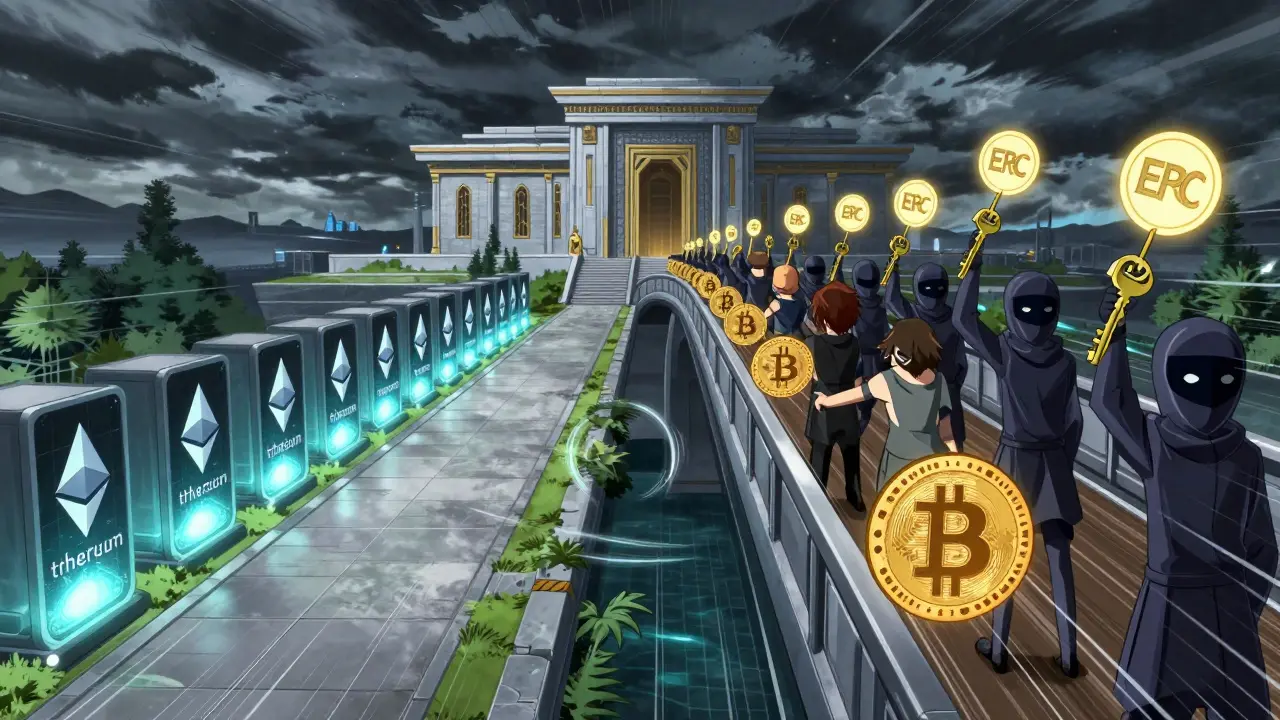
Security: Native vs Wrapped
This is where things get tricky.
Native tokens are as secure as their blockchain. Bitcoin has over 10,000 nodes validating every transaction. Ethereum has tens of thousands. The security is distributed, decentralized, and battle-tested.
Wrapped tokens? They depend on custodians. In the case of WBTC, a group of approved members - including BitGo, Kyber, and Republic Protocol - hold the Bitcoin in multi-signature wallets. If one of them gets hacked, or goes rogue, your wrapped tokens could be at risk. There’s no blockchain consensus protecting them. Only human-run systems.
That’s why Vitalik Buterin called wrapped tokens “a compromise on decentralization.” They’re convenient, but they reintroduce trust. You’re no longer trusting code - you’re trusting companies.
There are alternatives. renBTC uses a decentralized network of nodes (renVM) to lock BTC without a single custodian. But even that isn’t perfect. In 2022, the Nomad Bridge hack stole $190 million in wrapped assets because of a flaw in its smart contract - not because the underlying Bitcoin was stolen, but because the wrapping mechanism failed.
Native tokens have no middlemen. Wrapped tokens have layers. More layers mean more points of failure.
Use Cases: Where Each One Shines
Here’s a simple rule: use native tokens when you can. Use wrapped tokens when you have to.
Use native tokens when:
- You’re holding long-term and don’t need DeFi access
- You’re transferring value directly on the original chain
- You care most about security and decentralization
- You’re paying network fees or staking
Use wrapped tokens when:
- You want to lend, borrow, or trade on a different chain
- You’re using a DEX or lending protocol that only accepts ERC-20
- You’re trying to earn yield on an asset that doesn’t support smart contracts
- You’re an institutional investor needing to access DeFi without selling your BTC
For example: If you’re a Bitcoin holder and you want to stake ETH on Lido, you need ETH. You can’t stake WBTC. But if you want to lend your BTC on Aave, you need WBTC. That’s the difference.
WETH is a special case. It’s not meant to replace ETH. It’s a technical workaround. Most wallets and DApps now auto-convert ETH to WETH behind the scenes. You don’t even notice it - unless you’re checking your token balance.

The Future: Are Wrapped Tokens Going Away?
Not anytime soon. But they might become less necessary.
Ethereum is working on EIP-3668 and EIP-3607 - upgrades that could let native ETH interact directly with smart contracts. If that happens, WETH might become obsolete for most users. Same could happen for other chains.
Chainlink’s CCIP protocol, launched in 2023, aims to replace custodians with decentralized oracles that verify asset locks across chains. If it works, wrapped tokens could become trustless - no single company holding your Bitcoin.
Galaxy Digital predicts that by 2026, 40% of wrapped token usage will shift to decentralized custody models. That’s a big change. But even then, wrapped tokens won’t disappear. They’ll just get safer.
Gartner forecasts that wrapped assets will still make up 12-15% of all cross-chain transfers by 2030. Why? Because not every blockchain will support native interoperability. And even if they do, users will still want to move assets quickly and cheaply.
How to Use Wrapped Tokens Safely
If you’re going to use wrapped tokens, do it right.
- Use only official wrappers. WBTC’s site is wbtc.network. WETH is wrapped.ethereum.org. Avoid random bridges.
- Check the custodians. WBTC’s custodians are public. renBTC uses a decentralized network. Know who holds your asset.
- Don’t wrap more than you can afford to lose. If the custodian fails, recovery is unlikely.
- Always test with a small amount first. A $10 wrap before committing $10,000.
- Watch gas fees. Wrapping on Ethereum costs $1-$3. On slower chains, it’s cheaper. Don’t get surprised.
And never forget: wrapped tokens are not the same as the original. They’re a bridge - useful, but temporary.
What’s Next?
Native tokens are the foundation. Wrapped tokens are the scaffolding. One keeps the system running. The other lets it grow.
Right now, we’re in a transitional phase. Blockchains are still learning to talk to each other. Wrapped tokens are the best solution we have - flawed, but functional.
As cross-chain tech improves, we’ll need fewer wrappers. But until then, knowing the difference between native and wrapped isn’t just technical knowledge - it’s financial safety.
Don’t assume your Bitcoin is safe just because it’s in your wallet. If it’s WBTC, it’s not on Bitcoin anymore. It’s on Ethereum - and it’s being held by someone else.
Understand the trade-off: convenience vs control. Choose wisely.
Are wrapped tokens the same as the original cryptocurrency?
No. Wrapped tokens are digital representations of native assets on a different blockchain. They maintain a 1:1 value ratio, but they’re not the original coin. For example, WBTC is Bitcoin locked on the Bitcoin chain, with an equivalent ERC-20 token minted on Ethereum. You can’t use WBTC on the Bitcoin network - only on Ethereum-based platforms.
Is WETH safer than ETH?
WETH and ETH have the same value, but ETH is more secure. ETH is the native token of Ethereum and interacts directly with the blockchain’s consensus. WETH is an ERC-20 version created to work with smart contracts. While WETH is widely trusted and used, it’s technically a wrapper - so it depends on the smart contract that created it. If that contract has a bug, WETH could be compromised. ETH cannot be.
Can I convert WBTC back to Bitcoin anytime?
Yes, but it’s not instant. You must initiate a redemption request through the official WBTC portal. The custodians verify your request, burn your WBTC, and release the equivalent BTC from their vault. This process usually takes 15-30 minutes, but can be delayed during high network congestion or if custodian verification is pending. Always use the official channel - third-party sites may steal your funds.
Why do DeFi apps require ERC-20 tokens instead of native ETH?
Smart contracts on Ethereum can’t directly pull native ETH using the standard transferFrom() function. This is a technical limitation of how Ethereum handles native currency. ERC-20 tokens, like WETH, have built-in functions that allow contracts to approve, transfer, and manage balances - something native ETH lacks. So WETH was created to bridge this gap. It’s not a flaw in ETH - it’s a design choice in smart contract architecture.
Are wrapped tokens regulated?
Yes. In 2023, the U.S. Office of the Comptroller of the Currency (OCC) issued guidance stating that custodians of wrapped assets must follow the same rules as traditional digital asset custodians. This means they need to comply with anti-money laundering (AML) and know-your-customer (KYC) rules. If you’re using WBTC through a regulated exchange or service, your identity may be verified. Decentralized wrappers like renBTC may avoid this, but they carry higher technical risk.
What happened in the Nomad Bridge hack?
In August 2022, a flaw in Nomad Bridge’s smart contract allowed attackers to drain $190 million in wrapped assets - mostly wrapped Bitcoin and Ethereum - across multiple chains. The issue wasn’t a hack of the underlying Bitcoin or Ethereum networks. It was a flaw in the wrapping mechanism itself. This event exposed the risks of centralized or poorly audited cross-chain bridges. Since then, most serious DeFi users avoid non-official wrapping protocols.
Should I use WBTC or renBTC?
WBTC is more widely accepted and has higher liquidity, but it relies on centralized custodians. renBTC uses a decentralized network of nodes to lock Bitcoin, reducing single-point failure risk - but it’s less supported by major DeFi apps. If you prioritize compatibility, use WBTC. If you prioritize decentralization and trust minimization, use renBTC - but test it with a small amount first.
Do wrapped tokens have fees?
Yes. Wrapping involves two fees: the gas fee on the target blockchain (e.g., Ethereum) and a small service fee charged by the wrapping provider. For WBTC, the service fee is typically 0.1%-0.5% of the amount wrapped. Gas fees on Ethereum average $1-$3 as of 2026. Always check the total cost before confirming - some platforms hide fees in the exchange rate.










Bryan Muñoz
January 13, 2026 AT 21:27 PMWRAPPED TOKENS ARE JUST THE GOVERNMENT'S WAY OF CONTROLLING YOUR BITCOIN 😈 THEY'RE TRACKING EVERY WBTC TRANSACTION AND SELLING YOUR DATA TO BIG TECH. WETH? MORE LIKE W-EAR-TH. THEY WANT YOU DEPENDENT ON THEIR SYSTEM. TRUST THE CODE, NOT THE CUSTODIANS.
myrna stovel
January 15, 2026 AT 14:44 PMI appreciate how this breaks down the real trade-offs. I started with WBTC to earn yield, but after reading about the custodians, I moved half to renBTC just to test. Small amount, but it felt better knowing no single company held my keys. Still using WBTC for liquidity though - it’s a balancing act.
Kelly Post
January 16, 2026 AT 04:38 AMI’ve been asking myself this exact question for months. Why does ETH need to be wrapped to work in DeFi? It’s not that ETH is broken - it’s that the smart contract standard was built before native token handling was optimized. It’s a legacy quirk, not a feature. We’re patching a design decision from 2015 with a workaround in 2026.
Shaun Beckford
January 17, 2026 AT 23:02 PMLet’s be real - wrapped tokens are crypto’s version of a paperclip holding a house together. You think you’re building wealth, but you’re just stacking fragile proxies on top of fragile proxies. One smart contract bug, one custodian goes rogue, and your ‘Bitcoin’ evaporates into gas fees and regret. This isn’t finance. It’s a high-stakes magic trick.
Tony Loneman
January 19, 2026 AT 18:43 PMNah you all missing the point. WETH isn’t a workaround - it’s the future. Native tokens are relics. The real innovation is composability. Why should Bitcoin’s chain dictate what I can do with my assets? We’re past the era of siloed money. If you’re still clinging to native tokens like they’re sacred, you’re the guy still using dial-up because ‘it’s more secure’.
Alexandra Heller
January 20, 2026 AT 07:29 AMWe’ve traded decentralization for convenience like it’s a free sample at the mall. Wrapped tokens are the opiate of the masses. We’re told ‘earn yield on your BTC’ and we cheer like it’s a gift - not realizing we’ve handed over our sovereignty to a handful of corporate custodians who answer to regulators, not code. We’re not building a new financial system. We’re just repackaging the old one with blockchain glitter.
Christina Shrader
January 21, 2026 AT 12:39 PMJust started learning DeFi last month and this post saved me from making a huge mistake. I was about to wrap $5k in BTC without knowing the risks. Now I’m using WBTC for $500 max, testing the redemption process with a tiny amount first. Small steps. Big safety net. Thank you for the clarity.
Chris Evans
January 22, 2026 AT 23:39 PMThe fundamental asymmetry here is epistemological: native tokens derive ontological security from consensus mechanisms; wrapped tokens derive epistemic legitimacy from institutional trust. The former is crypto-anarchist idealism; the latter is institutionalized pragmatism. We’re not choosing between assets - we’re choosing between competing paradigms of value. And right now, the market is betting on the latter - because it’s easier to explain to a hedge fund than a Merkle tree.
Pat G
January 23, 2026 AT 17:34 PMIf you’re using WBTC, you’re already compromised. America built this. The OCC says so. You think your Bitcoin is yours? It’s on Ethereum, under American jurisdiction, and if they decide to freeze it - you have zero recourse. This isn’t finance. It’s colonialism with a blockchain UI.
Chris O'Carroll
January 25, 2026 AT 11:27 AMHonestly? I just use WETH because my wallet does it automatically. I don’t even know what I’m holding half the time. If it shows up in my portfolio and I can trade it, I’m good. This whole debate feels like arguing over whether to use a fork or spoon at a buffet.