
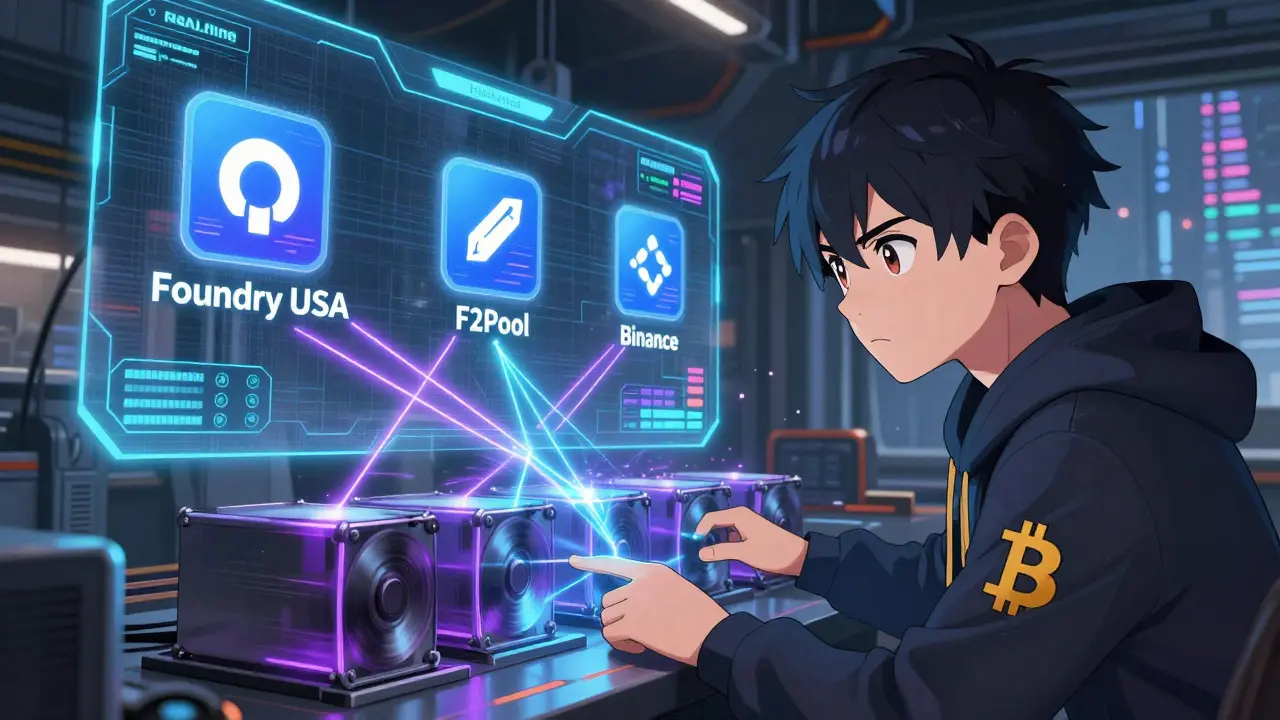
Choosing the right mining pool isn’t just about picking the one with the lowest fee. It’s about matching your hardware, your risk tolerance, and your cash flow needs to a pool that actually delivers-consistently and fairly. If you’re mining Bitcoin or another Proof-of-Work cryptocurrency, your pool choice can make the difference between steady income and frustratingly slow payouts. The best mining pool for you isn’t necessarily the biggest. It’s the one that works for you.
Why Mining Pools Matter More Than Ever
Back in 2010, you could mine Bitcoin on a regular laptop and still earn a few coins a week. Today, the network difficulty is over 80 trillion. Solo mining is practically impossible unless you’re running thousands of ASICs. That’s why nearly every miner joins a mining pool. A mining pool combines the computational power of hundreds or thousands of individual miners. When the pool solves a block, rewards are split based on how much work each miner contributed. The pool handles the coordination, the payout distribution, and the technical heavy lifting. But not all pools are built the same. Some charge hidden fees. Others have servers that drop connections every few hours. A few even vanish without paying out. Your pool choice affects your daily earnings, your withdrawal timing, and even how secure your mining operation is. Don’t treat it like a random sign-up. Treat it like choosing a bank for your mining income.Pool Fees: The Hidden Cost Trap
Most pools charge between 1% and 2.5% of your mining rewards. On paper, that sounds small. But over a year, a 0.5% difference can cost you hundreds of dollars in Bitcoin. Binance Pool charges just 0.99%, making it one of the cheapest options. BTC.com follows closely at 0.95%. On the other end, BraiinsPool charges 1.58%-nearly 60% more than Binance. That’s not just a fee difference. That’s lost income. But here’s the catch: the lowest fee isn’t always the best deal. Some pools hide costs in other places. They might charge a $0.50 withdrawal fee every time you cash out. Or they deduct transaction fees from your payout instead of including them in the reward. Others penalize you for stale shares-shares submitted too late to count-reducing your effective earnings without telling you upfront. Always check the fine print. Look for:- Are transaction fees included in payouts?
- Is there a withdrawal fee?
- How are stale shares handled?
- Is there a minimum payout threshold that delays your cash flow?
Payout Methods: Stability vs. Big Wins
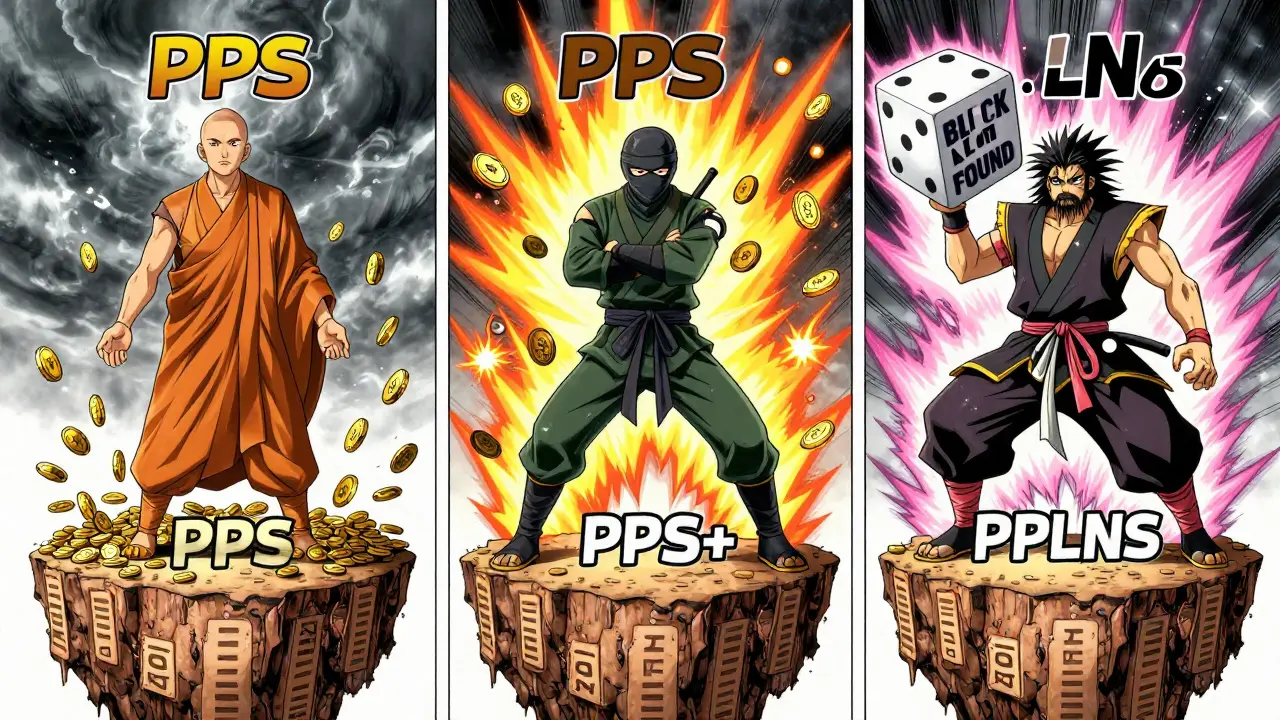
There are three main ways pools pay you. Each has trade-offs. Pay Per Share (PPS) gives you a fixed payout for every valid share you submit. It’s predictable, but it’s also the most expensive-pools charge higher fees to cover their own risk. Good if you need steady income. Pay Per Share Plus (PPS+) is the sweet spot for most miners. You get paid for each share, plus a share of the transaction fees from the block. No risk of losing out when the pool doesn’t find a block. Fees are still moderate, usually around 1.2-1.5%. Pay Per Last N Shares (PPLNS) is the high-risk, high-reward option. You only get paid when the pool finds a block, and your share is based on the last N shares you submitted before that block. If the pool is lucky and finds a block every day, you earn more than with PPS+. But if it goes 3 days without a block, you earn nothing during that time. This method works best for miners with powerful rigs who can afford to wait. If you’re mining with a small ASIC or just starting out, stick with PPS+.Hash Rate and Pool Size: Bigger Isn’t Always Better
Foundry USA controls 26.6% of the Bitcoin network. AntPool is at 17.96%. Together, they control nearly half the network. That’s a problem for decentralization-and a risk for you. Larger pools find blocks more often. That means more frequent payouts. If you’re mining with a 100 TH/s ASIC, a small pool might take 2 weeks to find a block. A big pool might do it in 2 days. That’s a huge difference in cash flow. But here’s what most beginners miss: pool size doesn’t guarantee better earnings. A small pool with modern ASICs can outperform a giant pool with outdated hardware. The total hash rate matters more than the number of miners. Check the current hash rate of your target pools. Look for:- Foundry USA: 256.3 EH/s
- AntPool: 178.4 EH/s
- ViaBTC: 113.7 EH/s
- F2Pool: 102.9 EH/s
- SpiderPool: 87.9 EH/s
- Binance Pool: 68.2 EH/s
Uptime and Server Location: Don’t Let Downtime Eat Your Profits
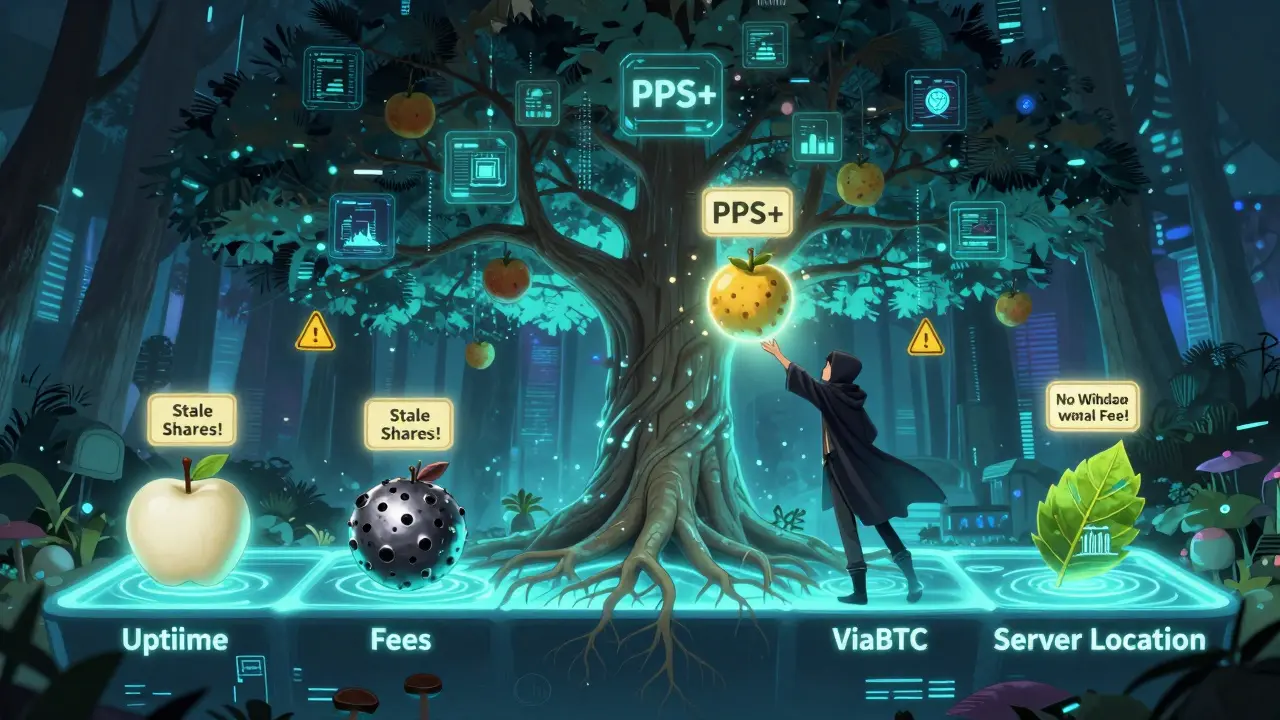
If your miner is disconnected for 10 minutes, you lose 10 minutes of earnings. That’s not a small thing. At current difficulty levels, even 30 minutes of downtime per day can cost you $10-$20 in Bitcoin monthly. Leading pools maintain 99.5%+ uptime. But don’t just take their word for it. Check forums, Reddit, or mining communities. Look for complaints about:- Random disconnects
- Delayed share submissions
- Dashboard crashes
Transparency and Reputation: Watch Out for Scams
Some pools are honest. Others? Not so much. Reputable pools show real-time stats: how many shares you’ve submitted, how many blocks they’ve found, your estimated earnings, and exactly how fees are calculated. They update their dashboards every minute. Avoid pools that:- Don’t show your hashrate in real time
- Have no public block history
- Require you to contact support to see your earnings
- Have a history of delayed or missing payouts
User Experience: Mobile Access and Easy Setup
You don’t need to be a sysadmin to mine. But you do need a pool with a clean interface. Look for:- A mobile app or responsive dashboard
- One-click setup for popular ASICs (Antminer, Whatsminer)
- Clear documentation on port numbers and server addresses
- No mandatory KYC unless you’re withdrawing large amounts
What to Do Next: A Simple 5-Step Plan
1. Know your hardware. Are you using an Antminer S21? A Whatsminer M50? Check its hashrate and power consumption. 2. Set your goal. Do you want daily payouts? Or are you okay waiting for bigger chunks? Pick PPS+ if you’re unsure. 3. Shortlist 3 pools. Pick one big (like Foundry), one mid-sized (like F2Pool), and one low-fee (like Binance). 4. Test them. Connect your miner to each pool for 48 hours. Monitor uptime, share rejection rate, and payout estimates. Use a tool like WhatToMine to compare projected earnings. 5. Switch if needed. Don’t stay with a bad pool out of laziness. Mining is a business. Re-evaluate every 3-6 months as fees and difficulty change.Red Flags to Avoid
- Pools promising “guaranteed daily profits.” (They’re lying.) - Pools that don’t list their fee structure clearly. - Pools with no public contact info or support channels. - Pools that ask for your private wallet keys. - Pools with zero online reputation or reviews.Final Thought: Your Mining Pool Is Your Partner
You’ve invested in ASICs, electricity, and cooling. Don’t let a bad pool waste that investment. The best mining pool isn’t the one with the most hype. It’s the one that pays you reliably, transparently, and with minimal friction. Start small. Test. Compare. Switch if you need to. Your wallet will thank you.What’s the best mining pool for beginners?
For beginners, Binance Pool or F2Pool are the best choices. Both offer low fees (under 1%), simple setup, mobile dashboards, and reliable payouts. They support most ASIC miners out of the box and don’t require complex configuration. Stick with PPS+ payout mode for steady income without the variance of PPLNS.
Can I mine on multiple pools at once?
Technically, yes-but it’s not practical. Most miners run one ASIC per device, and each ASIC can only connect to one pool at a time. You can run multiple miners and assign each to a different pool, but that’s only useful for testing or risk diversification. For most people, sticking to one reliable pool is simpler and more profitable.
Do mining pools charge for withdrawals?
Some do, some don’t. Binance Pool and BTC.com don’t charge withdrawal fees. Others, like ViaBTC and Foundry USA, charge a small fee (usually 0.0001-0.0005 BTC) per withdrawal. Always check the pool’s fee page before signing up. If you’re making frequent small withdrawals, a pool with no withdrawal fee saves you money over time.
How often do mining pools pay out?
It depends on the payout threshold and your hashrate. Most pools pay out when you hit a minimum balance-usually between 0.001 and 0.005 BTC. With a mid-sized ASIC (100 TH/s), you’ll typically hit that threshold every 2-7 days on a big pool. On a small pool, it could take 1-3 weeks. PPS+ and FPPS pools pay daily based on shares, even if no block is found.
Is it safe to use a pool based in China?
Many major pools like AntPool and F2Pool are based in China, but they operate globally and have servers in multiple countries. The location of the company doesn’t affect your payouts as long as the servers you connect to are geographically close and have good uptime. Focus on server locations and reputation, not the company’s headquarters. If a pool has a long track record of payments and transparent stats, it’s safe to use.






nayan keshari
January 2, 2026 AT 14:37 PMEveryone says Binance Pool is the best but have you seen their server lag during peak hours? I lost 12% of my shares last week just because their US node kept timing out. F2Pool’s Singapore server is way more stable for Asia-Pacific miners. Stop following hype, check your actual share rejection rate.
Johnny Delirious
January 4, 2026 AT 04:14 AMIt is imperative that miners approach the selection of a mining pool with the utmost diligence and strategic foresight. The integrity of one's operational infrastructure hinges upon the reliability and transparency of the chosen entity. One must not treat this decision as a casual transaction but rather as a fiduciary commitment to long-term profitability and network security.
Bianca Martins
January 6, 2026 AT 02:23 AMPPS+ is honestly the way to go if you're not rich or crazy. I started with PPLNS and went 11 days without a payout. Then I switched to F2Pool with PPS+ and got paid every 3 days like clockwork. Also, no withdrawal fees = life changer. 🙌
alvin mislang
January 7, 2026 AT 11:21 AMWhy are people still trusting pools based in China? The CCP controls everything. Even if the servers are in Singapore, the backend is still monitored by state actors. Your mining rewards could be frozen tomorrow. Use only Western pools with clear legal jurisdiction. This isn't paranoia-it's survival.
Monty Burn
January 9, 2026 AT 10:44 AMBig pools find blocks faster but they also centralize power. If one entity controls 30% of the network what happens when they decide to censor transactions or fork the chain? We’re not just mining coins we’re defending a decentralized ideal. Sometimes slow payouts are the price of freedom
Kenneth Mclaren
January 11, 2026 AT 00:26 AMDid you know Binance Pool is owned by the same people who ran the FTX scam? They’re just rebranding. The ‘low fees’ are bait. They’re harvesting your IP addresses, your miner IDs, your wallet patterns. They’re building a profile. One day they’ll freeze your account and say ‘fraud detected’ and you’ll never get your coins back. This is all a honeypot.
Alexandra Wright
January 11, 2026 AT 13:57 PMOh sweetie. You wrote a 2000-word essay on mining pools and still didn’t mention that the real winner is the one with the lowest stale share rate. Who cares if Binance charges 0.99% if your ASIC is sending 15% of its shares too late? Go check your pool’s dashboard for stale shares. If it’s over 2% run. Don’t let ego blind you to the math.
Michelle Slayden
January 12, 2026 AT 23:49 PMWhile the article provides a comprehensive overview of mining pool selection criteria, it fails to address the environmental impact of Proof-of-Work mining at scale. The energy consumption of large pools, particularly those operating in regions with coal-dependent grids, contributes significantly to global carbon emissions. Ethical mining requires not only financial prudence but ecological responsibility.
christopher charles
January 14, 2026 AT 08:45 AMJust wanna say-DO NOT IGNORE UPTIME! I had a 100 TH/s Antminer sitting there for two weeks thinking it was working. Turned out the pool’s dashboard was frozen. I only found out because I checked the miner’s logs manually. Set up a simple script to ping your pool’s status page every hour. Save yourself the heartache. You’re welcome.
Vernon Hughes
January 15, 2026 AT 14:10 PMUse F2Pool. Servers in Japan. Low fees. No KYC. Payouts every 48 hours. Done.